


Early Predictors of Growth in Diversity of Key Consonants Used in Communication in Initially Preverbal Children with Autism Spectrum Disorder
- PMID: 26603885
- PMCID: PMC4747804
- DOI: 10.1007/s10803-015-2647-7
Early Predictors of Growth in Diversity of Key Consonants Used in Communication in Initially Preverbal Children with Autism Spectrum Disorder
Abstract
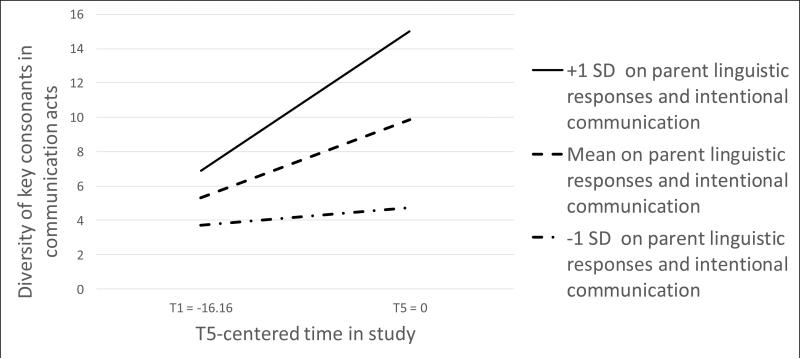
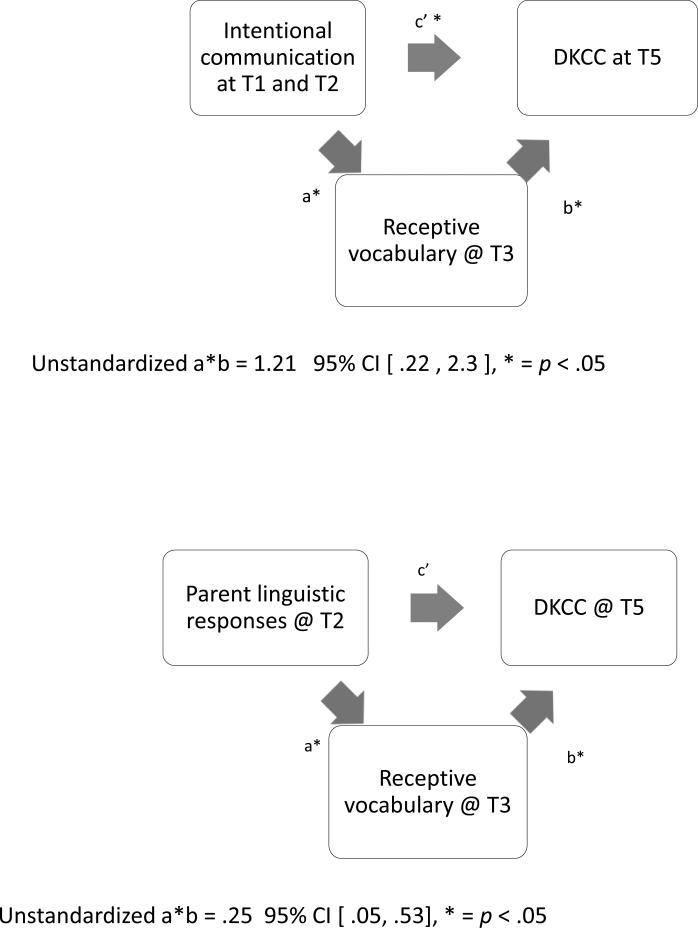
Diversity of key consonants used in communication (DKCC) is a value-added predictor of expressive language growth in initially preverbal children with autism spectrum disorder (ASD). Studying the predictors of DKCC growth in young children with ASD might inform treatment of this under-studied aspect of prelinguistic development. Eighty-seven initially preverbal preschoolers with ASD and their parents were observed at five measurement periods. In this longitudinal correlational investigation, we found that child intentional communication acts and parent linguistic responses to child leads predicted DKCC growth, after controlling for two other predictors and two background variables. As predicted, receptive vocabulary mediated the association between the value-added predictors and endpoint DKCC.
Keywords: Autism; Consonant inventory; Intentional communication; Parent linguistic responses; Predictors; Receptive vocabulary; Vocal communication.
Figures
References
-
- Amato J, Slavin D. A preliminary investigation of oromotor function in young verbal and nonverbal children with autism. Infant-Toddler Intervention: The Transdisciplinary Journal. 1998;8(2):175–184.
-
- American Psychiatric Association . Diagnostic and Statistical Manual of Mental Disorders-IV-TR. APA; Washington, DC: 2000.
-
- Billstedt E, Carina Gillberg I, Gillberg C. Autism in adults: symptom patterns and early childhood predictors. Use of the DISCO in a community sample followed from childhood. Journal of Child Psychology and Psychiatry. 2007;48(11):1102–1110. doi: 10.1111/j.1469-7610.2007.01774.x. - PubMed
-
- Charman T, Baron-Cohen S, Swettenham J, Baird G, Drew A, Cox A. Predicting language outcome in infants with autism and pervasive developmental disorder. International Journal of Language & Communication Disorders. 2003;38(3):265–285. - PubMed
Publication types
MeSH terms
Grants and funding
LinkOut - more resources
Full Text Sources
Other Literature Sources
Medical
Research Materials
