Review
. 2015 Dec;64(12):3996-4010.
doi: 10.2337/db15-0640.

Measurements of Gluconeogenesis and Glycogenolysis: A Methodological Review

Affiliations
Review

Measurements of Gluconeogenesis and Glycogenolysis: A Methodological Review

Stephanie T Chung et al. Diabetes. 2015 Dec.

Abstract

Gluconeogenesis is a complex metabolic process that involves multiple enzymatic steps regulated by myriad factors, including substrate concentrations, the redox state, activation and inhibition of specific enzyme steps, and hormonal modulation. At present, the most widely accepted technique to determine gluconeogenesis is by measuring the incorporation of deuterium from the body water pool into newly formed glucose. However, several techniques using radioactive and stable-labeled isotopes have been used to quantitate the contribution and regulation of gluconeogenesis in humans. Each method has its advantages, methodological assumptions, and set of propagated errors. In this review, we examine the strengths and weaknesses of the most commonly used stable isotopes methods to measure gluconeogenesis in vivo. We discuss the advantages and limitations of each method and summarize the applicability of these measurements in understanding normal and pathophysiological conditions.


Figures

Figure 1
Figure 1
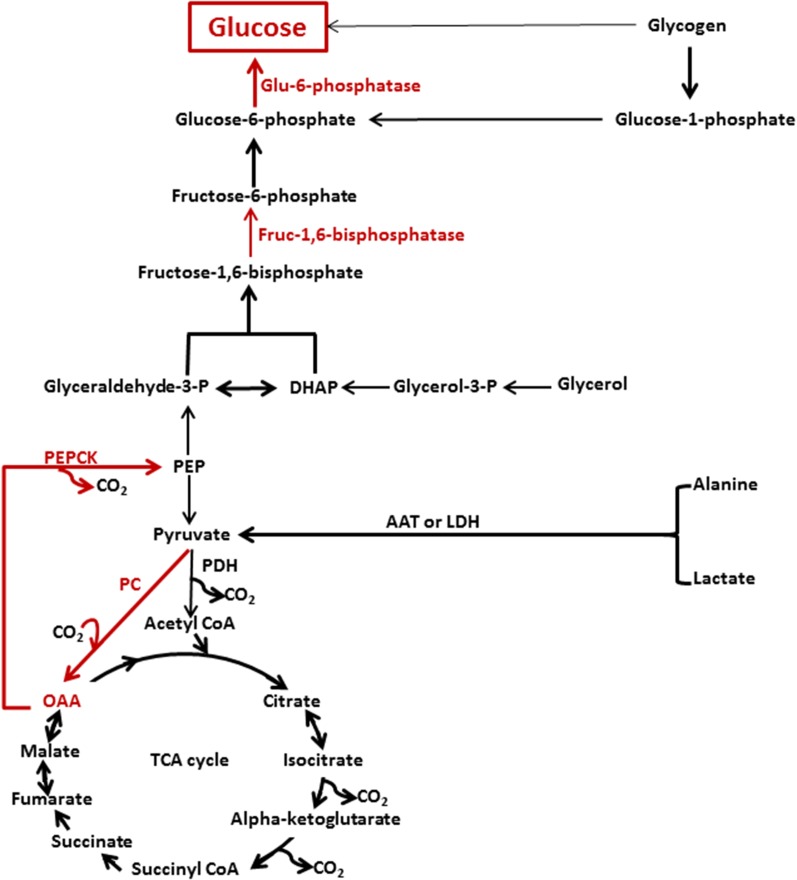
Major enzymes and substrates involved in the regulation of gluconeogenesis. Red arrows and text represent the major enzymes and pathways involved in the regulation of gluconeogenesis. Direct glucose release from glycogen via the debranching enzyme accounts for <10% of the total glucose made via gluconeogenesis. AAT, alanine aminotransferase; fruc-1,6-bisphosphatase, fructose-1,6-bisphosphatase; glu-6-phosphatase, glucose-6-phosphatase; glyceraldehyde-3-P, glyceraldehyde-3-phosphate; glycerol-3-P, glycerol-3-phosphate; LDH, lactate dehydrogenase; OAA, oxaloacetate; PC, pyruvate carboxylase; PDH, pyruvate dehydrogenase.
Figure 2
Figure 2
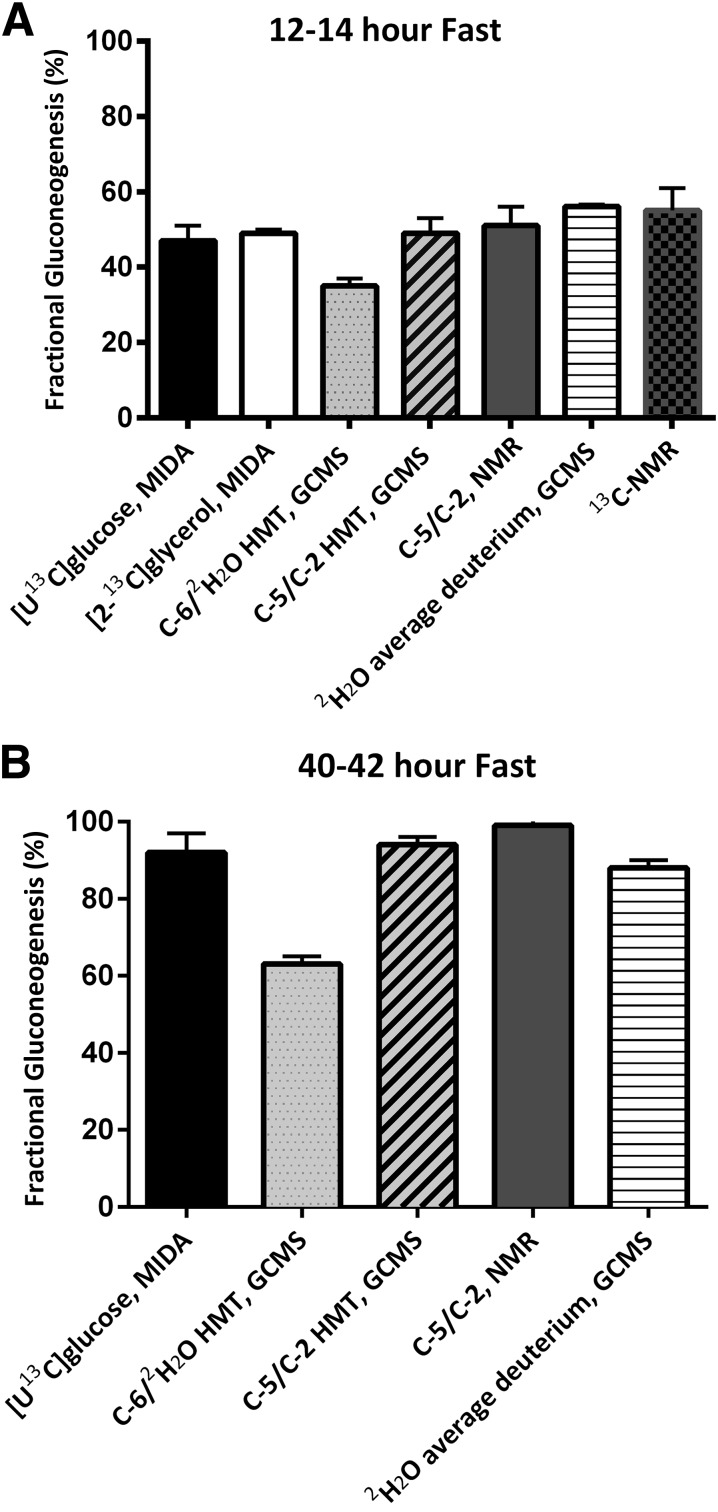
Estimates of fractional gluconeogenesis using various methods in healthy volunteers after 14-h fast (A) and after 40–42-h fast (B). Methods for panel A: [U-13C]glucose, MIDA (49); [2-13C]glycerol, MIDA (26); C-6/2H2O HMT, GCMS (71); C-5/C-2 HMT, GCMS (53); C-5/C-2, 2H-NMR (74); 2H2O average deuterium, GCMS (108); 13C-NMR (68). Methods for panel B: [U-13C]glucose, MIDA (58); C-6/2H2O HMT, GCMS (71); C-5/C-2 HMT, GCMS (53); C-5/C-2, 2H-NMR (74); 2H2O average deuterium, GCMS (2). Please note that C-6/2H2O HMT, GCMS reflects gluconeogenesis on pyruvate alone.
Figure 3
Figure 3
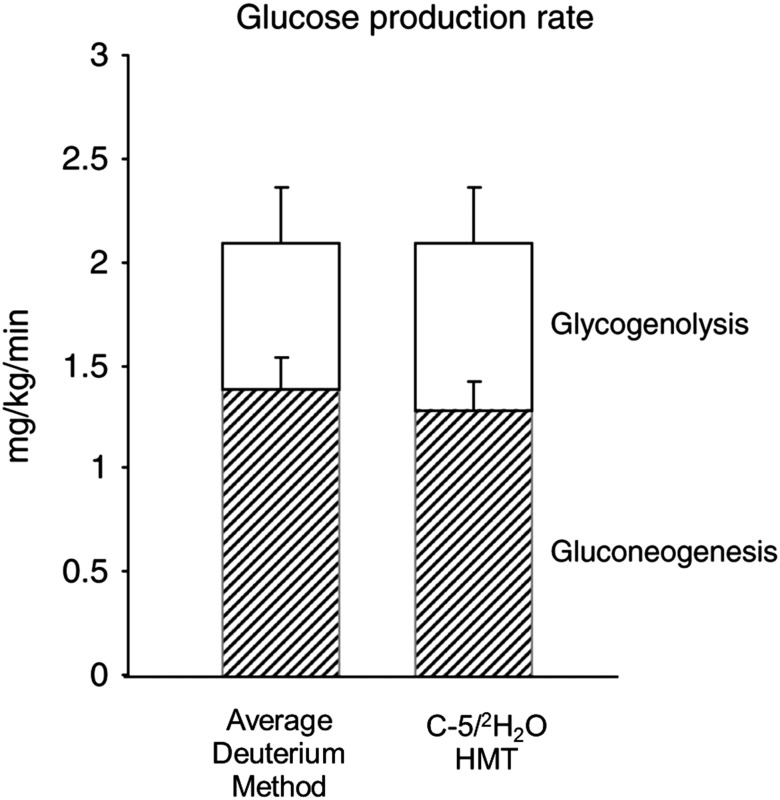
Comparative analyses of average deuterium and C-5/2H2O methods. Glucose production rate in premature infants receiving total parenteral nutrition for 20 h, gluconeogenesis (hatched bars) and glycogenolysis (white bars). Gluconeogenesis was measured by the average deuterium method (33) and C-5/2H2O method (53), respectively. There was no significant difference between the estimates of gluconeogenesis obtained by the two methods. Data are mean ± SE. Reprinted with permission from Chacko and Sunehag (32).

References

    1. Ekberg K, Landau BR, Wajngot A, et al. . Contributions by kidney and liver to glucose production in the postabsorptive state and after 60 h of fasting. Diabetes 1999;48:292–298 - PubMed
    1. Mohammad MA, Sunehag AL, Chacko SK, Pontius AS, Maningat PD, Haymond MW. Mechanisms to conserve glucose in lactating women during a 42-h fast. Am J Physiol Endocrinol Metab 2009;297:E879–E888 - PMC - PubMed
    1. Lin HV, Accili D. Hormonal regulation of hepatic glucose production in health and disease. Cell Metab 2011;14:9–19 - PMC - PubMed
    1. Burgess SC, He T, Yan Z, et al. . Cytosolic phosphoenolpyruvate carboxykinase does not solely control the rate of hepatic gluconeogenesis in the intact mouse liver. Cell Metab 2007;5:313–320 - PMC - PubMed
    1. Samuel VT, Beddow SA, Iwasaki T, et al. . Fasting hyperglycemia is not associated with increased expression of PEPCK or G6Pc in patients with type 2 diabetes. Proc Natl Acad Sci U S A 2009;106:12121–12126 - PMC - PubMed

Publication types