. 2015 Dec;5(1):73.
doi: 10.1186/s13568-015-0160-1. Epub 2015 Nov 25.

Improvement and efficient display of Bacillus thuringiensis toxins on M13 phages and ribosomes

Affiliations

Improvement and efficient display of Bacillus thuringiensis toxins on M13 phages and ribosomes

Sabino Pacheco et al. AMB Express. 2015 Dec.

Abstract

Bacillus thuringiensis (Bt) produces insecticidal proteins that have been used worldwide in the control of insect-pests in crops and vectors of human diseases. However, different insect species are poorly controlled by the available Bt toxins or have evolved resistance to these toxins. Evolution of Bt toxicity could provide novel toxins to control insect pests. To this aim, efficient display systems to select toxins with increased binding to insect membranes or midgut proteins involved in toxicity are likely to be helpful. Here we describe two display systems, phage display and ribosome display, that allow the efficient display of two non-structurally related Bt toxins, Cry1Ac and Cyt1Aa. Improved display of Cry1Ac and Cyt1Aa on M13 phages was achieved by changing the commonly used peptide leader sequence of the coat pIII-fusion protein, that relies on the Sec translocation pathway, for a peptide leader sequence that relies on the signal recognition particle pathway (SRP) and by using a modified M13 helper phage (Phaberge) that has an amber mutation in its pIII genomic sequence and preferentially assembles using the pIII-fusion protein. Also, both Cry1Ac and Cyt1Aa were efficiently displayed on ribosomes, which could allow the construction of large libraries of variants. Furthermore, Cry1Ac or Cyt1Aa displayed on M13 phages or ribosomes were specifically selected from a mixture of both toxins depending on which antigen was immobilized for binding selection. These improved systems may allow the selection of Cry toxin variants with improved insecticidal activities that could counter insect resistances.

Keywords: Bacillus thuringiensis; Cry toxins; Phage display; Ribosome display.


Figures
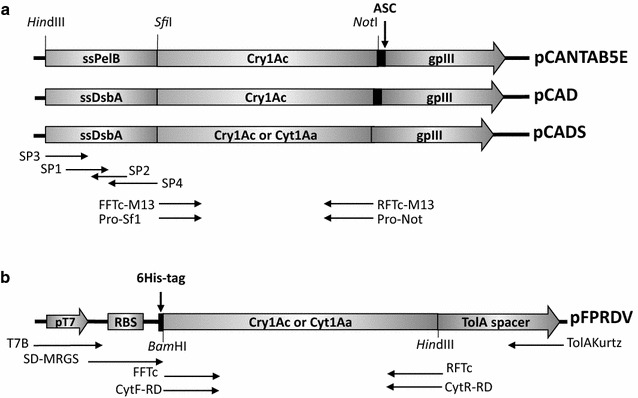
Fig. 1
Fig. 1
a Schematic representation of the phagemid constructs for phage display. ASC amber stop codon. b Schematic representation of the constructs for ribosome display. RBS, ribosome binding-site. Horizontal arrows indicate the annealing region of the primers at the constructs
Fig. 2
Fig. 2
a Western blot analysis of 1011 M13 phages displaying Cry1Ac toxin prepared from E. coli cells harbouring the phagemids pCANTAB 5E-Cry1Ac (lane 2), pCAD-Cry1Ac (lane 3) or pCADS-Cry1Ac (lane 4). Lane 1 is trypsin-activated Cry1Ac toxin and lane 5 is the M13 helper phage. Values above the bands indicate the number fold of Cry1Ac displaying level as judged by the optical density of the 100 kDa band. b ELISA binding assays of M13-Cry1Ac phage particles, prepared from the phagemid pCAD-Cry1Ac, to cadherin fragment CR7-12. c Analysis of binding competition by ELISA of M13-Cry1Ac in presence of increasing concentrations of Cry1Ac toxin. d Toxicity of Cry1Ac-M13 (1011) to neonates M. sexta larvae after 7 days. Error bars at each plot represent the standard deviation
Fig. 3
Fig. 3
a Western blot analysis of M13 phage particles displaying Cyt1Aa toxin prepared from E. coli cells harbouring the phagemid pCADS-Cyt1Aa. Lane 1 Cyt1Aa protoxin; lane 2 M13-Cyt1Aa phage particles; lane 3, M13 helper phage. b ELISA binding assay of M13-Cyt1Aa to immobilized polyclonal anti-Cyt1Aa antibody. Error bars represent the standard deviation
Fig. 4
Fig. 4
a DNA template prepared by PCR amplification for ribosome display of Cry1Ac and Cyt1Aa toxins. MWM Mass weight marker GeneRuler 1 kb DNA Ladder. b mRNA of Cry1Ac and Cyt1Aa obtained from in vitro transcription. MWM, Mass weight marker RiboRuler 6000 RNA Ladder c ELISA binding assay of the nascent Cry1Ac or Cyt1Aa toxin from ribosomal complex
Fig. 5
Fig. 5
a Colony PCR after affinity selection of M13-toxins phage particles. A mixture of M13-Cry1Ac and M13-Cyt1Aa phages (1:1) was applied to immobilized cadherin fragment CR7-12 (1), anti-Cry1Ac antibody (2) and anti-Cyt1Aa antibody (3). E. coli XL1-Blue MRF’ cells were infected with the output phages and ten random colonies were analyzed by PCR to amplify cry1Ac or cyt1Aa. b RT-PCR products after selection of ternary complex prepared with a mixture of Cry1Ac and Cyt1Aa mRNA (1:1) against cadherin fragment CR7-12, anti-Cry1Ac antibody, anti-Cyt1Aa antibody or Cry11Aa toxin. Lane 1 RT-PCR preformed with specific primers for Cry1Ac toxin; lane 2 RT-PCR performed with specific primers for Cyt1Aa toxin. MWM Mass weight marker GeneRuler 1 kb DNA Ladder

References

    1. Azzazy HME, Highsmith JWE. Phage display technology: clinical applications and recent innovations. Clin Biochem. 2002;35:425–445. doi: 10.1016/S0009-9120(02)00343-0. - DOI - PubMed
    1. Bratkovic T. Progress in phage display: evolution of the technique and its applications. Cell Mol Life Sci. 2010;67:749–767. doi: 10.1007/s00018-009-0192-2. - DOI - PMC - PubMed
    1. Bravo A, Likitvivatanavong S, Gill SS, Soberón M. Bacillus thuringiensis: a story of a successful bioinsecticide. Insect Biochem Mol Biol. 2011;41:423–431. doi: 10.1016/j.ibmb.2011.02.006. - DOI - PMC - PubMed
    1. Bravo A, Gómez I, Porta H, García-Gómez BI, Rodriguez-Almazan C, Pardo L, Soberón M. Evolution of Bacillus thuringiensis Cry toxins insecticidal activity. Microbial Biotechnol. 2013;6:17–26. doi: 10.1111/j.1751-7915.2012.00342.x. - DOI - PMC - PubMed
    1. Cantón PE, Reyes EZ, Ruiz I, Bravo A, Soberón M. Binding of Bacillus thuringiensis subsp. israelensis Cry4Ba to Cyt1Aa has an important role in synergism. Peptides. 2011;32:595–600. doi: 10.1016/j.peptides.2010.06.005. - DOI - PMC - PubMed

LinkOut - more resources
