


The Molecular Karyotype of 25 Clinical-Grade Human Embryonic Stem Cell Lines
- PMID: 26607962
- PMCID: PMC4660465
- DOI: 10.1038/srep17258
The Molecular Karyotype of 25 Clinical-Grade Human Embryonic Stem Cell Lines
Abstract
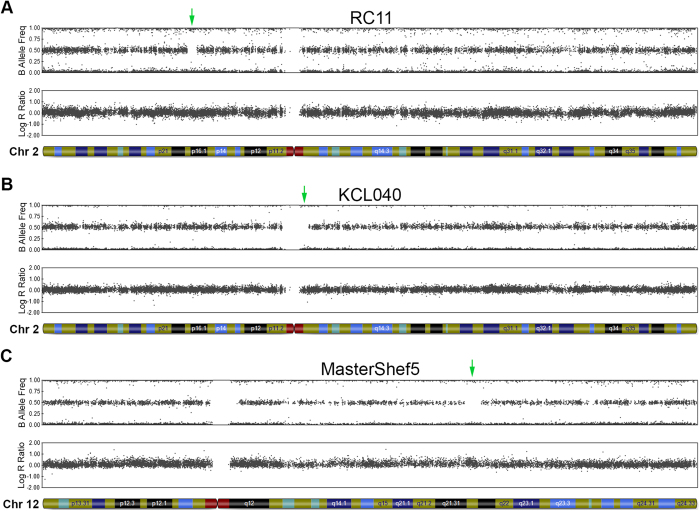
The application of human embryonic stem cell (hESC) derivatives to regenerative medicine is now becoming a reality. Although the vast majority of hESC lines have been derived for research purposes only, about 50 lines have been established under Good Manufacturing Practice (GMP) conditions. Cell types differentiated from these designated lines may be used as a cell therapy to treat macular degeneration, Parkinson's, Huntington's, diabetes, osteoarthritis and other degenerative conditions. It is essential to know the genetic stability of the hESC lines before progressing to clinical trials. We evaluated the molecular karyotype of 25 clinical-grade hESC lines by whole-genome single nucleotide polymorphism (SNP) array analysis. A total of 15 unique copy number variations (CNVs) greater than 100 kb were detected, most of which were found to be naturally occurring in the human population and none were associated with culture adaptation. In addition, three copy-neutral loss of heterozygosity (CN-LOH) regions greater than 1 Mb were observed and all were relatively small and interstitial suggesting they did not arise in culture. The large number of available clinical-grade hESC lines with defined molecular karyotypes provides a substantial starting platform from which the development of pre-clinical and clinical trials in regenerative medicine can be realised.
Figures


References
-
- Thomson J. A. et al. Embryonic stem cell lines derived from human blastocysts. Science 282, 1145–1147 (1998). - PubMed
-
- Takahashi K. et al. Induction of pluripotent stem cells from adult human fibroblasts by defined factors. Cell 131, 861–872 (2007). - PubMed
-
- Unger C., Skottman H., Blomberg P., Sirac Dilber M. & Hovatta O. Good manufacturing practice and clinical-grade human embryonic stem cell lines. Hum. Mol. Genet. 17, R48–R53 (2008). - PubMed
-
- Fraga A. M., Souza de Araújo É. S., Stabellini R., Vergani N. & Pereira L. V. A survey of parameters involved in the establishment of new lines of human embryonic stem cells. Stem Cell Rev and Rep 7, 775–781 (2011). - PubMed
-
- Ludwig T. E. et al. Derivation of human embryonic stem cells in defined conditions. Nat. Biotechnol. 24, 185–187 (2006). - PubMed
MeSH terms
Grants and funding
- G0700092/MRC_/Medical Research Council/United Kingdom
- G0801061/MRC_/Medical Research Council/United Kingdom
- G0801059/MRC_/Medical Research Council/United Kingdom
- K-1205/PUK_/Parkinson's UK/United Kingdom
- G0300484/MRC_/Medical Research Council/United Kingdom
- G0801057/MRC_/Medical Research Council/United Kingdom
- MR/M017354/1/MRC_/Medical Research Council/United Kingdom
- MR/K017276/1/MRC_/Medical Research Council/United Kingdom
- MR/L004992/1/MRC_/Medical Research Council/United Kingdom
- WT_/Wellcome Trust/United Kingdom
- MR/L020335/1/MRC_/Medical Research Council/United Kingdom
LinkOut - more resources
Full Text Sources
Other Literature Sources
Molecular Biology Databases
Research Materials
Miscellaneous
