


Symptomatic BK Virus Infection Is Associated With Kidney Function Decline and Poor Overall Survival in Allogeneic Hematopoietic Stem Cell Recipients
- PMID: 26608093
- PMCID: PMC5653306
- DOI: 10.1111/ajt.13635
Symptomatic BK Virus Infection Is Associated With Kidney Function Decline and Poor Overall Survival in Allogeneic Hematopoietic Stem Cell Recipients
Abstract
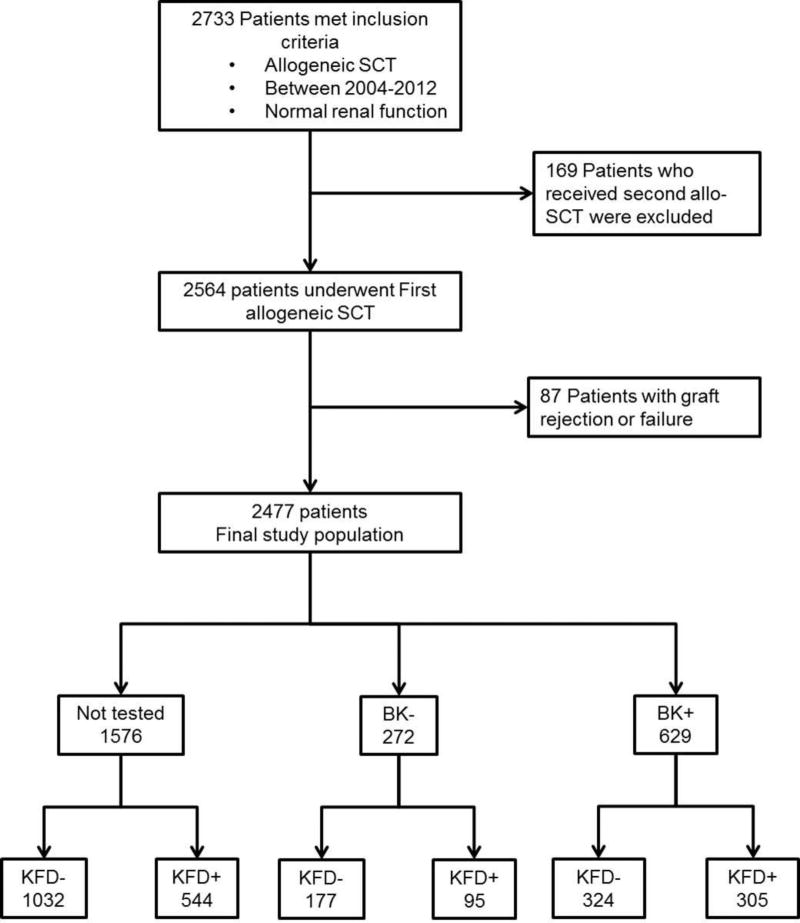
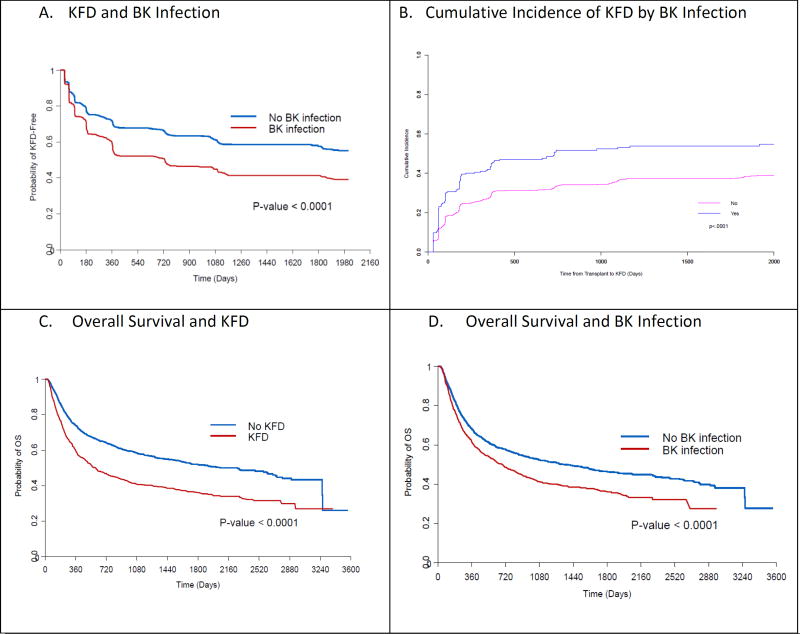
Nephropathy due to BK virus (BKV) infection is an evolving challenge in patients undergoing hematopoietic stem cell transplantation (HSCT). We hypothesized that BKV infection was a marker of kidney function decline and a poor prognostic factor in HSCT recipients who experience this complication. In this retrospective study, we analyzed all patients who underwent their first allogeneic HSCT at our institution between 2004 and 2012. We evaluated the incidence of persistent kidney function decline, which was defined as a confirmed reduction in estimated glomerular filtration rate of at least 25% from baseline using the Chronic Kidney Disease Epidemiology equation. Cox proportional hazard regression was used to model the cause-specific hazard of kidney function decline, and the Fine-Gray method was used to account for the competing risks of death. Among 2477 recipients of a first allogeneic HSCT, BK viruria was detected in 25% (n = 629) and kidney function decline in 944 (38.1%). On multivariate analysis, after adjusting for age, sex, acute graft-versus-host disease (GVHD), chronic GVHD, preparative conditioning regimen, and graft source, BK viruria remained a significant risk factor for kidney function decline (p < 0.001). In addition, patients with BKV infection and kidney function decline experienced worse overall survival. After allogeneic HSCT, BKV infection was strongly and independently associated with subsequent kidney function decline and worse patient survival after HSCT.
© Copyright 2015 The American Society of Transplantation and the American Society of Transplant Surgeons.
Conflict of interest statement
The authors of this manuscript have conflicts of interest to disclose as described by the American Journal of Transplantation. The other authors have no conflicts of interest to disclose.
Figures
References
-
- Arthur RR, Shah KV, Baust SJ, Santos GW, Saral R. Association of BK viruria with hemorrhagic cystitis in recipients of bone marrow transplants. The New England journal of medicine. 1986;315(4):230–4. - PubMed
-
- Pappo O, Demetris AJ, Raikow RB, Randhawa PS. Human polyoma virus infection of renal allografts: histopathologic diagnosis, clinical significance, and literature review. Modern pathology : an official journal of the United States and Canadian Academy of Pathology, Inc. 1996;9(2):105–9. - PubMed
-
- Hirsch HH, Knowles W, Dickenmann M, Passweg J, Klimkait T, Mihatsch MJ, et al. Prospective study of polyomavirus type BK replication and nephropathy in renal-transplant recipients. The New England journal of medicine. 2002;347(7):488–96. - PubMed
-
- Hirsch HH. BK virus: opportunity makes a pathogen. Clinical infectious diseases : an official publication of the Infectious Diseases Society of America. 2005;41(3):354–60. - PubMed
-
- van Aalderen MC, Heutinck KM, Huisman C, ten Berge IJ. BK virus infection in transplant recipients: clinical manifestations, treatment options and the immune response. Neth J Med. 2012;70(4):172–83. - PubMed
Publication types
MeSH terms
Grants and funding
LinkOut - more resources
Full Text Sources
Other Literature Sources
Medical
