


Review
doi: 10.4103/0971-5916.169193.
Alzheimer's disease: Unique markers for diagnosis & new treatment modalities
Affiliations
- PMID: 26609028
- PMCID: PMC4683821
- DOI: 10.4103/0971-5916.169193
Item in Clipboard
Review
Alzheimer's disease: Unique markers for diagnosis & new treatment modalities
Indian J Med Res.
2015 Oct.
Abstract
Alzheimer's disease (AD) is a progressive and irreversible neurodegenerative disease. In humans, AD becomes symptomatic only after brain changes occur over years or decades. Three contiguous phases of AD have been proposed: (i) the AD pathophysiologic process, (ii) mild cognitive impairment due to AD, and (iii) AD dementia. Intensive research continues around the world on unique diagnostic markers and interventions associated with each phase of AD. In this review, we summarize the available evidence and new therapeutic approaches that target both amyloid and tau pathology in AD and discuss the biomarkers and pharmaceutical interventions available and in development for each AD phase.
Figures
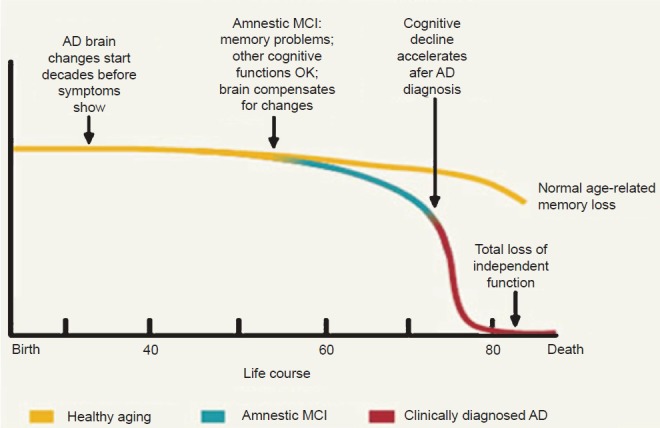
Cognitive trajectories over a lifetime and AD phases. National Institute on Aging's document titled “Alzheimer's Disease: Unraveling the Mystery”. Available from: https://www.nia.nih.gov/alzheimers/publication/alzheimers_disease-unraveling-mystery/preface , accessed on August 20, 2015. [Reproduced with permission from: www.nih.gov <http://www.nia.nih.gov/ >].
References
-
- Qui C, De Ronchi D, Fratiglioni L. The epidemiology of the dementias: an update. Curr Opin Psychiatry. 2007;20:380–5. - PubMed
-
- World Health Organization and Alzheimer's Disease International. Dementia: a public health priority. [accessed on August 20, 2015]. Available from: http://www.who.int/mental_health/publications/dementia_report_2012/en .
-
- World Alzheimer's Report 2010. [accessed on August 20, 2015]. Available from: http://www.alz.org/documents/national/Worldalzheimerreport2010.pdf .
Publication types
MeSH terms
Substances
LinkOut - more resources
Full Text Sources
Other Literature Sources
Medical