


Theory-of-mind-related neural activity for one's romantic partner predicts partner well-being
- PMID: 26609107
- PMCID: PMC4814790
- DOI: 10.1093/scan/nsv144
Theory-of-mind-related neural activity for one's romantic partner predicts partner well-being
Abstract
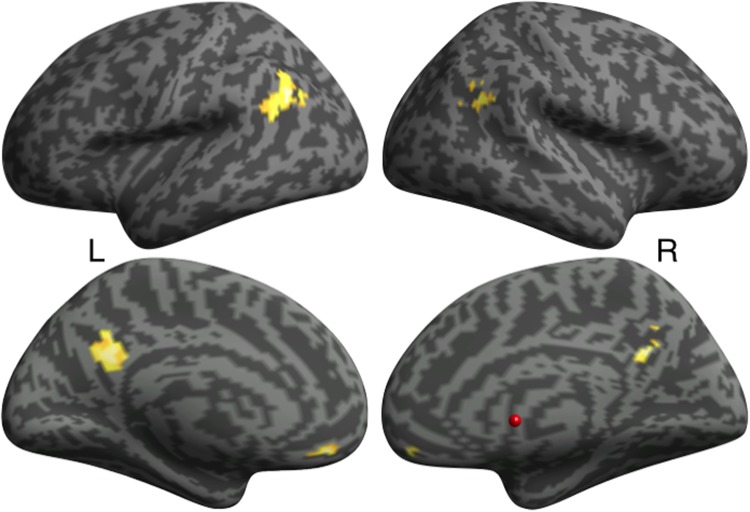
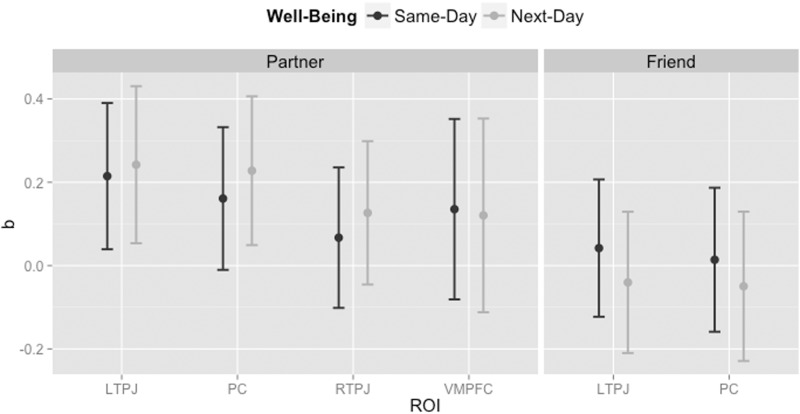
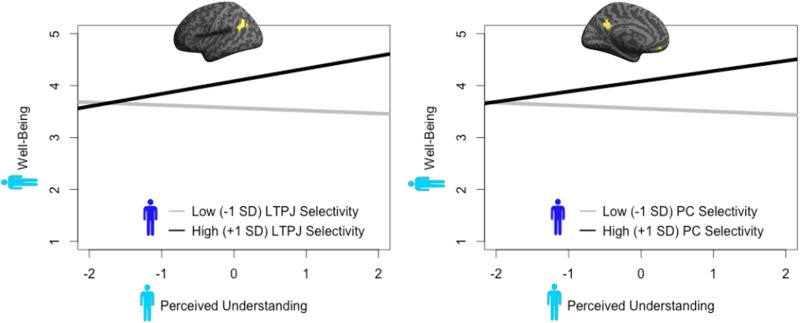
Healthy social relationships are linked to myriad positive physical and mental health outcomes, raising the question of how to enhance relationship formation and quality. Behavioral data suggest that theory of mind (ToM) may be one such process. ToM is supported by a network of brain regions including the temporo-parietal junction (TPJ), medial prefrontal cortex and precuneus (PC). However, little research has investigated how the ToM network supports healthy social relationships. Here, we investigate whether recruitment of the ToM network when thinking about the mental states of one's romantic partner predicts the partner's well-being. We find that selectivity in left TPJ (LTPJ) and PC for beliefs vs physical attributes of one's partner is positively associated with partner well-being the day of and day after a meaningful encounter. Furthermore, LTPJ and PC selectivity moderated how the partner's perception of being understood during the encounter affected their later well-being. Finally, we find the association between ToM-related neural selectivity and well-being robust to other factors related to the relationship and the encounter. Together, these data suggest that selective engagement of the neural network supporting ToM may be a key ingredient for the development and maintenance of healthy romantic relationships.
Keywords: fMRI; relationships; temporo-parietal junction; theory of mind; well-being.
© The Author (2015). Published by Oxford University Press. For Permissions, please email: journals.permissions@oup.com.
Figures
References
-
- Aiken L.S., West S.G. (1991). Multiple Regression: Testing and Interpreting Interactions. Thousand Oaks, CA: Sage.
-
- American Psychiatric Association (2013). Diagnostic and Statistical Manual of Mental Disorders : DSM-5. Washington, DC: American Psychiatric Association.
-
- Boehm J.K., Kubzansky L.D. (2012). The heart’s content: the association between positive psychological well-being and cardiovascular health. Psychological Bulletin, 138(4), 655–91. - PubMed
-
- Bolger N., Davis A., Rafaeli E. (2003). Diary methods: capturing life as it is lived. Annual Review of Psychology, 54, 579–616. - PubMed
-
- Brainard D.H. (1997). The Psychophysics Toolbox. Spatial Vision, 10(4), 433–6. - PubMed
Publication types
MeSH terms
LinkOut - more resources
Full Text Sources
Other Literature Sources
Medical
