. 2016 Apr 1;213(7):1189-97.
doi: 10.1093/infdis/jiv570. Epub 2015 Nov 26.

Genetic Variation in Toll-Interacting Protein Is Associated With Leprosy Susceptibility and Cutaneous Expression of Interleukin 1 Receptor Antagonist

Affiliations

Genetic Variation in Toll-Interacting Protein Is Associated With Leprosy Susceptibility and Cutaneous Expression of Interleukin 1 Receptor Antagonist

Javeed A Shah et al. J Infect Dis. .

Abstract

Leprosy is a chronic disease characterized by skin and peripheral nerve pathology and immune responses that fail to control Mycobacterium leprae. Toll-interacting protein (TOLLIP) regulates Toll-like receptor (TLR) and interleukin 1 receptor (IL-1R) signaling against mycobacteria. We analyzed messenger RNA (mRNA) expression of candidate immune genes in skin biopsy specimens from 85 individuals with leprosy. TOLLIP mRNA was highly and specifically correlated with IL-1R antagonist (IL-1Ra). In a case-control gene-association study with 477 cases and 1021 controls in Nepal, TOLLIP single-nucleotide polymorphism rs3793964 TT genotype was associated with increased susceptibility to leprosy (recessive, P = 1.4 × 10(-3)) and with increased skin expression of TOLLIP and IL-1Ra. Stimulation of TOLLIP-deficient monocytes with M. leprae produced significantly less IL-1Ra (P < .001), compared with control. These data suggest that M. leprae upregulates IL-1Ra by a TOLLIP-dependent mechanism. Inhibition of TOLLIP may decrease an individual's susceptibility to leprosy and offer a novel therapeutic target for IL-1-dependent diseases.

Keywords: IL-1; IL-1 receptor; IL-1Ra; Mycobacterium leprae; Skin immunity; TLR regulation; TOLLIP; genetics; immune evasion; leprosy.


Figures

Figure 1.
Figure 1.
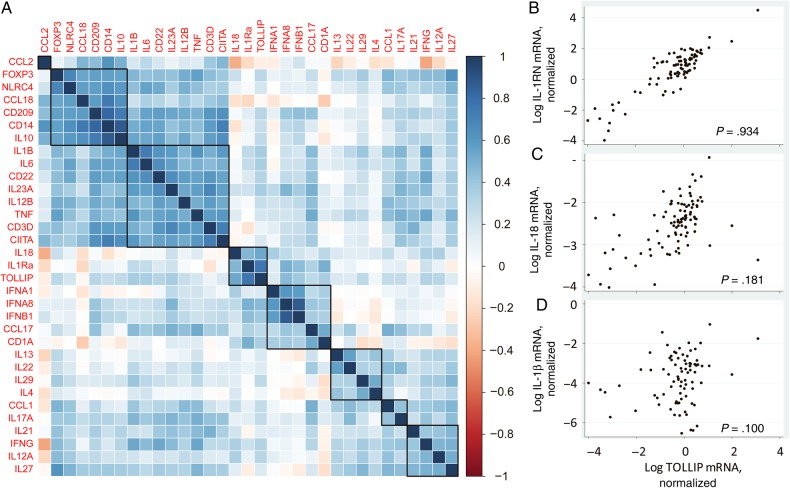
Hierarchical clustering of Toll-interacting protein (TOLLIP) with cytokines in leprosy skin biopsy specimens. Heat map of 32 immune genes and TOLLIP in skin biopsy specimens from individuals with leprosy. Correlation was performed in 85 skin biopsy specimens from individuals with leprosy encompassing all categories of disease and including those with immune reactions. Statistical analyses were performed using a nonparametric Spearman rank correlation test. A, TOLLIP formed a cluster with interleukin 1 receptor antagonist (IL-1Ra; ρ = 0.93) and interleukin 18 (IL-18; ρ = 0.18). Heat map values extend from red to blue, with the reddest values denoting a ρ of −1, indicating a strong negative correlation between expression levels, and the bluest values representing a ρ of 1, indicating a strong positive correlation between expression values. B, Correlation scatterplot of messenger RNA (mRNA) expression of TOLLIP and IL-1Ra. C, Correlation scatterplot of mRNA expression of TOLLIP and IL-18, which was not as strong as that for IL-1Ra. D, Correlation scatterplot of TOLLIP with IL-1β, which was not clustered with TOLLIP. mRNA expression is shown in log10 scale after normalization with GAPDH. This figure is available in black and white in print and in color online.
Figure 2.
Figure 2.
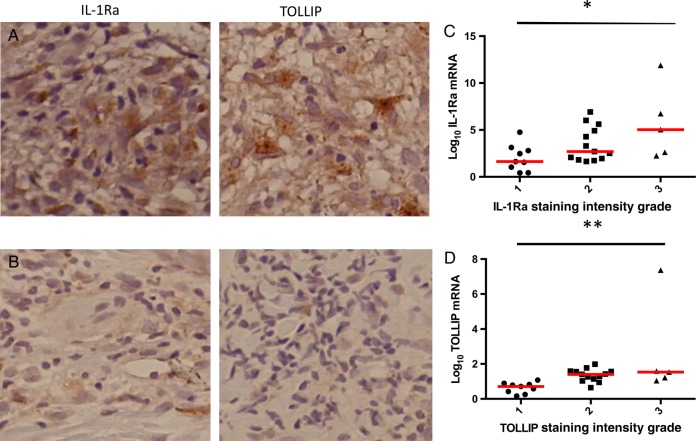
Toll-interacting protein (TOLLIP) and interleukin 1 receptor antagonist (IL-1Ra) immunohistochemical findings. Skin biopsy specimens were obtained from lesions in individuals with leprosy and stained for TOLLIP and IL-1Ra. A and B, A skin biopsy specimen from a representative individual with 3+ TOLLIP and 3+ IL-1Ra staining (A) and 1+ TOLLIP and 1+ IL-1Ra staining (B). C, Plot of the IL-1Ra messenger RNA level, normalized to GAPDH, compared to the IL-1Ra immunohistochemical grade staining score (1+–3+). IL-Ra protein expression and mRNA expression were correlated by linear regression. *P = .0031. D, The TOLLIP mRNA level, normalized to GAPDH, was compared to the TOLLIP immunohistochemical grade staining score (1+–3+). TOLLIP protein expression and mRNA expression were correlated by linear regression. **P < .0001.
Figure 3.
Figure 3.
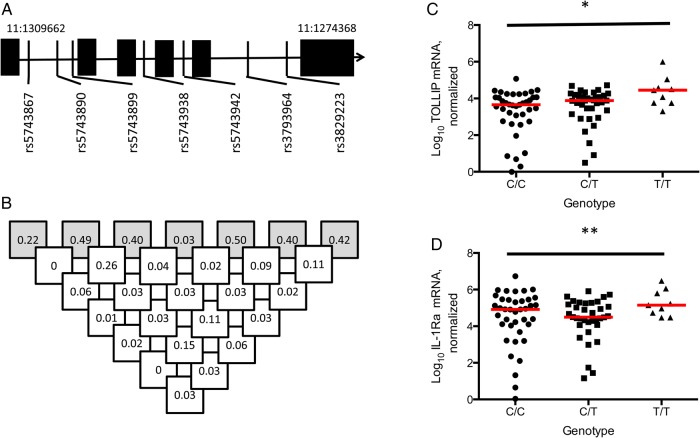
Toll-interacting protein (TOLLIP) variants, linkage disequilibrium, and association with skin messenger RNA (mRNA) expression. Haplotype-tagging TOLLIP single-nucleotide polymorphisms (SNPs) studied were selected from the Chinese Han (CHB) population in HapMap. A, TOLLIP gene chromosomal location and SNP map. B, Linkage disequilibrium of selected haplotype-tagging SNPs in the study population. Shaded boxes describe minor allele frequency of SNP and open boxes show R2 linkage disequilibrium values. C, Log10 interleukin 1 receptor antagonist (IL-1Ra) skin mRNA expression, stratified by TOLLIP SNP rs3793964 genotype. D, Log10 TOLLIP skin mRNA expression, stratified by TOLLIP SNP rs3793964 genotype. Statistical significance was determined via a generalized linear model. Lines represent median values of each sample. *P = .018 and **P = .022.
Figure 4.
Figure 4.
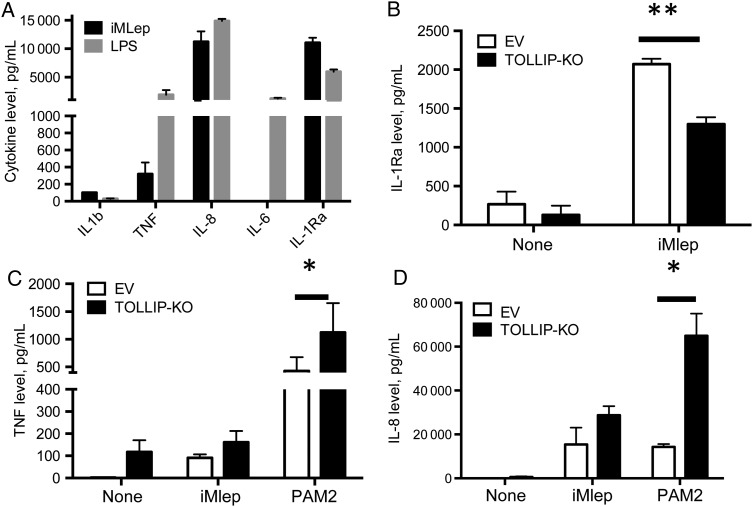
Toll-interacting protein (TOLLIP) regulation of interleukin 1 receptor antagonist (IL-1Ra) expression after Mycobacterium leprae monocyte stimulation. Cytokine responses in peripheral blood monocytes from a healthy volunteer after stimulation with lipopolysaccharide (LPS) and whole irradiated M. leprae (iMLep). A, Interleukin 1 receptor antagonist (IL-1Ra), IL-1β, interleukin 6 (IL-6), tumor necrosis factor (TNF), and interleukin 8 (IL-8) cytokine production after 20 µg/mL iMLep and 10 ng/mL LPS stimulation of 2 × 10⁵ human peripheral blood mononuclear cells from a healthy donor. Data are representative of 2 experiments. BD, 105 TOLLIP-deficient (TOLLIP-KO) or empty vector (EV) THP-1 monocytes were stimulated with medium, 20 µg/mL iMLep, or 250 ng/mL PAM2 CysKKKK (TLR2/6 ligand) for 24 hours, followed by measurement of IL-1Ra (B), TNF (C), and IL-8 (D) production. Error bars show standard errors of the mean for 3 technical replicates from this experiment, and these data are representative of 2 independent experiments. *P < .05 and **P < .001, by the 2-sided Student t test.
Figure 5.
Figure 5.
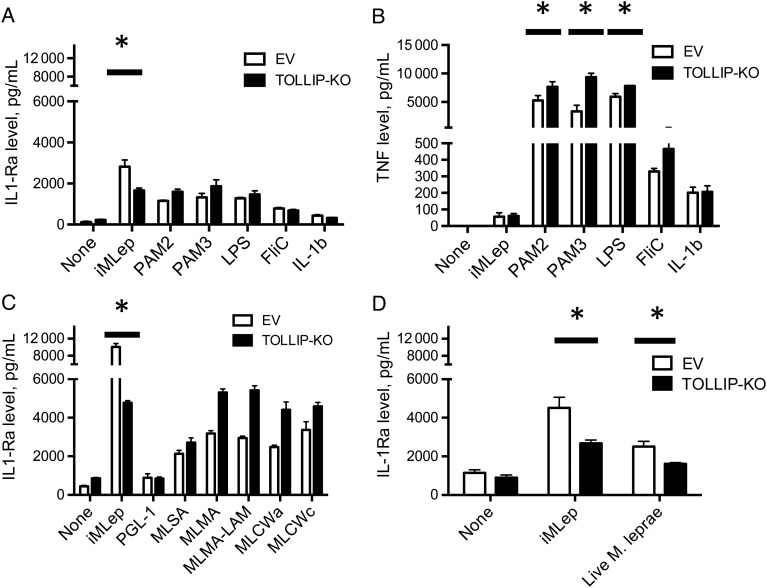
Toll-interacting protein (TOLLIP)–dependent interleukin 1 receptor antagonist (IL-1Ra) secretion in monocytes requires whole Mycobacterium leprae. TOLLIP and empty vector (EV) control THP-1 cells were stimulated for 24 hours, followed by collection of supernatants and measurement of cytokine concentrations by enzyme-linked immunosorbent assay. A and B, Secreted IL-1Ra (A) and tumor necrosis factor (TNF; B) concentrations after stimulating 105 TOLLIP or EV monocytes with 80 µg/mL whole irradiated M. leprae (iMLep), 250 ng/mL PAM2, 250 ng/mL PAM3, 10 ng/mL LPS, 50 ng/mL Salmonella typhimurium flagellin FliC, or 100 ng/mL recombinant IL-1β for 24 hours. C, Secreted IL-1Ra concentrations after stimulating 105 TOLLIP or EV THP-1 monocytes with 80 µg/mL of the following M. leprae cellular fractions: iMLep, phenolic glycolipid 1 conjugated to human serum albumin (PGL1), M. leprae cytosolic fractions (MLSA), M. leprae cell membrane (MLMA), M. leprae cell membrane with lipoarabinomannan removed (MLSA – LAM), M. leprae cell wall (MLCWa), or M. leprae cell wall core (MLCWc). D, Secreted IL-1Ra concentrations after stimulating 105 TOLLIP-deficient THP-1 cell line (TOLLIP-KO) or EV THP-1 monocytes with iMLep or live M. leprae (multiplicity of infection, 10) derived from footpads of nude mice and incubated overnight at 33°C. Error bars show standard errors of the mean of 3 technical replicates from this experiment, which is representative of 2 independent experiments. *P < .05 and **P < .001, by the 2-sided Student t test.

References

    1. Institute for Health Metrics and Evaluation. Global burden of leprosy. http://www.healthdata.org/search-gbd-data?s=leprosy Accessed 15 May 2015.
    1. World Health Organization. Global leprosy update, 2013; reducing disease burden. Wkly Epidemiol Rec 2014; 89:389–400. - PubMed
    1. Geluk A, Bobosha K, van der Ploeg-van Schip JJ et al. New biomarkers with relevance to leprosy diagnosis applicable in areas hyperendemic for leprosy. J Immunol 2012; 188:4782–91. - PMC - PubMed
    1. Duthie MS, Ireton GC, Kanaujia GV et al. Selection of antigens and development of prototype tests for point-of-care leprosy diagnosis. Clin Vaccine Immunol 2008; 15:1590–7. - PMC - PubMed
    1. Lahiri R, Randhawa B, Franken KL et al. Development of a mouse food pad model for detection of sub clinical leprosy. Lepr Rev 2011; 82:432–44. - PubMed

Publication types

MeSH terms

Substances