. 2016 Jan 4;44(D1):D231-8.
doi: 10.1093/nar/gkv1270. Epub 2015 Nov 26.

DIANA-LncBase v2: indexing microRNA targets on non-coding transcripts

Affiliations

DIANA-LncBase v2: indexing microRNA targets on non-coding transcripts

Maria D Paraskevopoulou et al. Nucleic Acids Res. .

Abstract

microRNAs (miRNAs) are short non-coding RNAs (ncRNAs) that act as post-transcriptional regulators of coding gene expression. Long non-coding RNAs (lncRNAs) have been recently reported to interact with miRNAs. The sponge-like function of lncRNAs introduces an extra layer of complexity in the miRNA interactome. DIANA-LncBase v1 provided a database of experimentally supported and in silico predicted miRNA Recognition Elements (MREs) on lncRNAs. The second version of LncBase (www.microrna.gr/LncBase) presents an extensive collection of miRNA:lncRNA interactions. The significantly enhanced database includes more than 70 000 low and high-throughput, (in)direct miRNA:lncRNA experimentally supported interactions, derived from manually curated publications and the analysis of 153 AGO CLIP-Seq libraries. The new experimental module presents a 14-fold increase compared to the previous release. LncBase v2 hosts in silico predicted miRNA targets on lncRNAs, identified with the DIANA-microT algorithm. The relevant module provides millions of predicted miRNA binding sites, accompanied with detailed metadata and MRE conservation metrics. LncBase v2 caters information regarding cell type specific miRNA:lncRNA regulation and enables users to easily identify interactions in 66 different cell types, spanning 36 tissues for human and mouse. Database entries are also supported by accurate lncRNA expression information, derived from the analysis of more than 6 billion RNA-Seq reads.


Figures

Figure 1.
Figure 1.
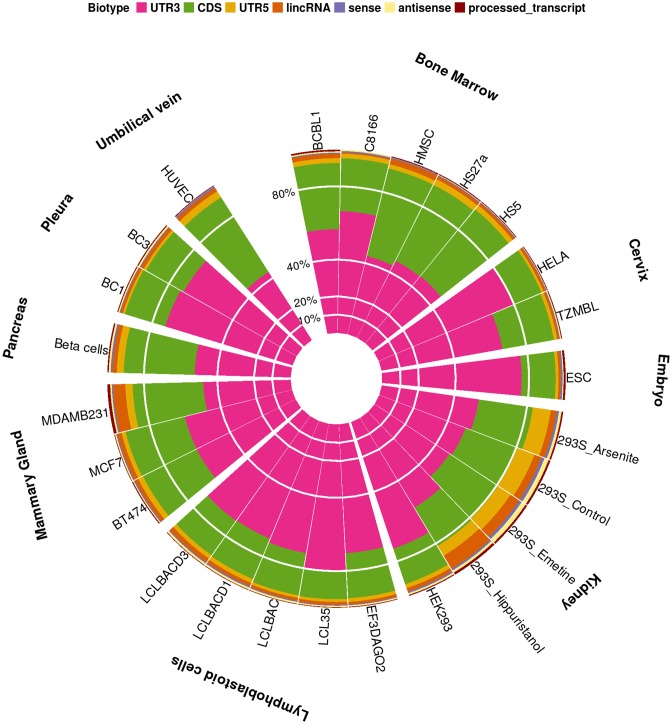
Spatial classification of miRNA-targeted regions as identified in human CLIP-Seq libraries. MREs are being distributed in 3′UTR, 5′UTR, CDS, lincRNA, (anti)sense and processed lncRNA transcript regions across different cell types, with 5 ± 2% of the exonic MREs were annotated on lncRNAs.
Figure 2.
Figure 2.
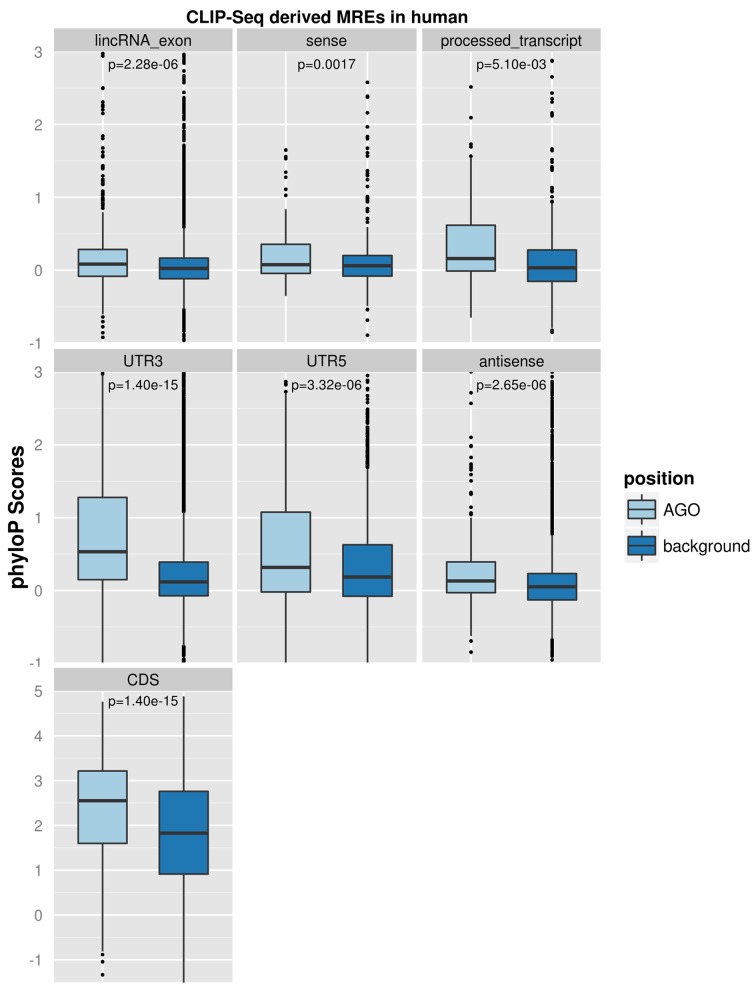
Evaluation of CLIP-Seq-supported human MRE substitution rates. miRNA binding sites were spatially classified on CDS, 3′UTR, 5′UTR, lincRNA exons, processed transcripts and (anti)sense lncRNA regions. Random background regions retrieved from each spatially classified genomic group were additionally utilized as controls for the assessment of MRE evolutionary pressure. MRE and background region conservation were estimated using PhyloP pre-computed base-wise values from genome-wide multiple alignments of 46 vertebrate species. Pairwise comparisons revealed that MREs, even in lncRNA regions, are significantly more conserved than their background sequences, which is a phenomenon previously known to occur in MREs located in mRNA 3′UTRs. P-values derived from statistical analyses are marked in the relevant panels.
Figure 3.
Figure 3.
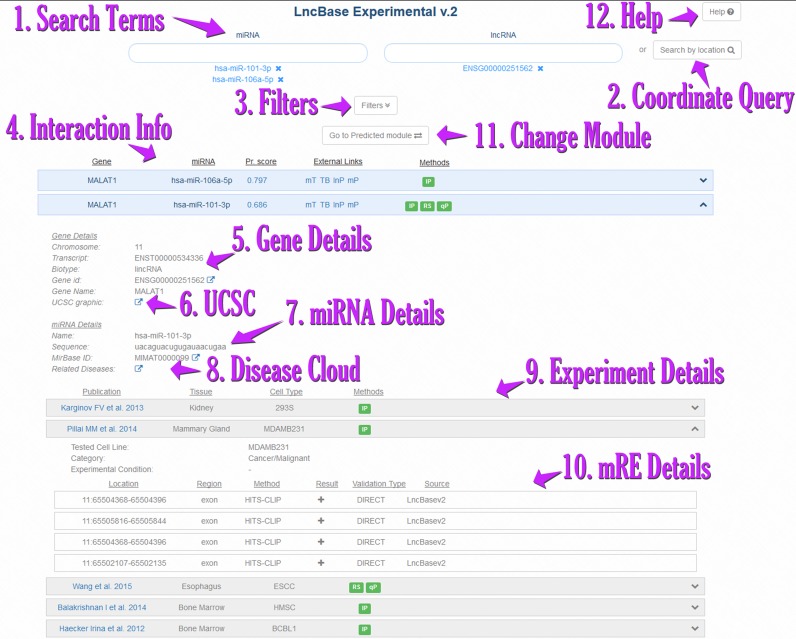
Snapshot depicting the DIANA-LncBase v2 interface. Queries using one or more microRNAs and/or lncRNAs [1] or even the coordinates of a genomic location [2] are supported. Users can add and remove search terms or filter [3] their results based on cell/tissue type and experimental methodology, as well as the experimental outcome (positive/negative) or type of validation (direct/indirect). LncBase offers extensive information for each identified interaction, such as gene/miRNA details [4,5], as well as active links to UCSC graphical representation [6], Ensembl, miRBase and DIANA disease tag cloud [8]. LncBase also provides useful information for each performed experiment [9], including the methodology, cell or tissue that was utilized, as well as a link to the original publication. There are direct links to external applications such as microT, TarBase, miRPath, where the studied miRNA can be further examined. Interactions are also coupled with miRNA binding site details [10]. Users can navigate between the Experimental and Predicted LncBase v2 modules [11]. The Help button [12] leads to the LncBase Help section.

References

    1. Huntzinger E., Izaurralde E. Gene silencing by microRNAs: contributions of translational repression and mRNA decay. Nat. Rev. Genet. 2011;12:99–110. - PubMed
    1. Consortium E.P. An integrated encyclopedia of DNA elements in the human genome. Nature. 2012;489:57–74. - PMC - PubMed
    1. Johnsson P., Lipovich L., Grander D., Morris K.V. Evolutionary conservation of long non-coding RNAs; sequence, structure, function. Biochim. Biophys. Acta. 2014;1840:1063–1071. - PMC - PubMed
    1. Rinn J.L., Chang H.Y. Genome regulation by long noncoding RNAs. Annu. Rev. Biochem. 2012;81:145–166. - PMC - PubMed
    1. Gutschner T., Diederichs S. The hallmarks of cancer: a long non-coding RNA point of view. RNA Biol. 2012;9:703–719. - PMC - PubMed

Publication types