


Review
doi: 10.1155/2015/497387.
Epub 2015 Nov 3.
Novel Roles for Chloride Channels, Exchangers, and Regulators in Chronic Inflammatory Airway Diseases
Affiliations
- PMID: 26612971
- PMCID: PMC4647060
- DOI: 10.1155/2015/497387
Item in Clipboard
Review
Novel Roles for Chloride Channels, Exchangers, and Regulators in Chronic Inflammatory Airway Diseases
Mediators Inflamm.
2015.
Abstract
Chloride transport proteins play critical roles in inflammatory airway diseases, contributing to the detrimental aspects of mucus overproduction, mucus secretion, and airway constriction. However, they also play crucial roles in contributing to the innate immune properties of mucus and mucociliary clearance. In this review, we focus on the emerging novel roles for a chloride channel regulator (CLCA1), a calcium-activated chloride channel (TMEM16A), and two chloride exchangers (SLC26A4/pendrin and SLC26A9) in chronic inflammatory airway diseases.
Figures
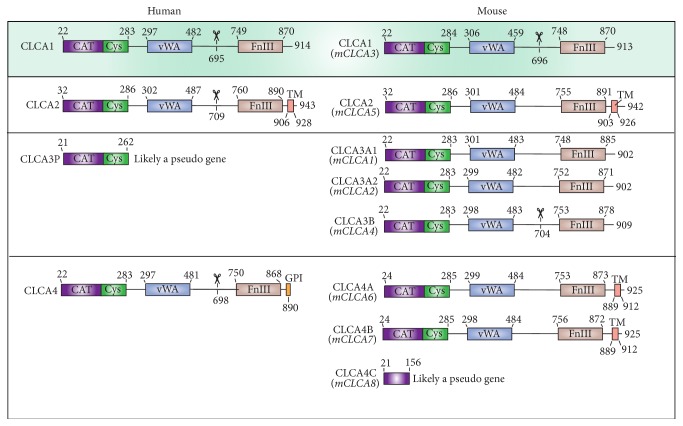
Domain architecture schematic for human and mouse CLCA proteins. Each row contains the corresponding human and mouse homologs. Mouse CLCA proteins are labeled according to the recently updated naming commissioned by the Mouse Gene Nomenclature Committee (MGNC) in order to align the numbering established by the Human Gene Nomenclature Committee and the Rat Genome Database. The previously used names for the mouse proteins are shown below the current names and are in italics. Scissors denote the experimentally determined location of proteolytic cleavage sites [18]. Human CLCA3 and mouse CLCA4C are likely pseudogenes because they contain premature stop codons. Labels denote the following domains: CAT: matrix-metalloprotease-like catalytic domain; CYS: matrix-metalloprotease-like cysteine rich domain; vWA: von Willebrand factor type A domain; FnIII: fibronectin type III domain; TM: transmembrane domain; GPI: glycosylphosphatidylinositol anchor.
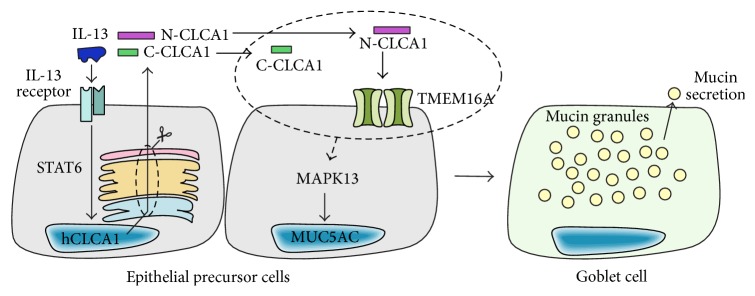
Schematic of CLCA1-driven MCM in human airways based on the current literature. IL-13 induces CLCA1 gene expression through activated STAT6. CLCA1 protein is expressed, is secreted, and undergoes proteolytic self-cleavage to yield two fragments (N-CLCA1: N-terminal fragment; C-CLCA1: C-terminal fragment). N-CLCA1 engages and activates the CaCC TMEM16A. Downstream, a signaling pathway is activated through MAPK13 which leads to induction of the inflammatory mucin MUC5AC, followed by goblet cell differentiation and subsequent MCM. It is currently unknown whether or how the steps highlighted in the dashed ellipse (CLCA1 cleavage and activation of TMEM16A) contribute to the activation of MAPK13.
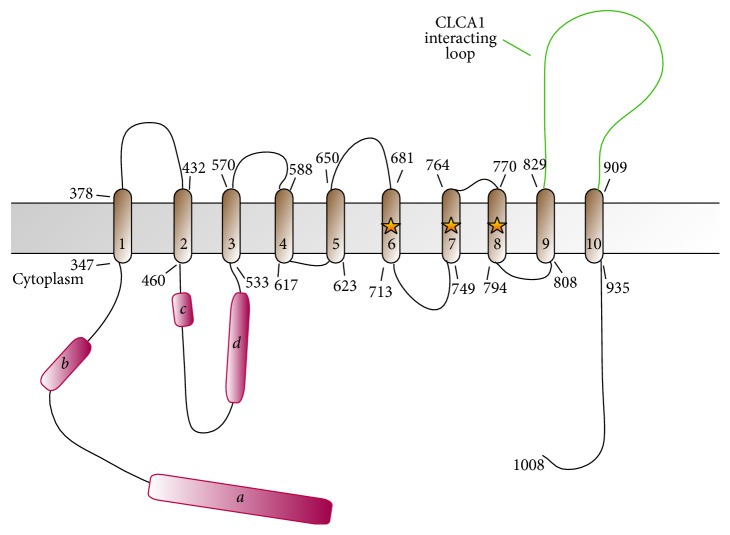
Domain architecture schematic for human TMEM16A. Topology shown is predicted from structure-based alignment to the crystal structure of the fungal Nectria haematococca TMEM16 [31]. Alternative splicing segments a, b, c, and d are shown in magenta. The location of residues of a crystallographically determined Ca2+ binding site is highlighted with stars. The extracellular loop mediating interaction with CLCA1 is highlighted in green.
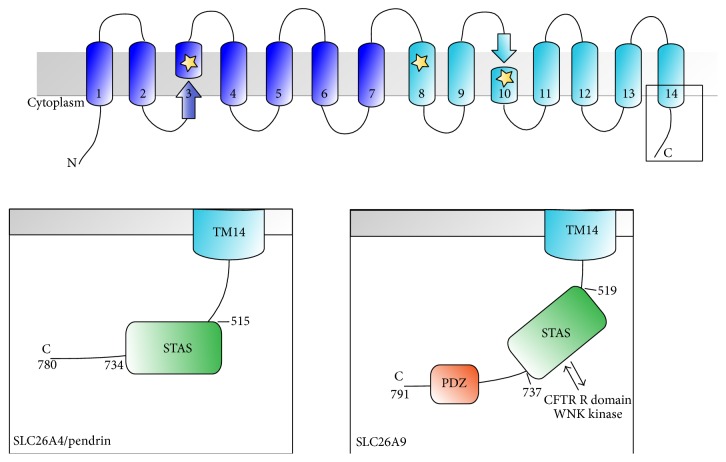
Domain architecture schematic for human SLC26 family proteins discussed here, SLC26A4 (pendrin) and SLC26A9, based on the crystal structure of SLC26Dg (PDB ID 5DA0). Upper inset shows general schematic while the lower insets show details of the C-terminal cytoplasmic region for each protein. Labels denote the following domains: STAS: sulfate transporter and antisigma factor antagonist domain; PDZ: PSD95-Dlg1-Zo-1 domain. Locations of SLC26A9 interaction with CFTR R domains and WNK kinases are denoted. The location of residues of a crystallographically determined ligand binding site is highlighted with stars.
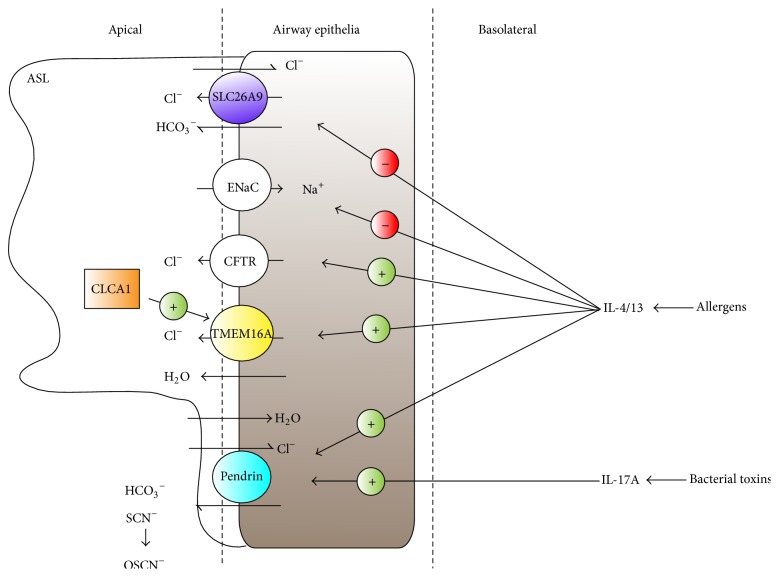
Roles of ion channels in the airway epithelium. In response to allergens and other asthma and COPD exacerbating factors, Th2-cytokines IL-4 and IL-13 induce a water secretory phenotype by stimulating Cl− secretion via CFTR and Ca2+-activated Cl− channels such as TMEM16A and by decreasing Na+ and Cl− reabsorption via ENaC and SLC26A9, respectively, which leads to the thickening of the airway surface liquid (ASL). TMEM16A activity can be increased by secreted CLCA1 protein. In concert, signaling through IL-4/IL-13 increases the functional expression of pendrin, which results in reabsorption of water and thinning of the ASL. Pendrin can also increase the secretion of thiocyanate (SCN−), a substrate for the production of the antimicrobial agent hypothiocyanite (OSCN−) by the lactoperoxidase system. Toxins from B. pertussis and other bacteria trigger an IL-17A-mediated inflammatory host response in the lung epithelium, which is characterized by a significant upregulation of pendrin activity.
References
Publication types
MeSH terms
Substances
Grants and funding
LinkOut - more resources
Full Text Sources
Other Literature Sources
Medical
