. 2015;58(6):857-865.
doi: 10.1007/s13765-015-0113-z. Epub 2015 Aug 27.

Effects of ascorbic acid on α-l-arabinofuranosidase and α-l-arabinopyranosidase activities from Bifidobacterium longum RD47 and its application to whole cell bioconversion of ginsenoside

Affiliations

Effects of ascorbic acid on α-l-arabinofuranosidase and α-l-arabinopyranosidase activities from Bifidobacterium longum RD47 and its application to whole cell bioconversion of ginsenoside

Seockmo Ku et al. J Korean Soc Appl Biol Chem. 2015.

Abstract

Bifidobacterium longum RD47 was cultured in 24 kinds of modified MRS broths containing various ingredients to select the most promising source that induces microbial enzymes. Among the various ingredients, ascorbic acid significantly enhanced α-l-arabinofuranosidase and α-l-arabinopyranosidase activities in Bifidobacterium longum RD47. Addition of 2 % ascorbic acid (w/v) to MRS showed the maximum enzyme activities. Both whole cell and disrupted cell homogenates showed efficient ρ-nitrophenyl-β-d-glucopyranoside and ρ-nitrophenyl-β-d-glucofuranoside hydrolysis activities. The initially enhanced α-l-arabinopyranosidase and α-l-arabinofuranosidase activities by ascorbic acid were maintained over the cell disruption process. The optimal pH of α-l-arabinofuranosidase and α-l-arabinopyranosidase was 5.0 and 7.0, respectively. Both enzymes showed the maximum activities at 40.0 °C. Under the controlled condition using Bifidobacterium longum RD47, ginsenoside Rb2, and Rc were converted to ginsenoside Rd.

Keywords: Ascorbic acid; Bifidobacterium; Bioconversion; Ginsenosides; α-l-Arabinofuranosidase; α-l-Arabinopyranosidase.


Figures
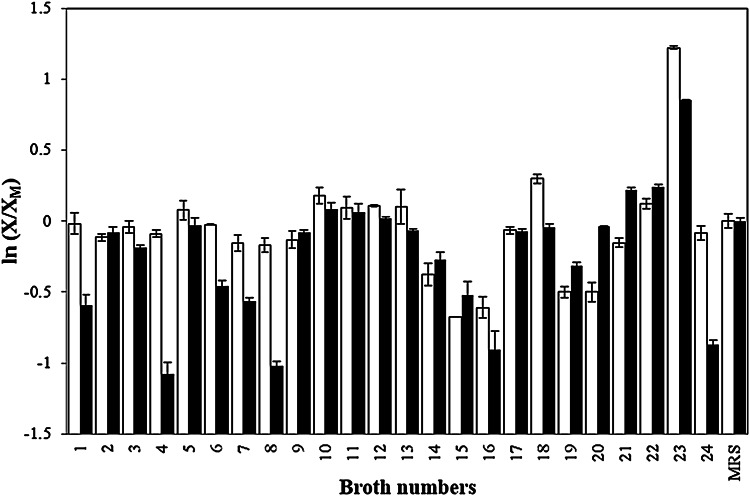
Fig. 1
Fig. 1
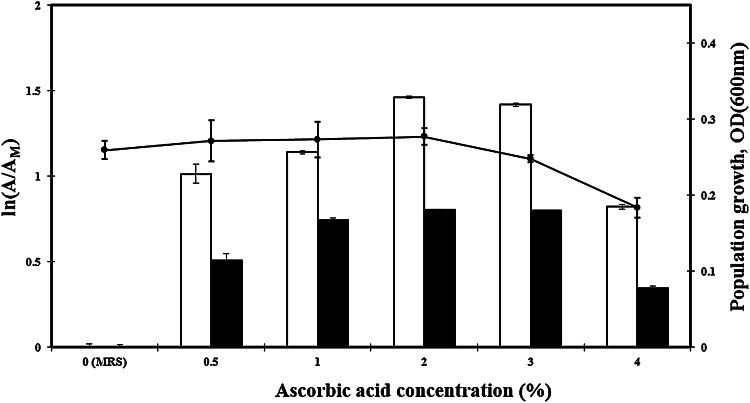
Relative enzyme activities of Bifidobacterium longum Rd47 cultured in the various broths (n = 3). Cell lysis solution was treated to samples. Error bars standard deviation. White bars α-arabinofuranosidase, black bars α-arabinopyranosidase
Fig. 2
Fig. 2
The effect of ascorbic acid on the production of α-L-arabinofuranosidase and α-L-arabinopyranosidase from Bifidobacterium longum Rd47 (n = 3). Cell lysis solution was treated to samples. Error bars represent standard deviation. White bars α-arabinofuranosidase, black bars α-arabinopyranosidase, black circles population growth
Fig. 3
Fig. 3
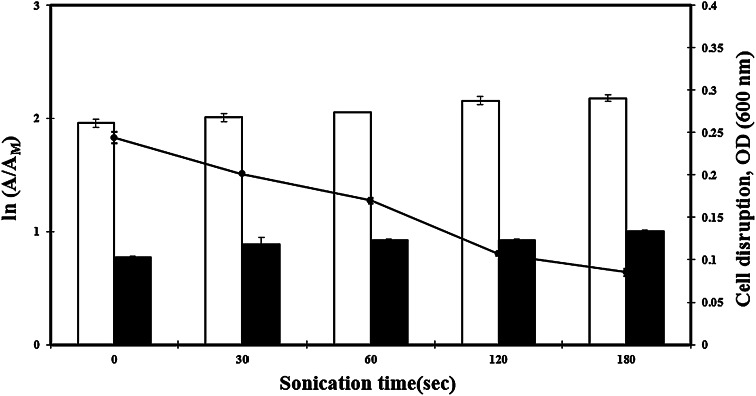
The effect of cell disruption (Sonication) on α-l-arabinofuranosidase and α-l-arabinopyranosidase activities from Bifidobacterium longum Rd47 (n = 3). Error bars represent standard deviation. White bars α-arabinofuranosidase, black bars α-arabinopyranosidase, black circles degree of cell disruption
Fig. 4
Fig. 4
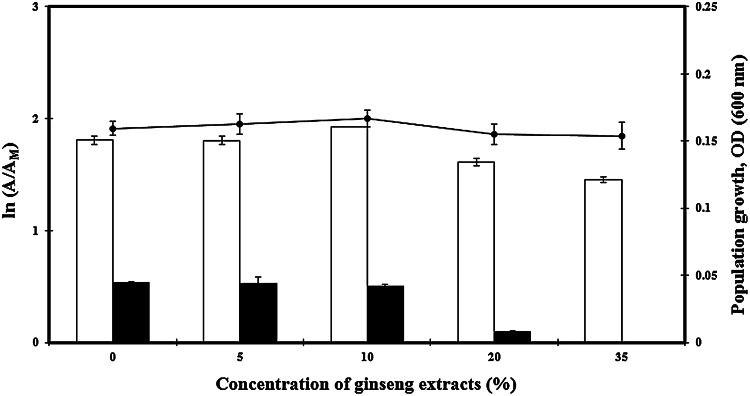
The effect of ginseng extracts on the production of α-l-arabinofuranosidase and α-l-arabinopyranosidase from Bifidobacterium longum Rd47 (n = 3). Enzyme activities were evaluated without disruption step. Error bars standard deviation. White bars α-arabinofuranosidase, black bars α-arabinopyranosidase, black circles population growth
Fig. 5
Fig. 5
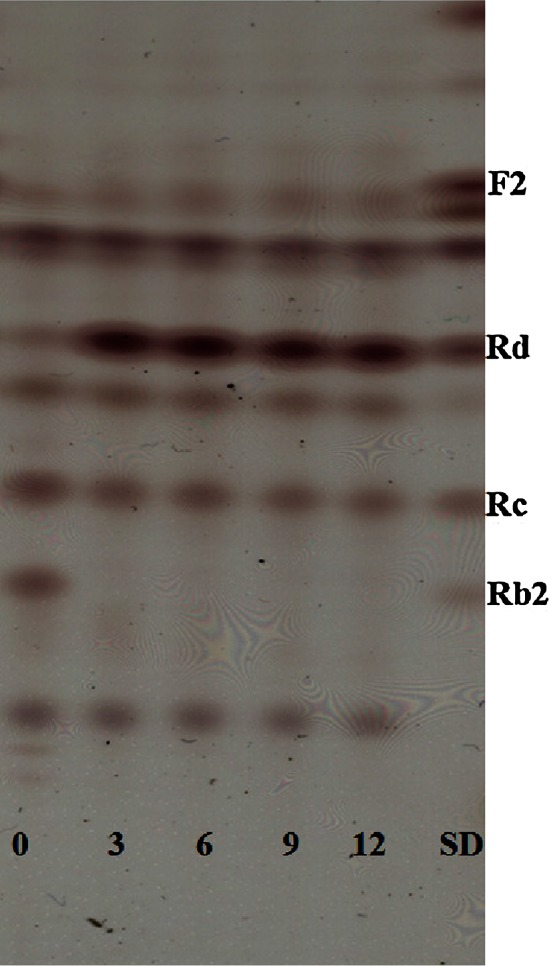
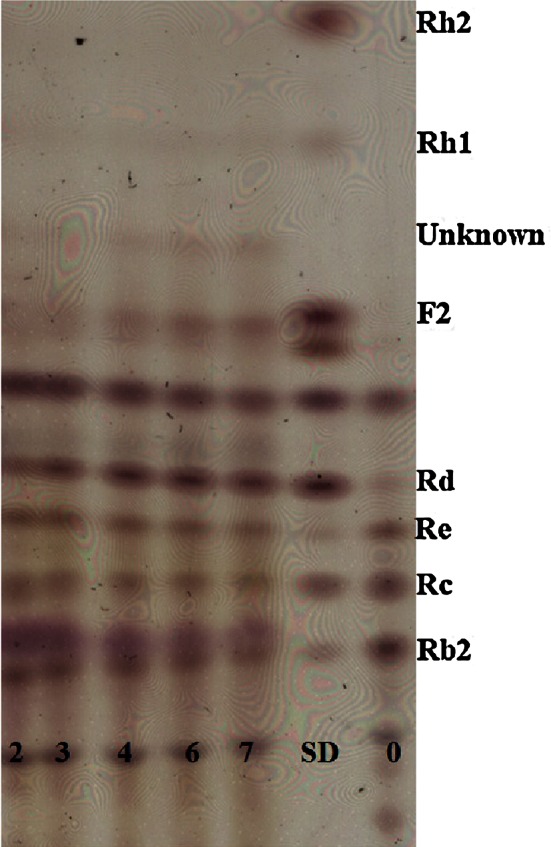
TLC profile of ginsenosides conversion using disrupted cell
Fig. 6
Fig. 6
TLC profile of ginsenosides conversion using whole cell

References

    1. An DS, Cui CH, Sung BH, Yang HC, Kim Sc, Lee ST, Im WT, Kim SG. Characterization of a novel ginsenoside hydrolyzing α-l-arabinofuranosidase, AbfA, from Rhodanobacter ginsenosidimutans Gsoli 3054T. Appl Microbiol Biotechnol. 2012;94:673–682. doi: 10.1007/s00253-011-3614-7. - DOI - PubMed
    1. Bae EA, Park SY, Kim DH. Constitutive β-glucosidases hydrolyzing ginsenoside Rb1 and Rb2 from human intestinal bacteria. Biol Pharm Bull. 2000;23:1481–1485. doi: 10.1248/bpb.23.1481. - DOI - PubMed
    1. Bae EA, Kim NA, Han MJ, Choo MK, Kim DH. Transformation of ginsenosides to compound K (IH-901) by lactic acid bacteria of human intestine. J Microbiol Biotechnol. 2003;13:9–14.
    1. Bae EA, Han MJ, Kim EJ, Kim DH. Transformation of ginseng saponins to ginsenoside Rh2 by acids and human intestinal bacteria and biological activities of their transformants. Arch Pharm Res. 2004;27:61–67. doi: 10.1007/BF02980048. - DOI - PubMed
    1. Baeg IH, So SH. The world ginseng market and the ginseng (Korea) J Ginseng Res. 2013;37:1–7. doi: 10.5142/jgr.2013.37.1. - DOI - PMC - PubMed