Review
. 2016 Feb;24(1):123-133.
doi: 10.1016/j.mric.2015.08.011.

Evaluation of Head and Neck Tumors with Functional MR Imaging

Affiliations
Review

Evaluation of Head and Neck Tumors with Functional MR Imaging

Jacobus F A Jansen et al. Magn Reson Imaging Clin N Am. 2016 Feb.

Abstract

Head and neck cancer is one of the most common cancers worldwide. MR imaging-based diffusion and perfusion techniques enable the noninvasive assessment of tumor biology and physiology, which supplement information obtained from standard structural scans. Diffusion and perfusion MR imaging techniques provide novel biomarkers that can aid monitoring in pretreatment, during treatment, and posttreatment stages to improve patient selection for therapeutic strategies; provide evidence for change of therapy regime; and evaluate treatment response. This review discusses pertinent aspects of the role of diffusion and perfusion MR imaging and computational analysis methods in studying head and neck cancer.

Keywords: Data processing; Diffusion; Head and neck cancer; MR imaging; Perfusion.


Figures

Figure 1
Figure 1
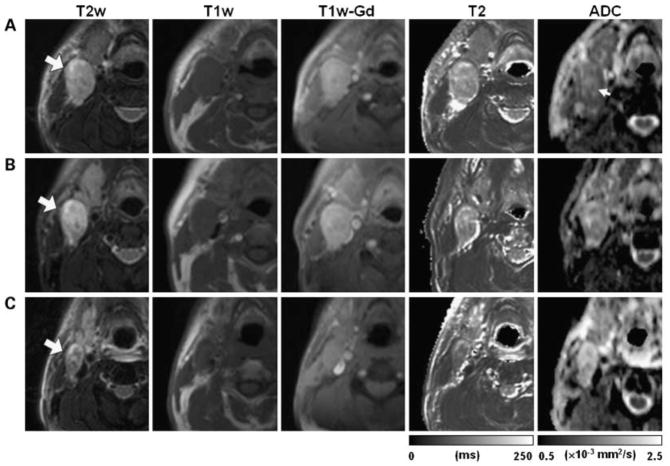
Array of representative images of a HNSCC patient with partial response after treatment. Images in each row are from three measurement time points: pretreatment (A), 1 week after radiation therapy (B), and 2 weeks after the completion of the treatment (C). Large arrows, same metastatic nodal mass that was followed through the treatment course; small arrow, central region of the mass with ADC higher than the rim. (From Kim S, Loevner L, Quon H, et al. Diffusion-weighted magnetic resonance imaging for predicting and detecting early response to chemoradiation therapy of squamous cell carcinomas of the head and neck. Clinical cancer research : an official journal of the American Association for Cancer Research 2009;15:986–94, with permission.)
Figure 2
Figure 2
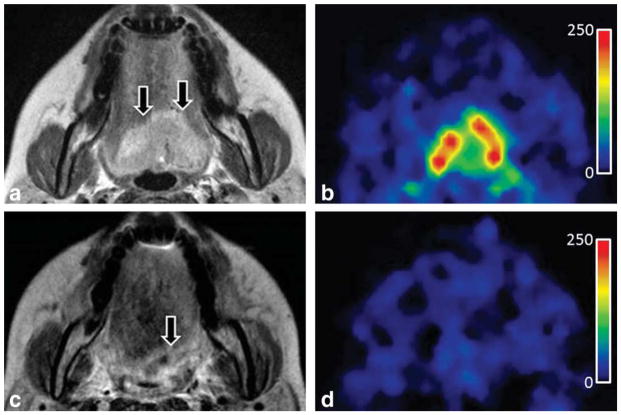
T2-weighted and ASL-derived (tumor blood flow) TBF maps of a patient (41-year-old female) with tongue cancer, before (a,b) and after (c,d) treatment. (b) Pretreatment TBF map shows high blood flow corresponding to the primary lesion. (d) The posttreatment TBF map shows that higher blood flow is not observed in the PTC area compared to the surrounding soft tissue. The 12-month follow-up confirmed that this lesion was not a residual tumor. (From Fujima N, Kudo K, Yoshida D, et al. Arterial spin labeling to determine tumor viability in head and neck cancer before and after treatment. J Magn Reson Imaging 2014;40:920–8, with permission.)
Figure 3
Figure 3
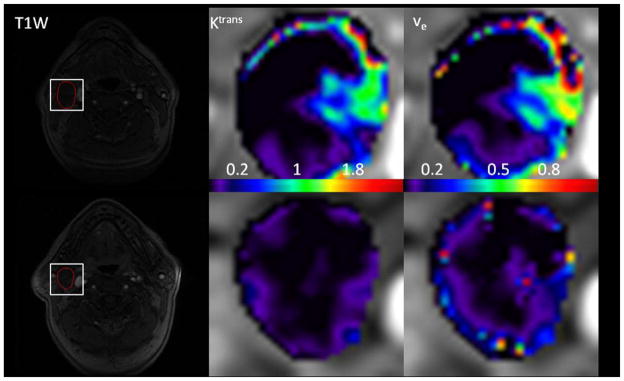
Pretreatment and intra-treatment DCE-MRI images of (a) a patient with locoregional control (male, 63y). The top row shows pretreatment images, and the bottom row shows images from the intra-treatment stage. From left to right, the columns show a T1-weighted image, Ktrans (min−1) map, and ve map. The white rectangles delineate the regions of interest (ROIs) at the metastatic nodes. Ktrans and ve maps are zoomed at the locations of ROIs (data is from the authors’ clinic).

References

    1. Jemal A, Siegel R, Xu J, Ward E. Cancer statistics, 2010. CA: a cancer journal for clinicians. 2010;60:277–300. - PubMed
    1. Vokes EE, Weichselbaum RR, Lippman SM, Hong WK. Head and neck cancer. The New England journal of medicine. 1993;328:184–94. - PubMed
    1. Jansen JF, Koutcher JA, Shukla-Dave A. Non-invasive imaging of angiogenesis in head and neck squamous cell carcinoma. Angiogenesis. 2010;13:149–60. - PMC - PubMed
    1. Stephen RM, Gillies RJ. Promise and progress for functional and molecular imaging of response to targeted therapies. Pharmaceutical research. 2007;24:1172–85. - PubMed
    1. Chawla S, Kim S, Wang S, Poptani H. Diffusion-weighted imaging in head and neck cancers. Future oncology. 2009;5:959–75. - PMC - PubMed

Publication types

MeSH terms