


Empowerment of Cancer Survivors Through Information Technology: An Integrative Review
- PMID: 26614438
- PMCID: PMC4704924
- DOI: 10.2196/jmir.4818
Empowerment of Cancer Survivors Through Information Technology: An Integrative Review
Abstract
Background: Patient empowerment may be an effective approach to strengthen the role of cancer survivors and to reduce the burden on health care. However, it is not well conceptualized, notably in oncology. Furthermore, it is unclear to what extent information technology (IT) services can contribute to empowerment of cancer survivors.
Objective: We aim to define the conceptual components of patient empowerment of chronic disease patients, especially cancer survivors, and to explore the contribution of existing and new IT services to promote empowerment.
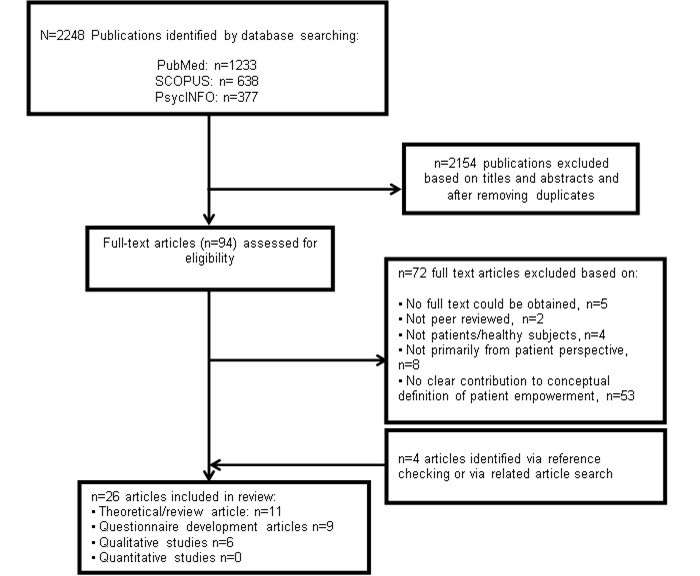
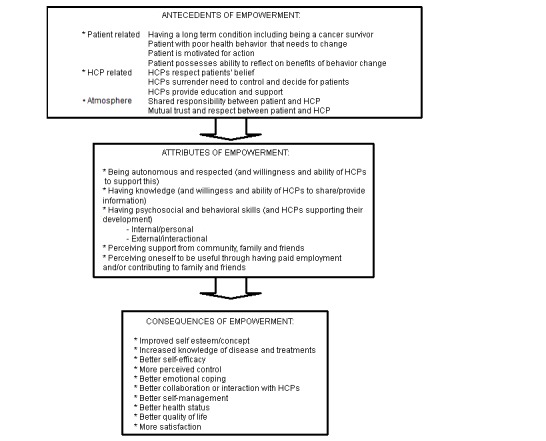
Methods: Electronic databases were searched to identify theoretical and empirical articles regarding empowerment. We extracted and synthesized conceptual components of patient empowerment (ie, attributes, antecedents, and consequences) according to the integrated review methodology. We identified recent IT services for cancer survivors by examining systematic reviews and a proposed inventory of new services, and we related their features and effects to the identified components of empowerment.
Results: Based on 26 articles, we identified five main attributes of patient empowerment: (1) being autonomous and respected, (2) having knowledge, (3) having psychosocial and behavioral skills, (4) perceiving support from community, family, and friends, and (5) perceiving oneself to be useful. The latter two were specific for the cancer setting. Systematic reviews of IT services and our additional inventory helped us identify five main categories: (1) educational services, including electronic survivorship care plan services, (2) patient-to-patient services, (3) electronic patient-reported outcome (ePRO) services, (4) multicomponent services, and (5) portal services. Potential impact on empowerment included knowledge enhancement and, to a lesser extent, enhancing autonomy and skills. Newly developed services offer promising and exciting opportunities to empower cancer survivors, for instance, by providing tailored advice for supportive or follow-up care based on patients' input.
Conclusions: We identified five main components of empowerment and showed that IT services may especially contribute to empowerment by providing knowledge. The components of empowerment could be used to develop IT services for cancer survivors. It is important to take into account patients' needs, follow up on these needs, and create a service that is attractive and easy to use.
Keywords: Internet; chronic disease; health education; neoplasms; power (psychology); review; technology.
Conflict of interest statement
Conflicts of Interest: None declared.
Figures
References
-
- Coulter A, Collins A. Making Shared Decision-Making a Reality: No Decision About Me, Without Me. London, UK: The King's Fund; 2011. [2015-11-20]. http://www.kingsfund.org.uk/sites/files/kf/Making-shared-decision-making... .
-
- McAllister M, Dunn G, Payne K, Davies L, Todd C. Patient empowerment: The need to consider it as a measurable patient-reported outcome for chronic conditions. BMC Health Serv Res. 2012;12:157. doi: 10.1186/1472-6963-12-157. http://www.biomedcentral.com/1472-6963/12/157 1472-6963-12-157 - DOI - PMC - PubMed
-
- Tsai AC, Morton SC, Mangione CM, Keeler EB. A meta-analysis of interventions to improve care for chronic illnesses. Am J Manag Care. 2005 Aug;11(8):478–488. http://www.ajmc.com/pubMed.php?pii=2921 2921 - PMC - PubMed
Publication types
MeSH terms
LinkOut - more resources
Full Text Sources
Other Literature Sources
