


A systematic review of predictive models for asthma development in children
- PMID: 26615519
- PMCID: PMC4662818
- DOI: 10.1186/s12911-015-0224-9
A systematic review of predictive models for asthma development in children
Abstract
Background: Asthma is the most common pediatric chronic disease affecting 9.6 % of American children. Delay in asthma diagnosis is prevalent, resulting in suboptimal asthma management. To help avoid delay in asthma diagnosis and advance asthma prevention research, researchers have proposed various models to predict asthma development in children. This paper reviews these models.
Methods: A systematic review was conducted through searching in PubMed, EMBASE, CINAHL, Scopus, the Cochrane Library, the ACM Digital Library, IEEE Xplore, and OpenGrey up to June 3, 2015. The literature on predictive models for asthma development in children was retrieved, with search results limited to human subjects and children (birth to 18 years). Two independent reviewers screened the literature, performed data extraction, and assessed article quality.
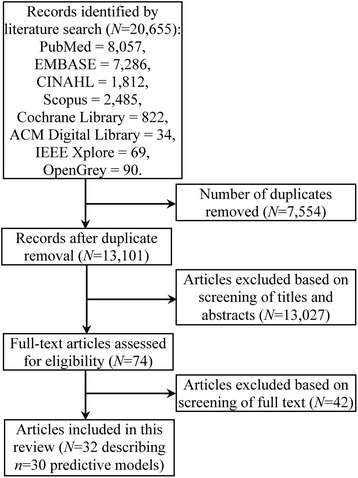
Results: The literature search returned 13,101 references in total. After manual review, 32 of these references were determined to be relevant and are discussed in the paper. We identify several limitations of existing predictive models for asthma development in children, and provide preliminary thoughts on how to address these limitations.
Conclusions: Existing predictive models for asthma development in children have inadequate accuracy. Efforts to improve these models' performance are needed, but are limited by a lack of a gold standard for asthma development in children.
Figures
References
-
- Roemer M. Health care expenditures for the five most common children’s conditions, 2008: estimates for U.S. civilian noninstitutionalized children, ages 0–17. MEPS statistical brief #349. Rockville, MD: AHRQ; 2011.
-
- Malveaux FJ. The state of childhood asthma: introduction. Pediatrics. 2009;123(Suppl 3):S129–S130. - PubMed
-
- Akinbami LJ, Moorman JE, Liu X. Asthma prevalence, health care use, and mortality: United States, 2005–2009. Natl Health Stat Report. 2011;32:1–14. - PubMed
-
- Akinbami LJ, Moorman JE, Bailey C, Zahran HS, King M, Johnson CA, et al. Trends in asthma prevalence, health care use, and mortality in the United States, 2001–2010. NCHS Data Brief. 2012;94:1–8. - PubMed
-
- Vargas PA, Simpson PM, Bushmiaer M, Goel R, Jones CA, Magee JS, et al. Symptom profile and asthma control in school-aged children. Ann Allergy Asthma Immunol. 2006;96(6):787–793. - PubMed
Publication types
MeSH terms
LinkOut - more resources
Full Text Sources
Other Literature Sources
Medical
