


Elevated plasma oxytocin levels in children with Prader-Willi syndrome compared with healthy unrelated siblings
- PMID: 26615966
- PMCID: PMC6679917
- DOI: 10.1002/ajmg.a.37488
Elevated plasma oxytocin levels in children with Prader-Willi syndrome compared with healthy unrelated siblings
Abstract
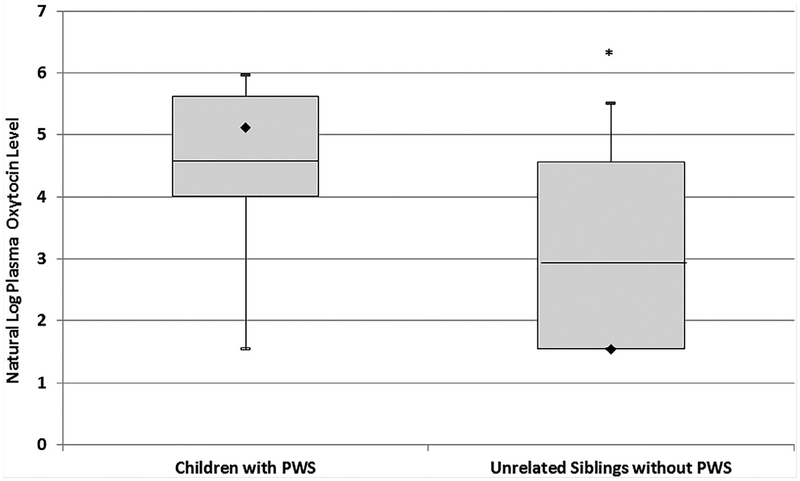
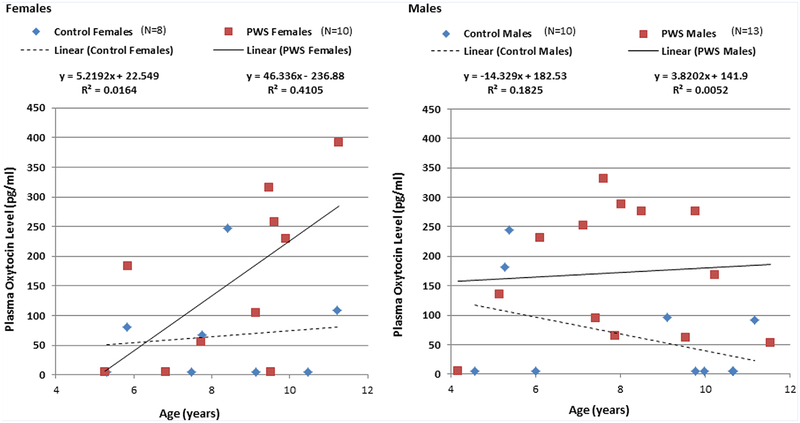
Prader-Willi syndrome (PWS) is a rare genetic disorder associated with distinct abnormal behaviors including hyperphagia, profound social deficits, and obsessive-compulsive tendencies. PWS males showed reduced oxytocin receptor (OTR) gene expression and density in the hypothalamic paraventricular nucleus that may play a role in PWS psychopathology. Oxytocin is an anorexigenic neuropeptide similar to vasopressin that is associated with social cognition and obsessive-compulsive behavior. To evaluate oxytocin biology in PWS, we examined overnight fasting plasma oxytocin levels in 23 children with PWS (mean ± SD age: 8.2 ± 2.0 year) having genetic confirmation and 18 age matched healthy unrelated siblings without PWS (mean ± SD age: 8.2 ± 2.3 year) and a similar gender ratio under the same clinical assessments, specimen processing and laboratory conditions. Multiplex immune assays were carried out using the Milliplex Human Neuropeptide Magnetic panel and the Luminex system. Natural log-transformed oxytocin levels were analyzed using general linear model adjusting for diagnosis, gender, age and body mass index (BMI). Oxytocin plasma levels were significantly elevated in children with PWS (168 ± 121 pg/ml) compared with unrelated and unaffected siblings without the diagnosis of PWS (64.8 ± 83.8 pg/ml, F = 8.8, P < 0.01) and the diagnosis of PWS predicted oxytocin level (F = 9.5, P < 0.003) in controlled regression analysis with an overall model fit R(2) = 0.33 (P < 0.01). The symptoms of hyperphagia, anxiety and repetitive behaviors classically seen in PWS may be related to the disruption of oxytocin responsivity or feedback in the hypothalamic paraventricular nucleus possibly influencing vasopressin signaling. Further study is needed to characterize oxytocin function in PWS.
Keywords: abnormal eating and social behavior; children with Prader-Willi syndrome; healthy unrelated siblings; neuropeptide; oxytocin.
© 2015 Wiley Periodicals, Inc.
Conflict of interest statement
Conflict of interest: None.
Figures
References
-
- Arletti R, Benelli A, Bertolini A. 1989. Influence of oxytocin on feeding behavior in the rat. Peptides 10:89–93. - PubMed
Publication types
MeSH terms
Substances
Grants and funding
LinkOut - more resources
Full Text Sources
Other Literature Sources
Medical
