Review
. 2016 Apr;73(7):1365-79.
doi: 10.1007/s00018-015-2101-1. Epub 2015 Nov 30.

Current disease modifying approaches to treat Parkinson's disease

Affiliations
Review

Current disease modifying approaches to treat Parkinson's disease

Dan Lindholm et al. Cell Mol Life Sci. 2016 Apr.

Abstract

Parkinson's disease (PD is a progressive neurological disorder characterized by the degeneration and death of midbrain dopamine and non-dopamine neurons in the brain leading to motor dysfunctions and other symptoms, which seriously influence the quality of life of PD patients. The drug L-dopa can alleviate the motor symptoms in PD, but so far there are no rational therapies targeting the underlying neurodegenerative processes. Despite intensive research, the molecular mechanisms causing neuronal loss are not fully understood which has hampered the development of new drugs and disease-modifying therapies. Neurotrophic factors are by virtue of their survival promoting activities attract candidates to counteract and possibly halt cell degeneration in PD. In particular, studies employing glial cell line-derived neurotrophic factor (GDNF) and its family member neurturin (NRTN), as well as the recently described cerebral dopamine neurotrophic factor (CDNF) and the mesencephalic astrocyte-derived neurotrophic factor (MANF) have shown positive results in protecting and repairing dopaminergic neurons in various models of PD. Other substances with trophic actions in dopaminergic neurons include neuropeptides and small compounds that target different pathways impaired in PD, such as increased cell stress, protein handling defects, dysfunctional mitochondria and neuroinflammation. In this review, we will highlight the recent developments in this field with a focus on trophic factors and substances having the potential to beneficially influence the viability and functions of dopaminergic neurons as shown in preclinical or in animal models of PD.

Keywords: Dopamine neurons; ER stress; Mitochondria; Neuroinflammation; Neuropeptides; Neurotrophic factors; Protein aggregation; α-Synuclein.


Figures
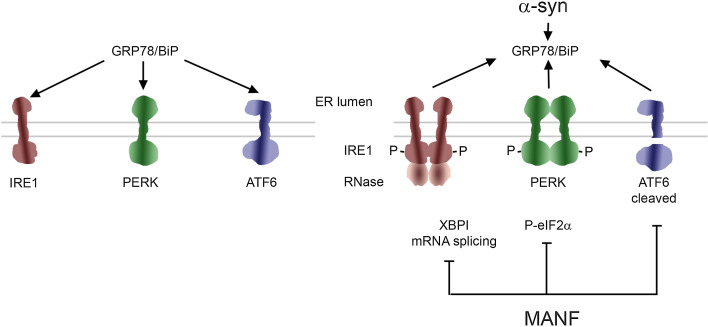
Fig. 1
Fig. 1
Unfolded protein response and ER stress signaling pathways in PD. The unfolded protein response (UPR) is a conserved pathway for regulating protein homeostasis in the cell and it is controlled by the chaperon GRP78/BIP protein complex in the ER (left). There are three signaling pathways (IRE1, PERK and ATF6 for detail see text) for UPR that become activated under conditions of cell stress, following dysregulation of cell calcium and accumulation of misfolded or mutant disease-causing proteins such as α-synuclein (α-syn) in the ER (right). Initially the activated UPR signaling is neuroprotective, but prolonged UPR causes ER stress that leads to activation of cell death pathways. MANF as a novel neurotrophic factor in the ER, reduces ER stress and can restore homeostasis and counteract cell death. The precise mechanisms by which α-syn induces ER stress and the action of MANF in cells are under investigations
Fig. 2
Fig. 2
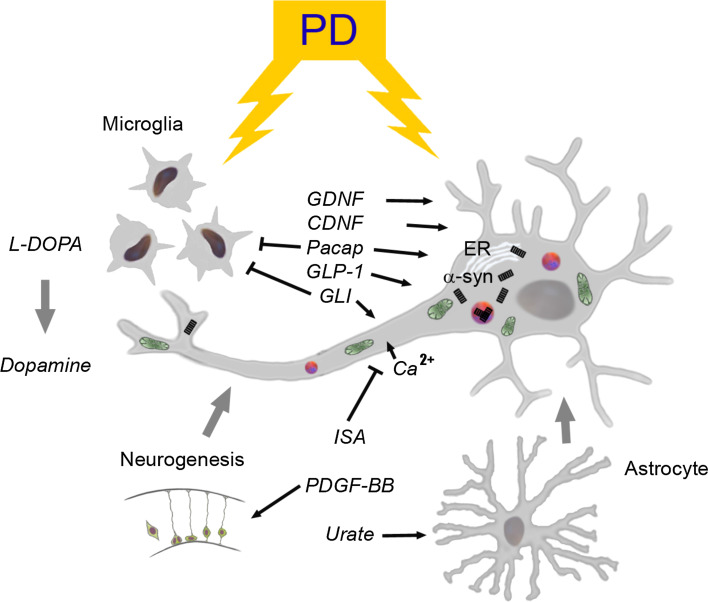
Neurotrophic approaches and cellular pathways in PD. Pathophysiological events leading to PD are complex and involve several cellular pathways associated with the disease progression as depicted here. L-dopa is used for treatment of PD to restore levels of dopamine in the brain but leads to severe dyskinesia by time. PD is characterized by the presence of cytoplasmic inclusions called Lewy body and Lewy neurites (shown as red circles) that contain ubiquitin and misfolded α-synuclein (α-syn) (black rectangles). Currents drugs and disease-modifying substances launched for neuroprotection in PD may act through one or several cellular pathways. Depicted here are the drugs that target dopaminergic neuron firing and calcium influx (isradipine), mitochondria (shown in green) and cell metabolism (glitatzone, GLP-1R agonists), ER stress and inflammatory responses (different drugs, neuropeptides). The neuropeptide Pacap influences cell signaling pathways to increase survival and counteract cell degeneration in neurons. The novel neurotrophic factor, CDNF is both neuroprotective and neurorestorative in animal models of PD. PDGF-BB is able to stimulate neurogenesis and favourably influence dopaminergic neurons, and is well tolerated in PD patients (see text). The GLP-1R agonists used in treatment of type-2 diabetes have potentials as disease-modifying drugs in PD but better controlled clinical trials are required to confirm data. Elevation of urate concentrations in brain can be neuroprotective via activation of antioxidant pathways through astrocytes (see text). α-syn α-synuclein, CDNF cerebral dopamine neurotrophic factor, ER endoplasmic reticulum, GDNF glial cell line-derived neurotrophic factor, GLI glitazone, GLP-1R glucagon-like peptide R1 receptor, ISA isradipine, PACAP pituitary adenylate cyclase-activating polypeptide, PD Parkinson’s disease, PDGF-BB platelet-derived growth factor BB isoform

Comment in

References

    1. Klein C, Westenberger A. Genetics of Parkinson’s disease. Cold Spring Harb Perspect Med. 2012;2:a008888. doi: 10.1101/cshperspect.a008888. - DOI - PMC - PubMed
    1. Mullin S, Schapira A. The genetics of Parkinson’s disease. Br Med Bull. 2015;114:39–52. doi: 10.1093/bmb/ldv022. - DOI - PubMed
    1. Henchcliffe C, Beal MF. Mitochondrial biology and oxidative stress in Parkinson disease pathogenesis. Nat Clin Pract Neurol. 2008;4:600–609. doi: 10.1038/ncpneuro0924. - DOI - PubMed
    1. Gupta A, Dawson VL, Dawson TM. What causes cell death in Parkinson’s disease? Ann Neurol. 2008;64(Suppl 2):S3–S15. - PMC - PubMed
    1. Perier C, Vila M. Mitochondrial biology and Parkinson’s disease. Cold Spring Harb Perspect Med. 2012;2:a009332. doi: 10.1101/cshperspect.a009332. - DOI - PMC - PubMed

Publication types

MeSH terms