


Whole body heat stress increases motor cortical excitability and skill acquisition in humans
- PMID: 26616546
- PMCID: PMC4747790
- DOI: 10.1016/j.clinph.2015.11.001
Whole body heat stress increases motor cortical excitability and skill acquisition in humans
Abstract
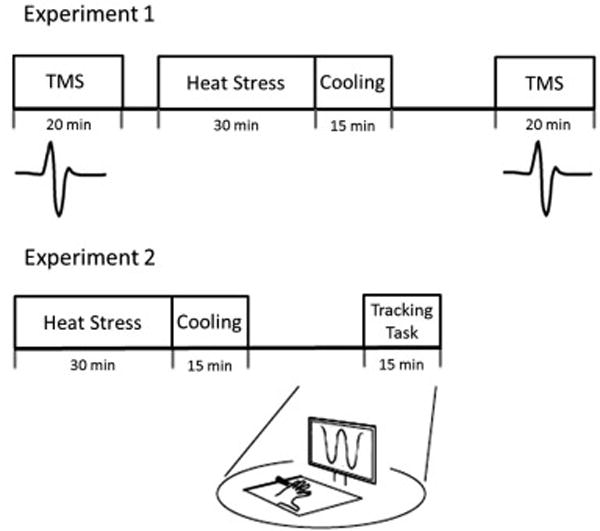
Objective: Vigorous systemic exercise stimulates a cascade of molecular and cellular processes that enhance central nervous system (CNS) plasticity and performance. The influence of heat stress on CNS performance and learning is novel. We designed two experiments to determine whether passive heat stress (1) facilitated motor cortex excitability and (2) improved motor task acquisition compared to no heat stress.
Methods: Motor evoked potentials (MEPs) from the first dorsal interosseus (FDI) were collected before and after 30 min of heat stress at 73 °C. A second cohort of subjects performed a motor learning task using the FDI either following heat or the no heat condition.
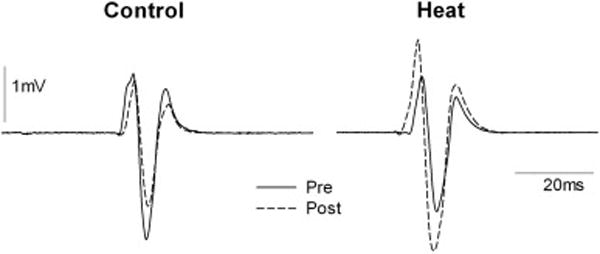
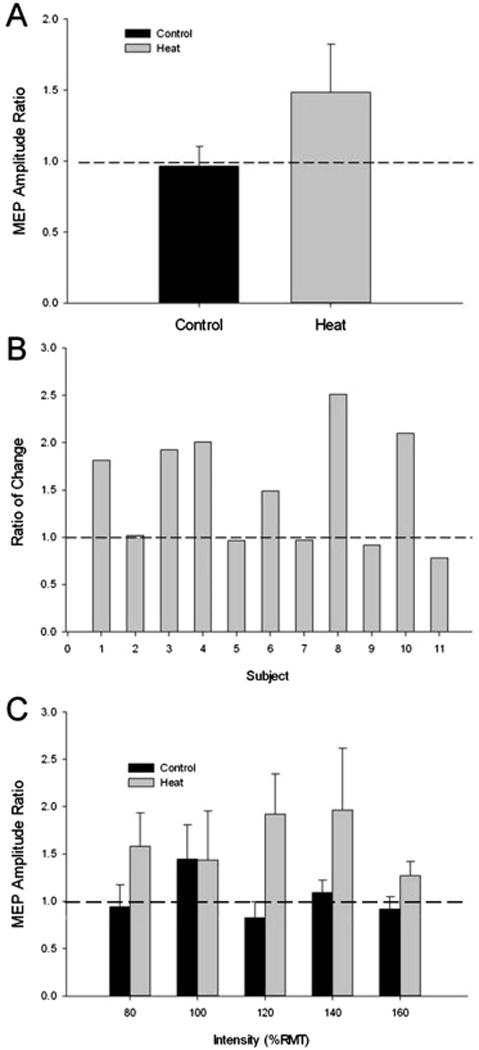
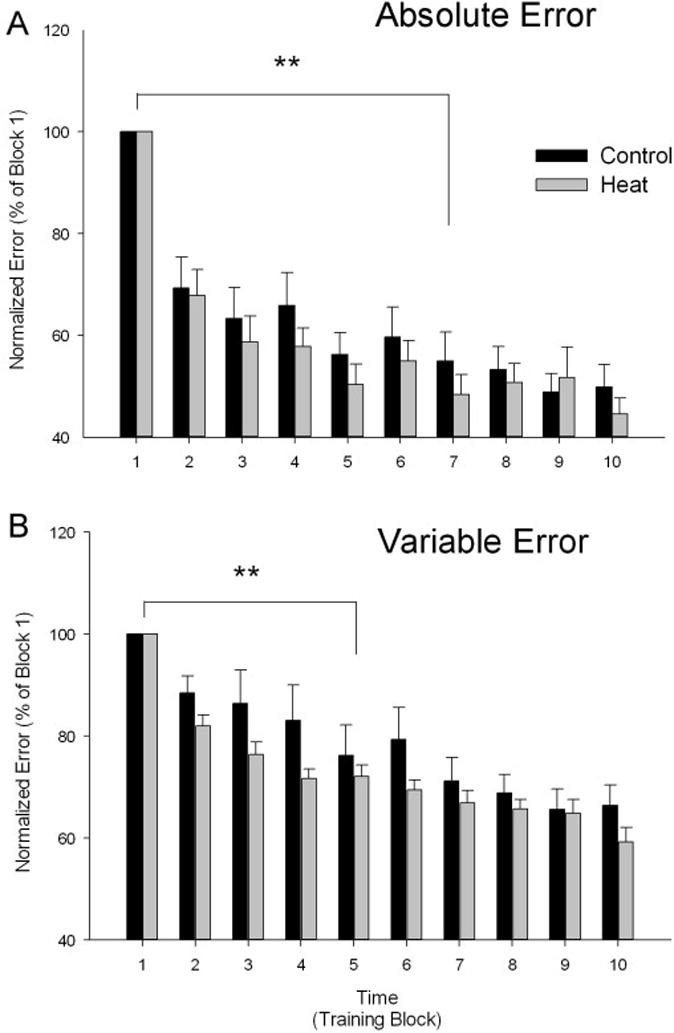
Results: Heat stress increased heart rate to 65% of age-predicted maximum. After heat, mean resting MEP amplitude increased 48% (p<0.05). MEP stimulus-response amplitudes did not differ according to stimulus intensity. In the second experiment, heat stress caused a significant decrease in absolute and variable error (p<0.05) during a novel movement task using the FDI.
Conclusions: Passive environmental heat stress (1) increases motor cortical excitability, and (2) enhances performance in a motor skill acquisition task.
Significance: Controlled heat stress may prime the CNS to enhance motor skill acquisition during rehabilitation.
Keywords: Cortical excitability; Heat stress; Motor learning.
Copyright © 2015 International Federation of Clinical Neurophysiology. Published by Elsevier Ireland Ltd. All rights reserved.
Conflict of interest statement
None of the authors have potential conflicts of interest to be disclosed.
Figures
References
-
- Adlard PA, Engesser-Cesar C, Cotman CW. Mild stress facilitates learning and exercise improves retention in aged mice. Exp Gerontol. 2011;46:53–9. - PubMed
-
- Antal A, Chaieb L, Moliadze V, Monte-Silva K, Poreisz C, Thirugnanasambandam N, et al. Brain-derived neurotrophic factor (BDNF) gene polymorphisms shape cortical plasticity in humans. Brain Stimul. 2010;3:230–7. - PubMed
-
- Baecke JA, Burema J, Frijters JE. A short questionnaire for the measurement of habitual physical activity in epidemiological studies. Am J Clin Nutr. 1982;36:936–42. - PubMed
-
- Bakken RC, Carey JR, Di Fabio RP, Erlandson TJ, Hake JL, Intihar TW. Effect of aerobic exercise on tracking performance in elderly people: a pilot study. Phys Ther. 2001;81:1870–9. - PubMed
-
- Berchtold NC, Chinn G, Chou M, Kesslak JP, Cotman CW. Exercise primes a molecular memory for brain-derived neurotrophic factor protein induction in the rat hippocampus. Neuroscience. 2005;133:853–61. - PubMed
Publication types
MeSH terms
Grants and funding
LinkOut - more resources
Full Text Sources
Other Literature Sources
