. 2015 Sep 1;8(9):11414-20.
eCollection 2015.

Long non-coding RNA HOTTIP is up-regulated and associated with poor prognosis in patients with osteosarcoma

Affiliations

Long non-coding RNA HOTTIP is up-regulated and associated with poor prognosis in patients with osteosarcoma

Fan Li et al. Int J Clin Exp Pathol. .

Abstract

Long non-coding RNAs (lncRNAs) have been shown to play key roles in cancer development and progression. In this study, we focused on lncRNA HOTTIP and investigated its expression pattern, clinical significance, and biological function in osteosarcoma (OS). In the present study, lncRNA HOTTIP expression in OS tissues was examined and its correlation with clinicopathological features and patient prognosis was analyzed. In vitro assays were performed to understand the biological roles of lncRNA HOTTIP in OS progression. In the study, we found that HOTTIP expression was up-regulated in OS tissues, and correlated with advanced clinical stage and distant metastasis. OS patients with high HOTTIP expression level had poorer overall survival than those with low HOTTIP expression. Multivariable Cox proportional hazards regression analysis suggested that increased HOTTIP expression was an independent prognostic factor of overall survival in OS patients. Moreover, the results of in vitro assays showed that the suppression of HOTTIP in OS cells significantly reduced cell proliferation, migration and invasion ability. Our study demonstrated that lncRNA HOTTIP play critical roles in OS progression and could represent a novel prognostic marker and potential therapeutic target in OS patients.

Keywords: HOTTIP; Osteosarcoma; long non-coding RNAs; prognosis.


Figures
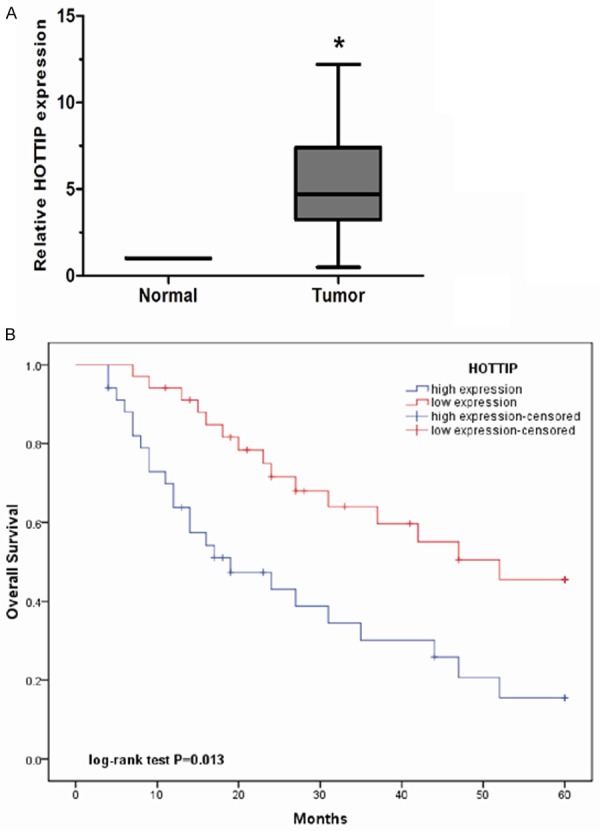
Figure 1
Figure 1
Expression of HOTTIP was up-regulated in OS. A. The relative expression of HOTTIP was measured by qRT-PCR in 68 OS tissues and paired adjacent non-tumor tissues. The expression of HOTTIP was calculated with the 2-ΔΔCt method using GAPDH levels for normalization. B. Kaplan-Meier plots showed overall survival according to the level of HOTTIP in OS patients who underwent surgery. The data represent the mean ± SD of three independent experiments. *P<0.05.
Figure 2
Figure 2
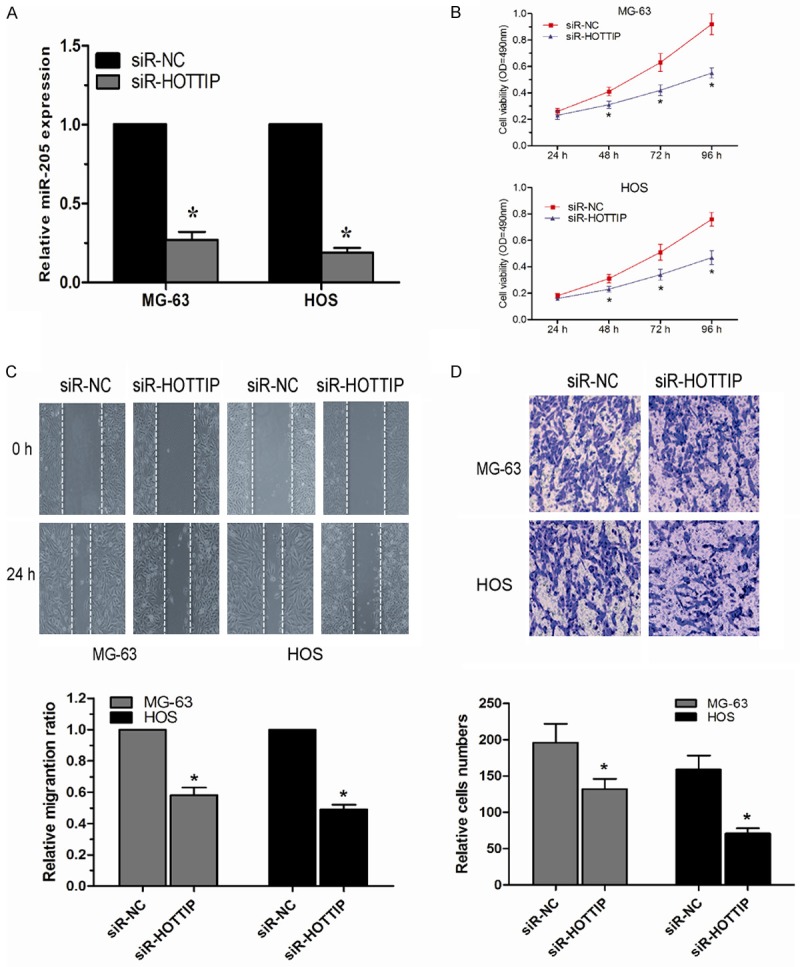
The knockdown of HOTTIP inhibited OS cell proliferation, migration and invasion. A. qRT-PCR revealed that HOTTIP expression was efficiently knocked down by treatment with siR-HOTTIP in MG-63 and HOS cells. B. Suppression of HOTTIP in MG-63 and HOS cells significantly reduced their proliferative capacities, as determined by MTT assay. C. Knockdown of HOTTIP reduced migration capacities of MG-63 and HOS cells, as determined by scratch assay. D. Decreased expression of HOTTIP inhibited invasion abilities of MG-63 and HOS cells, as determined by transwell invasion assay. The data represent the mean ± SD of three independent experiments. *P<0.05.

References

    1. Jemal A, Bray F, Center MM, Ferlay J, Ward E, Forman D. Global cancer statistics. CA Cancer J Clin. 2011;61:69–90. - PubMed
    1. Mirabello L, Troisi RJ, Savage SA. Osteosarcoma incidence and survival rates from 1973 to 2004: data from the Surveillance, Epidemiology, and End Results Program. Cancer. 2009;115:1531–1543. - PMC - PubMed
    1. Broadhead ML, Clark JC, Myers DE, Dass CR, Choong PF. The molecular pathogenesis of osteosarcoma: a review. Sarcoma. 2011;2011:959248. - PMC - PubMed
    1. Mercer TR, Dinger ME, Mattick JS. Long non-coding RNAs: insights into functions. Nat Rev Genet. 2009;10:155–159. - PubMed
    1. Gibb EA, Brown CJ, Lam WL. The functional role of long non-coding RNA in human carcinomas. Mol Cancer. 2011;10:38. - PMC - PubMed

Substances

LinkOut - more resources