Review
. 2016 Jan 21;141(2):403-15.
doi: 10.1039/c5an01995h.

Aptamers: versatile molecular recognition probes for cancer detection

Affiliations
Review

Aptamers: versatile molecular recognition probes for cancer detection

Hongguang Sun et al. Analyst. .

Abstract

In the past two decades, aptamers have emerged as a novel class of molecular recognition probes comprising uniquely-folded short RNA or single-stranded DNA oligonucleotides that bind to their cognate targets with high specificity and affinity. Aptamers, often referred to as "chemical antibodies", possess several highly desirable features for clinical use. They can be chemically synthesized and are easily conjugated to a wide range of reporters for different applications, and are able to rapidly penetrate tissues. These advantages significantly enhance their clinical applicability, and render them excellent alternatives to antibody-based probes in cancer diagnostics and therapeutics. Aptamer probes based on fluorescence, colorimetry, magnetism, electrochemistry, and in conjunction with nanomaterials (e.g., nanoparticles, quantum dots, single-walled carbon nanotubes, and magnetic nanoparticles) have provided novel ultrasensitive cancer diagnostic strategies and assays. Furthermore, promising aptamer targeted-multimodal tumor imaging probes have been recently developed in conjunction with fluorescence, positron emission tomography (PET), single-photon emission computed tomography (SPECT), and magnetic resonance imaging (MRI). The capabilities of the aptamer-based platforms described herein underscore the great potential they hold for the future of cancer detection. In this review, we highlight the most prominent recent developments in this rapidly advancing field.


Figures
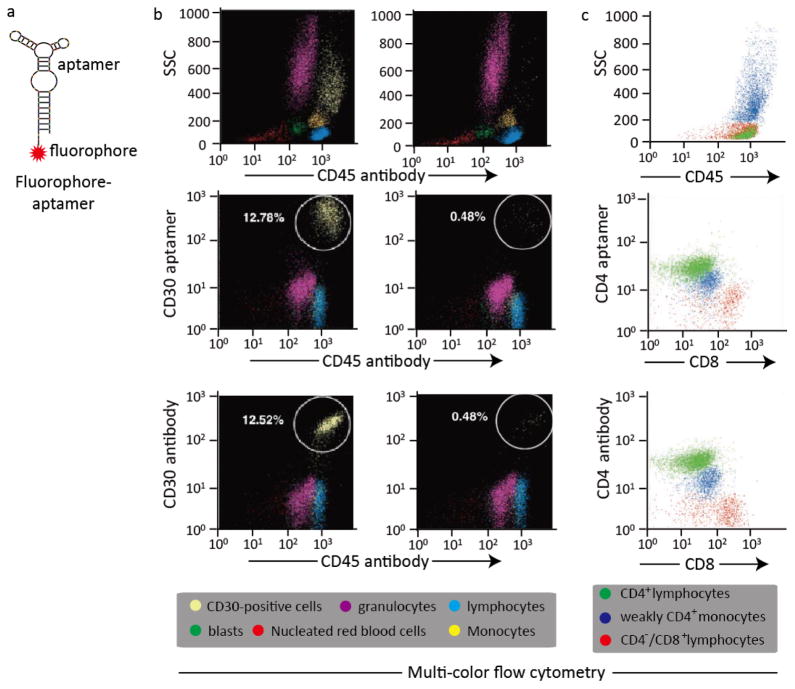
Fig. 1
Fig. 1. Aptamer-based fluorescent probe for multi-color flow cytometric analysis
(a) Design of a simple, sensitive and versatile fluorophore-aptamer probe for cancer cell detection or in vivo tumor imaging; (b) Multi-color flow cytometric analysis of lymphoma cells by aptamer probes and antibodies. CD30-positive lymphoma cells were mixed with fresh normal marrow cells and stained with AmCyan-labeled CD45 antibodies, and Cy5-labeled CD30 aptamers simultaneously, or FITC-labeled CD30 antibodies as standard control. The individual cellular populations in the cell mixture including nucleated red blood cells, blasts, lymphocytes, granulocytes, monocytes and CD30-positive lymphoma cells, were separated and gated according to the side scatter (SSC) and CD45 panels. Multi-color flow cytometric analysis revealed that both aptamer probes and antibodies detected the same population of CD30-positive lymphoma cells with identical specificities and sensitivities; (c) Cells from patients’ pleural fluids were collected and incubated with different fluorophore-labeled CD4 aptamers (CD4 antibodies as standard control), CD8 and CD45 antibody simultaneously. Multi-color flow cytometric analysis revealed that the CD4 aptamers also showed similar staining patterns and numbers for the as-prepared cells as the CD4 antibodies.
Fig. 2
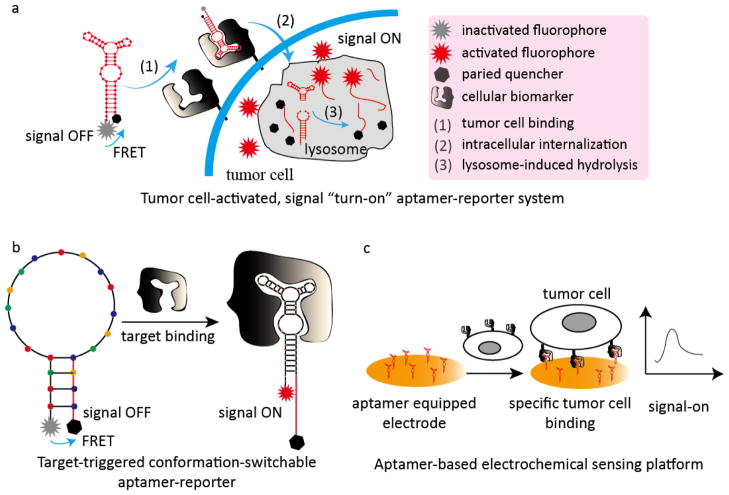
Fig. 2. Representative aptamer-based analytical models for CTC detection
(a) Tumor-cell activated, signal ‘turn-on’ aptamer reporter for one-step high-throughput detection of CTCs in patient whole blood samples; (b) Target-triggered conformation-switchable aptamer reporter for CTC detection; (c) A simple aptamer-based electrochemical sensing platform for CTC detection.
Fig. 3
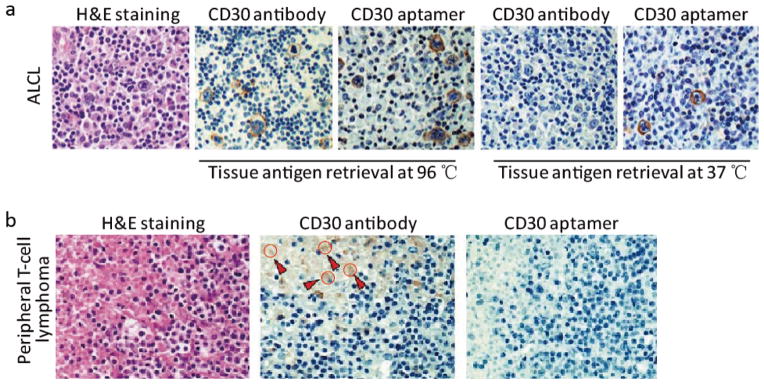
Fig. 3. Aptamer probes for IHC staining of FFPE tumor tissues
(a) Tissue sections of CD30-positive anaplastic large cell lymphoma (ALCL) were immunostained with aptamer probes, or antibodies as standard control. After antigen retrieval at 37 °C and probing for 20 min, tissue sections were probed with aptamers and lymphoma cells were specifically immunostained. In contrast, antibody immunostaining of lymphoma cells required higher antigen retrieval temperature (97 °C) for a long probing time (90 min); (b) Aptamer probes showed non-specific staining (brown color) in the tumor necrotic area compared to the antibody stain (depicted with red arrows and circles).
Fig. 4
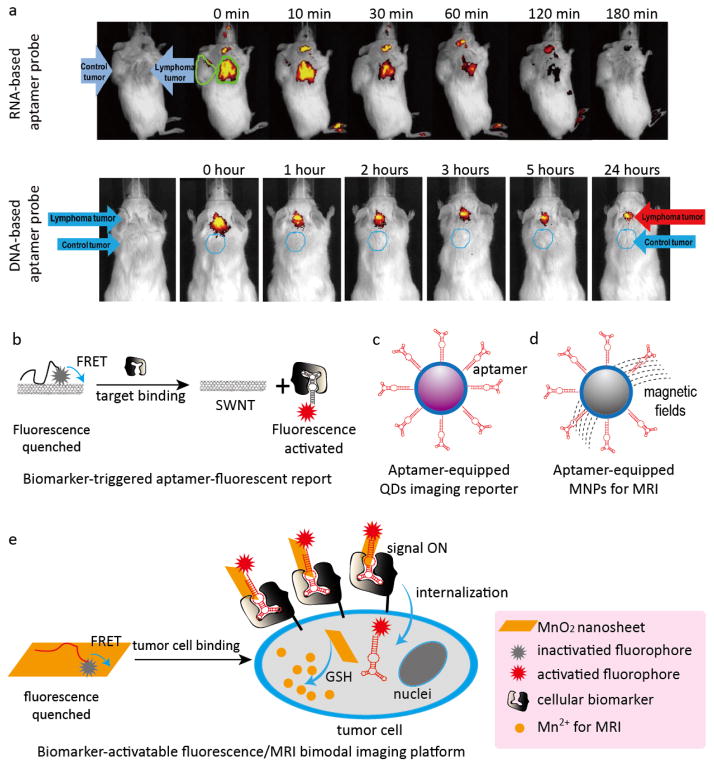
Fig. 4. Representative aptamer-based platforms for in vivo tumor imaging
(a) Studies of RNA- and DNA-based aptamer reporters for in vivo imaging. Both the CD30-positive lymphoma and CD30-negative control tumors were developed in each mouse. RNA-based (upper panel) or DNA-based (lower panel) aptamer probes were systemically administered through the tail veins and whole body imaging was carried out. Aptamer probes specifically highlighted lymphoma tumors but did not react with the control tumor present in the same mouse. (b) Target-triggered fluorescence imaging platform based on the principle of FRET for in vivo imaging; (c) Aptamer-targeted QDs for optical imaging; (d) Aptamer-targeted MNPs for MRI; (e) Dual-activatable, aptamer-based fluorescence/MRI bimodal imaging platform.

References

    1. Siegel R, Naishadham D, Jemal A. CA Cancer J Clin. 2013;63:11–30. - PubMed
    1. Zhang X, Soori G, Dobleman TJ, Xiao GG. Expert Rev Mol Diagn. 2014;14:97–106. - PubMed
    1. Souriau C, Hudson PJ. Expert Opin Biol Ther. 2003;3:305–318. - PubMed
    1. Sun H, Zhu X, Lu PY, Rosato RR, Tan W, Zu Y. Mol Ther Nucleic Acids. 2014;3:e182. - PMC - PubMed
    1. Ellington AD, Szostak JW. Nature. 1990;346:818–822. - PubMed

Publication types

LinkOut - more resources