International and Interdisciplinary Identification of Health Care Transition Outcomes
- PMID: 26619178
- PMCID: PMC6345570
- DOI: 10.1001/jamapediatrics.2015.3168
International and Interdisciplinary Identification of Health Care Transition Outcomes
Abstract
Importance: There is a lack of agreement on what constitutes successful outcomes for the process of health care transition (HCT) among adolescent and young adults with special health care needs.
Objective: To present HCT outcomes identified by a Delphi process with an interdisciplinary group of participants.
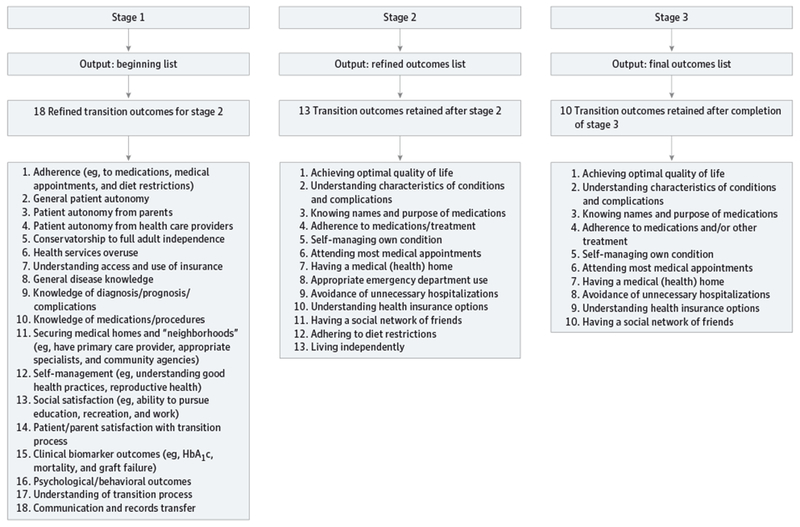
Design, setting, and participants: A Delphi method involving 3 stages was deployed to refine a list of HCT outcomes. This 18-month study (from January 5, 2013, of stage 1 to July 3, 2014, of stage 3) included an initial literature search, expert interviews, and then 2 waves of a web-based survey. On this survey, 93 participants from outpatient, community-based, and primary care clinics rated the importance of the top HCT outcomes identified by the Delphi process. Analyses were performed from July 5, 2014, to December 5, 2014.
Exposures: Health care transition outcomes of adolescents and young adults with special health care needs.
Main outcomes and measures: Importance ratings of identified HCT outcomes rated on a Likert scale from 1 (not important) to 9 (very important).
Results: The 2 waves of surveys included 117 and 93 participants as the list of outcomes was refined. Transition outcomes were refined by the 3 waves of the Delphi process, with quality of life being the highest-rated outcome with broad agreement. The 10 final outcomes identified included individual outcomes (quality of life, understanding the characteristics of conditions and complications, knowledge of medication, self-management, adherence to medication, and understanding health insurance), health services outcomes (attending medical appointments, having a medical home, and avoidance of unnecessary hospitalization), and a social outcome (having a social network). Participants indicated that different outcomes were likely needed for individuals with cognitive disabilities.
Conclusions and relevance: Quality of life is an important construct relevant to HCT. Future research should identify valid measures associated with each outcome and further explore the role that quality of life plays in the HCT process. Achieving consensus is a critical step toward the development of reliable and objective comparisons of HCT outcomes across clinical conditions and care delivery locations.
Conflict of interest statement
Figures
Comment in
-
Improving Health Care Transition Services: Just Grow Up, Will You Please.JAMA Pediatr. 2016 Mar;170(3):197-9. doi: 10.1001/jamapediatrics.2015.3268. JAMA Pediatr. 2016. PMID: 26618900 No abstract available.
References
-
- Blum RW, Garell D, Hodgman CH, et al. Transition from child-centered to adult health-care systems for adolescents with chronic conditions: a position paper of the Society for Adolescent Medicine. J Adolesc Health. 1993;14(7):570–576. - PubMed
-
- Schwartz LA, Daniel LC, Brumley LD, Barakat LP, Wesley KM, Tuchman LK. Measures of readiness to transition to adult health care for youth with chronic physical health conditions: a systematic review and recommendations for measurement testing and development. J Pediatr Psychol. 2014;39(6):588–601. - PMC - PubMed
-
- Fredericks EM, Magee JC, Opipari-Arrigan L, Shieck V, Well A, Lopez MJ. Adherence and health-related quality of life in adolescent liver transplant recipients. Pediatr Transplant. 2008;12 (3):289–299. - PubMed
-
- LaGreca AM, Follansbee D, Skyler JS. Developmental and behavioral aspects of diabetes management in youngsters. Child Health Care. 1990;19(3):132–139.
-
- Modi AC, Marciel KK, Slater SK, Drotar D, Quittner AL. The influence of parental supervision on medical adherence in adolescents with cystic fibrosis: developmental shifts from pre to late adolescence. Child Health Care. 2008;37(1):78–92.
MeSH terms
Grants and funding
LinkOut - more resources
Full Text Sources
Other Literature Sources
Medical