


Cost-Effectiveness of Peer Counselling for the Promotion of Exclusive Breastfeeding in Uganda
- PMID: 26619338
- PMCID: PMC4664391
- DOI: 10.1371/journal.pone.0142718
Cost-Effectiveness of Peer Counselling for the Promotion of Exclusive Breastfeeding in Uganda
Abstract
Background: Community based breastfeeding promotion programmes have been shown to be effective in increasing breastfeeding prevalence. However, there is limited data on the cost-effectiveness of these programmes in sub-Saharan Africa. This paper evaluates the cost-effectiveness of a breastfeeding promotion intervention targeting mothers and their 0 to 6 month old children.
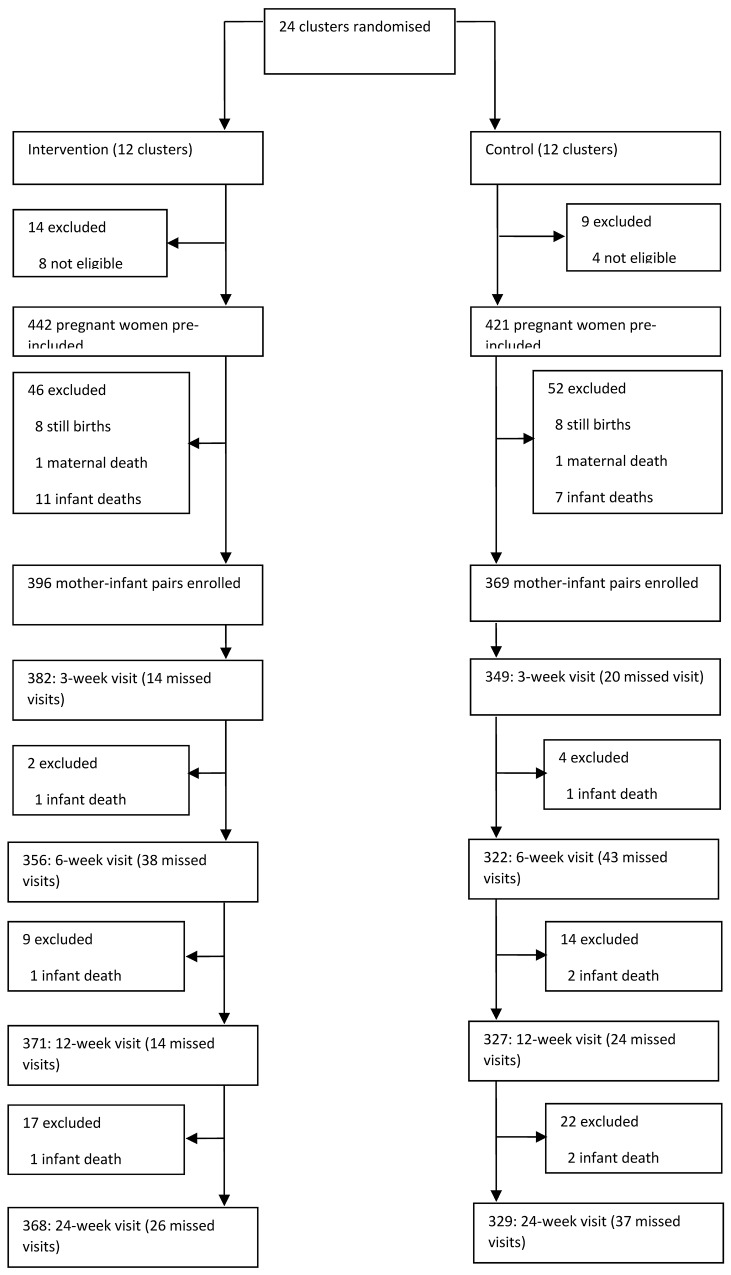
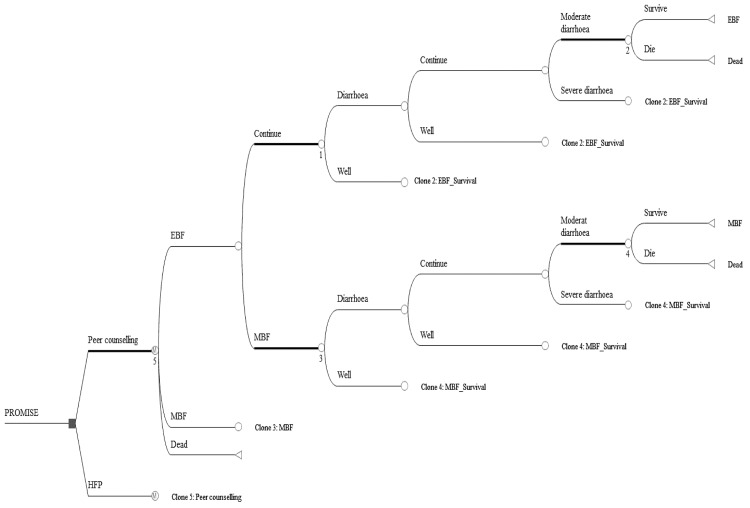
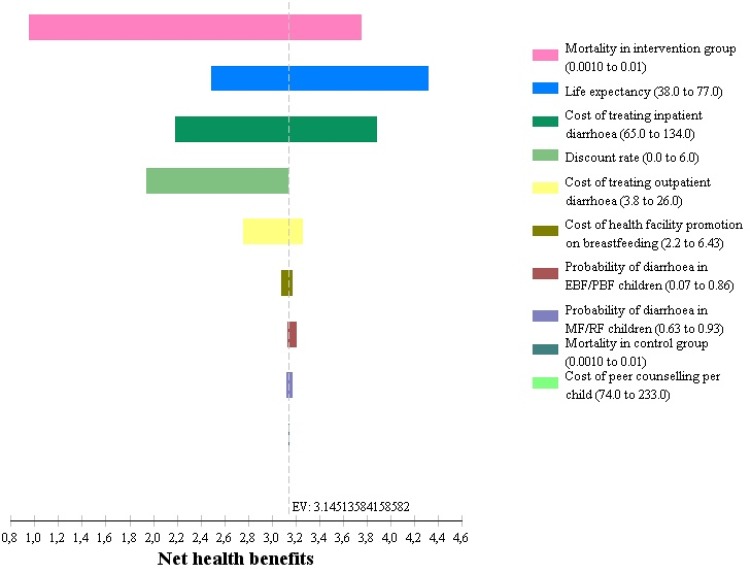
Methods: Data were obtained from a community randomized trial conducted in Uganda between 2006-2008, and supplemented with evidence from several studies in sub-Saharan Africa. In the trial, peer counselling was offered to women in intervention clusters. In the control and intervention clusters, women could access standard health facility breastfeeding promotion services (HFP). Thus, two methods of breastfeeding promotion were compared: community based peer counselling (in addition to HFP) and standard HFP alone. A Markov model was used to calculate incremental cost-effectiveness ratios between the two strategies. The model estimated changes in breastfeeding prevalence and disability adjusted life years. Costs were estimated from a provider perspective. Uncertainty around the results was characterized using one-way sensitivity analyses and a probabilistic sensitivity analysis.
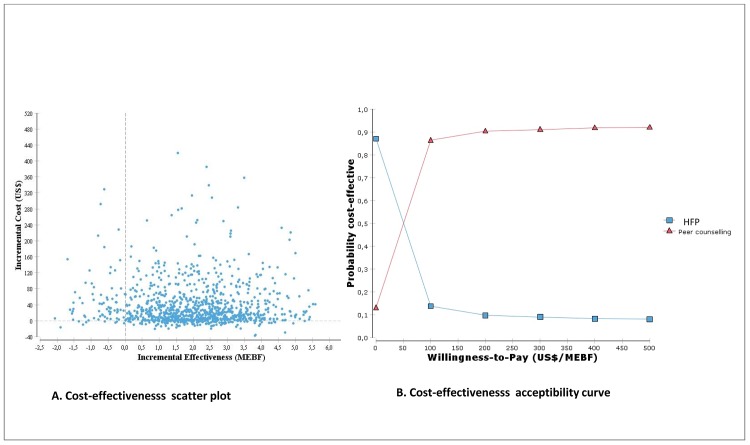
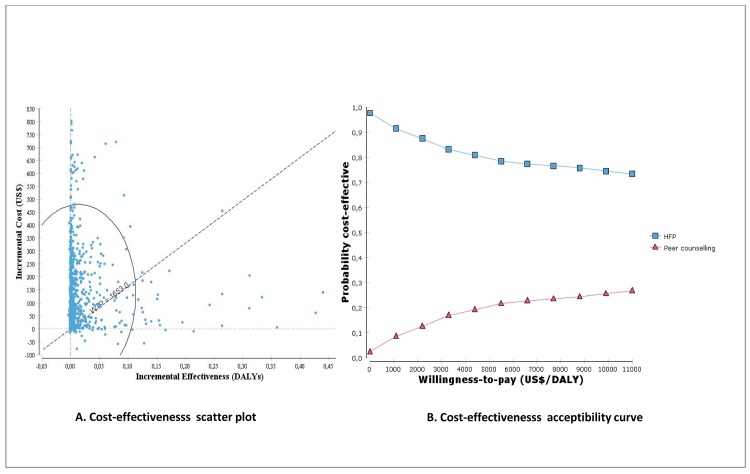
Findings: Peer counselling more than doubled the breastfeeding prevalence as reported by mothers, but there was no observable impact on diarrhoea prevalence. Estimated incremental cost-effectiveness ratios were US$68 per month of exclusive or predominant breastfeeding and U$11,353 per disability adjusted life year (DALY) averted. The findings were robust to parameter variations in the sensitivity analyses.
Conclusions: Our strategy to promote community based peer counselling is unlikely to be cost-effective in reducing diarrhoea prevalence and mortality in Uganda, because its cost per DALY averted far exceeds the commonly assumed willingness-to-pay threshold of three times Uganda's GDP per capita (US$1653). However, since the intervention significantly increases prevalence of exclusive or predominant breastfeeding, it could be adopted in Uganda if benefits other than reducing the occurrence of diarrhoea are believed to be important.
Conflict of interest statement
Figures
References
-
- Arifeen S, Black RE, Antelman G, Baqui A, Caulfield L, Becker S. Exclusive breastfeeding reduces acute respiratory infection and diarrhea deaths among infants in Dhaka slums. Pediatrics. 2001;108(4):E67 Epub 2001/10/03. . - PubMed
-
- Kramer MS, Chalmers B, Hodnett ED, Sevkovskaya Z, Dzikovich I, Shapiro S, et al. Promotion of Breastfeeding Intervention Trial (PROBIT): a randomized trial in the Republic of Belarus. JAMA. 2001;285(4):413–20. Epub 2001/03/10. doi: joc00933 [pii]. . - PubMed
-
- WHO. Global Strategy for Infant and Young Child Feeding. Geneva: WHO, 2003. - PubMed
-
- Mukuria AG, Kothari MT, Abderrahim N. Infant and Young Child Feeding Updates. Calverton, Maryland, USA: ORC Macro, 2006.
Publication types
MeSH terms
LinkOut - more resources
Full Text Sources
Other Literature Sources
Medical
