. 2016 May;184(2):216-27.
doi: 10.1111/cei.12746. Epub 2016 Feb 9.

Chronic mucocutaneous candidiasis: characterization of a family with STAT-1 gain-of-function and development of an ex-vivo assay for Th17 deficiency of diagnostic utility

Affiliations

Chronic mucocutaneous candidiasis: characterization of a family with STAT-1 gain-of-function and development of an ex-vivo assay for Th17 deficiency of diagnostic utility

F Dhalla et al. Clin Exp Immunol. 2016 May.

Abstract

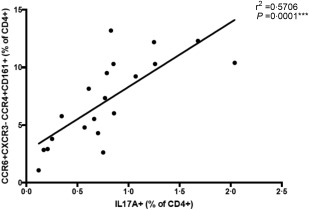
Chronic mucocutaneous candidiasis (CMC) is characterized by recurrent and persistent superficial infections, with Candida albicans affecting the mucous membranes, skin and nails. It can be acquired or caused by primary immune deficiencies, particularly those that impair interleukin (IL)-17 and IL-22 immunity. We describe a single kindred with CMC and the identification of a STAT1 GOF mutation by whole exome sequencing (WES). We show how detailed clinical and immunological phenotyping of this family in the context of WES has enabled revision of disease status and clinical management. Together with analysis of other CMC cases within our cohort of patients, we used knowledge arising from the characterization of this family to develop a rapid ex-vivo screening assay for the detection of T helper type 17 (Th17) deficiency better suited to the routine diagnostic setting than established in-vitro techniques, such as intracellular cytokine staining and enzyme-linked immunosorbent assay (ELISA) using cell culture supernatants. We demonstrate that cell surface staining of unstimulated whole blood for CCR6⁺ CXCR3⁻ CCR4⁺ CD161⁺ T helper cells generates results that correlate with intracellular cytokine staining for IL-17A, and is able to discriminate between patients with molecularly defined CMC and healthy controls with 100% sensitivity and specificity within the cohort tested. Furthermore, removal of CCR4 and CD161 from the antibody staining panel did not affect assay performance, suggesting that the enumeration of CCR6⁺ CXCR3⁻ CD4⁺ T cells is sufficient for screening for Th17 deficiency in patients with CMC and could be used to guide further investigation aimed at identifying the underlying molecular cause.

Keywords: Th17; chemokine receptors; chronic mucocutaneous candidiasis; surface phenotyping.


Figures

Figure 1
Figure 1
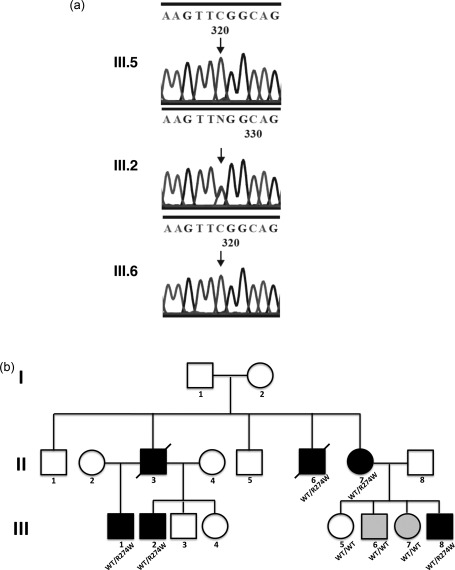
STAT1 mutation in chronic mucocutaneous candidiasis (CMC) family. Whole exome sequencing (WES) identified a CMC‐associated variant in STAT1 (c.C820T) in four of the affected individuals (a). Sanger sequencing confirmed the presence of this variant (and in one additional individual not exome sequenced) with plots shown for an unaffected (III.5), and an affected individual (III.2) and one family member originally misclassified as ‘affected’ (III.6) but found to have wild‐type STAT1, leading to a review of their diagnosis (b). Family pedigree with STAT1 genotype shown; light grey shading denotes individuals originally misclassified as ‘affected’.
Figure 2
Figure 2
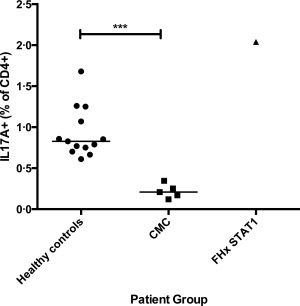
Graph showing significant reduction in the percentage of interleukin (IL)−17A‐producing CD4+ T cells in patients with chronic mucocutaneous candidiasis (CMC) compared to healthy controls after in‐vitro stimulation of peripheral blood mononuclear cells (PBMCs) for 6 h with phorbol myristate acetate (PMA) and ionomycin (P = 0·0002). Patients with CMC included four individuals with STAT1 mutations and one with hyper‐immunoglobulin (Ig)E syndrome (HIGE) syndrome due to signal transducer and activator of transcription‐3 (STAT‐3) deficiency. Also included was a STAT1 wild‐type individual (III.7) with a family history of CMC due to STAT‐1 gain‐of‐function (GOF) (FHx STAT1).
Figure 3
Figure 3
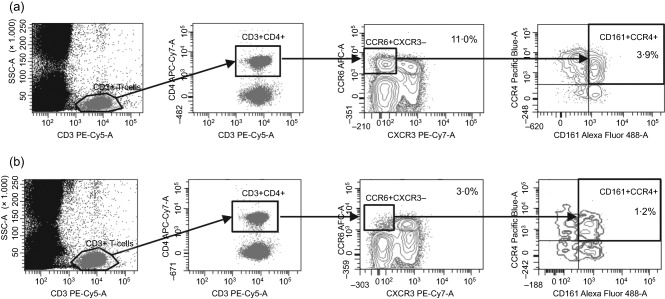
Fluorescence activated cell sorter (FACs) plots depicting gating strategy employed for the detection of CCR6+CXCR3CCR4+CD161+ helper T cells. Cells were gated initially to acquire 30 000 CD3+ events. CD4+ T cells were then selected based on co‐expression of CD3 and CD4. Cells that were positive for CCR6 but negative for CXCR3 were then gated, and finally cells that were double‐positive for CCR4 and CD161 were selected from the CD3+CD4+CCR6CXCR3 T cell population. Sample plots are shown for (a) one healthy control and (b) one patient with CMC due to signal transducer and activator of transcription‐1 (STAT‐1) gain‐of‐function (GOF). The relative counts depicted denote the percentage of CCR6+CXCR3CCR4+CD161+ cells within the CD4+ T cell population.
Figure 4
Figure 4
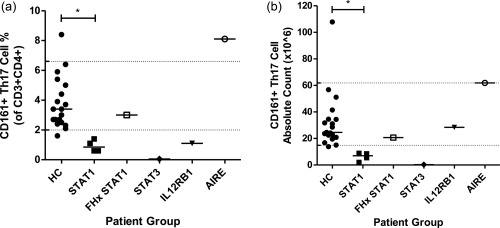
Graphs showing reduction in CCR6+CXCR3CCR4+CD161+ T helper cells in patients with chronic mucocutaneous candidiasis (CMC) compared to healthy controls. (a) Graph showing % of CCR6+CXCR3CCR4+CD161+ cells within the CD4+ T cell population in healthy controls versus individual patient groups. (b) Graph showing absolute counts (×106/l) of CCR6+CXCR3CCR4+CD161+ CD4+ T cells in healthy controls versus individual patient groups. HC = healthy controls; STAT1 = CMC due to STAT1 mutation; FHx STAT1 = STAT1 wild‐type individual (III.7) from the kindred CMC due to signal transducer and activator of transcription‐1 (STAT‐1) gain‐of‐function (GOF); STAT3 = hyper‐immunoglobulin (Ig)E syndrome due to STAT‐3 deficiency; IL 12RB1 = IL‐12RB1 deficiency; AIRE = APS1 due to AIRE deficiency; *P < 0·05.
Figure 5
Figure 5
Correlation plot showing positive correlation (r 2 = 0·5706, P = 0·0001) between the percentage of CCR6+CXCR3CCR4+CD161+ and interleukin (IL)‐17A producing CD4+ T cells measured using paired samples in healthy controls and patients with chronic mucocutaneous candidiasis (CMC).

References

    1. McDonald DR. TH17 deficiency in human disease. J Allergy Clin Immunol 2012; 129:1429–35; quiz 36–7. - PMC - PubMed
    1. Lilic D. Unravelling fungal immunity through primary immune deficiencies. Curr Opin Microbiol 2012; 15:420–6. - PubMed
    1. Engelhardt KR, Grimbacher B. Mendelian traits causing susceptibility to mucocutaneous fungal infections in human subjects. J Allergy Clin Immunol 2012; 129:294–305; quiz 6–7. - PubMed
    1. Ma CS, Chew GY, Simpson N et al Deficiency of Th17 cells in hyper IgE syndrome due to mutations in STAT3. J Exp Med 2008; 205:1551–7. - PMC - PubMed
    1. Milner JD, Brenchley JM, Laurence A et al Impaired T(H)17 cell differentiation in subjects with autosomal dominant hyper‐IgE syndrome. Nature 2008; 452:773–6. - PMC - PubMed

Publication types

MeSH terms