. 2016 Jan 5;113(1):194-9.
doi: 10.1073/pnas.1511905112. Epub 2015 Nov 30.

Neural evidence that three dimensions organize mental state representation: Rationality, social impact, and valence

Affiliations

Neural evidence that three dimensions organize mental state representation: Rationality, social impact, and valence

Diana I Tamir et al. Proc Natl Acad Sci U S A. .

Abstract

How do people understand the minds of others? Existing psychological theories have suggested a number of dimensions that perceivers could use to make sense of others' internal mental states. However, it remains unclear which of these dimensions, if any, the brain spontaneously uses when we think about others. The present study used multivoxel pattern analysis (MVPA) of neuroimaging data to identify the primary organizing principles of social cognition. We derived four unique dimensions of mental state representation from existing psychological theories and used functional magnetic resonance imaging to test whether these dimensions organize the neural encoding of others' mental states. MVPA revealed that three such dimensions could predict neural patterns within the medial prefrontal and parietal cortices, temporoparietal junction, and anterior temporal lobes during social thought: rationality, social impact, and valence. These results suggest that these dimensions serve as organizing principles for our understanding of other people.

Keywords: functional magnetic resonance imaging; mentalizing; multivoxel pattern analysis; social cognition; theory of mind.


Conflict of interest statement

The authors declare no conflict of interest.

Figures
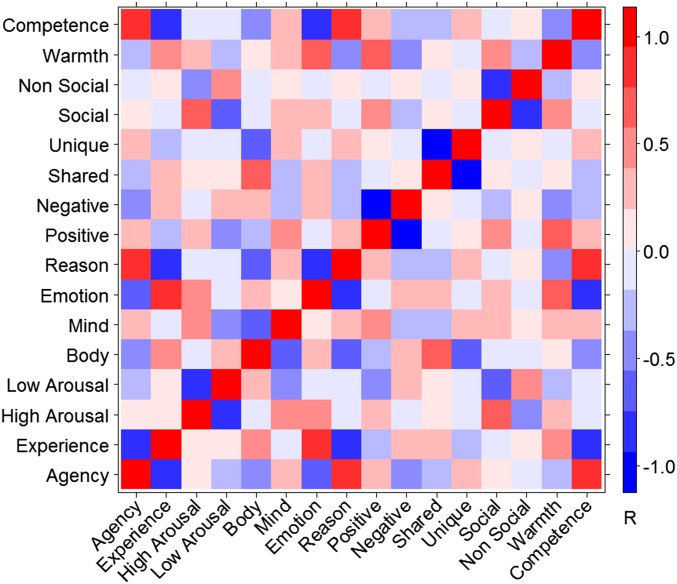
Fig. S1.
Fig. S1.
Correlations between theoretical dimensions. Pearson product-moment correlations between participant ratings of 60 mental states on 16 potential dimensions of mental state representation derived from the existing psychological literature (n = 1,205).
Fig. 1.
Fig. 1.
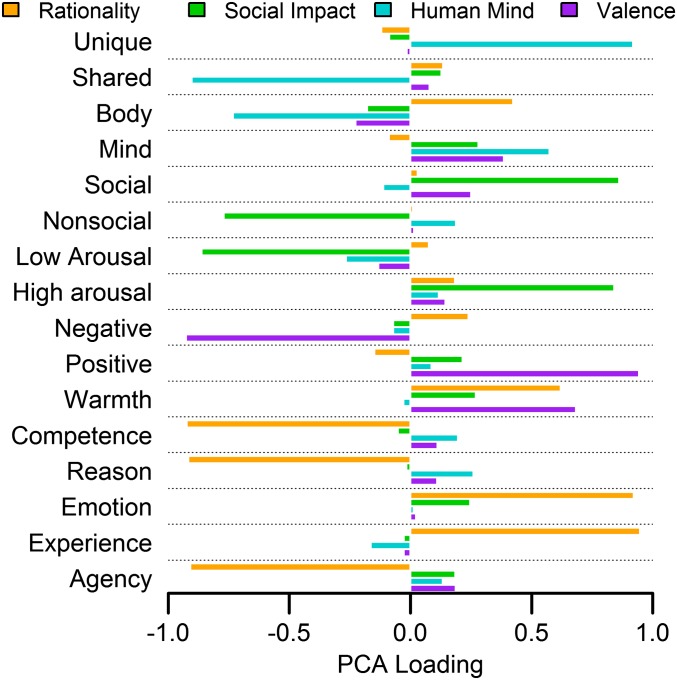
Principal component loadings. Principal component loadings of the 16 existing theoretical dimensions onto the optimal four-dimensional solution.
Fig. 2.
Fig. 2.
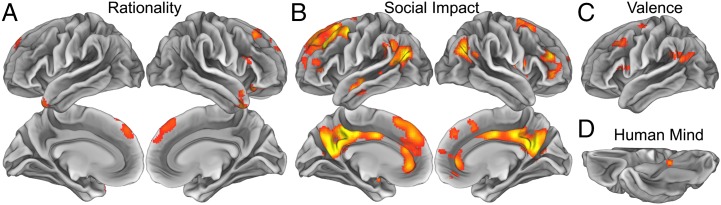
Searchlight results indicating regions sensitive to the (A) rationality, (B) social impact, (C) valence, and (D) human mind of others' mental states. Within the yellow/orange regions, the similarity of patterns elicited by thinking about mental states can be explained in terms of the corresponding social cognitive dimension extracted from existing theories via PCA (P < 0.05, corrected). Representational similarity searchlight analyses were conducted on each participant and combined through one-sample random-effects t tests.
Fig. 3.
Fig. 3.
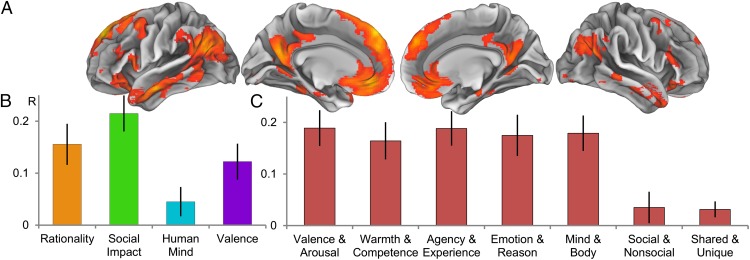
Network-wide representational similarity analysis. (A) Whole brain ANOVA used for feature selection (voxelwise P < 0.0001). Different mental states reliably elicited different levels of univariate activity within these regions. (B) Bar graphs of model fits for dimensions derived via principal component analysis from existing psychological theories. (C) Bar graphs of model fits for existing psychological models. All model fits are given in terms of Pearson product-moment correlations between neural pattern similarity and model predictions, with error bars indicating bootstrapped SEs. Note that bars in B refer to individual dimensions derived via PCA whereas bars in C indicate the performance of full multidimensional theories. The theoretical advantage of the synthetic model presented here can thus be seen by comparing any one bar in C with the combination of the three significant bars in B.
Fig. S2.
Fig. S2.
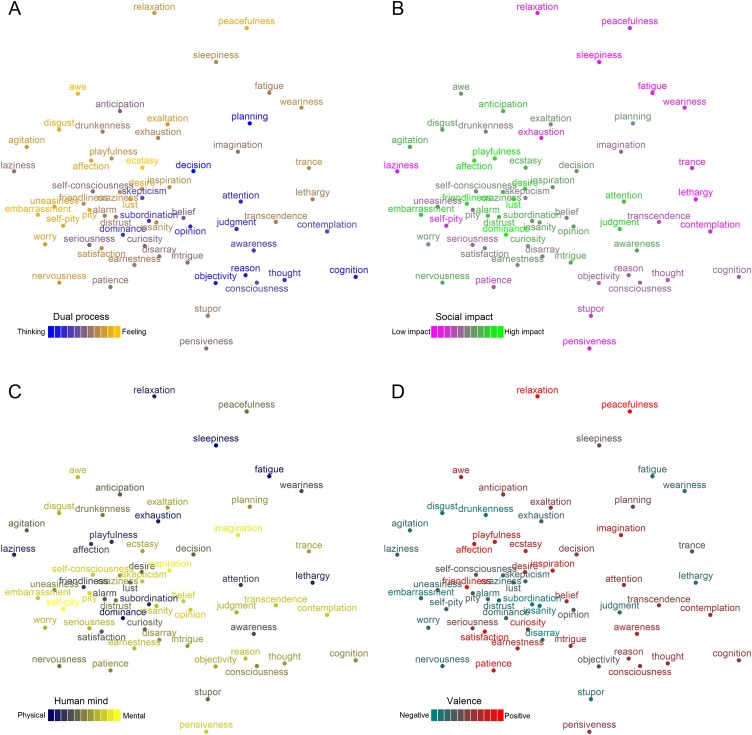
Multidimensional scaling of network-level neural similarity. Proximity between points indicates greater neural pattern similarity within the social brain network. The same 2D scaling is presented in AD, overlaid with each of the four hypothetical dimensions of mental state representation. The 2D scaling is insufficient to fully capture the differences between patterns elicited for each mental state, but associations between neural space and psychological dimension are still visible.
Fig. S3.
Fig. S3.
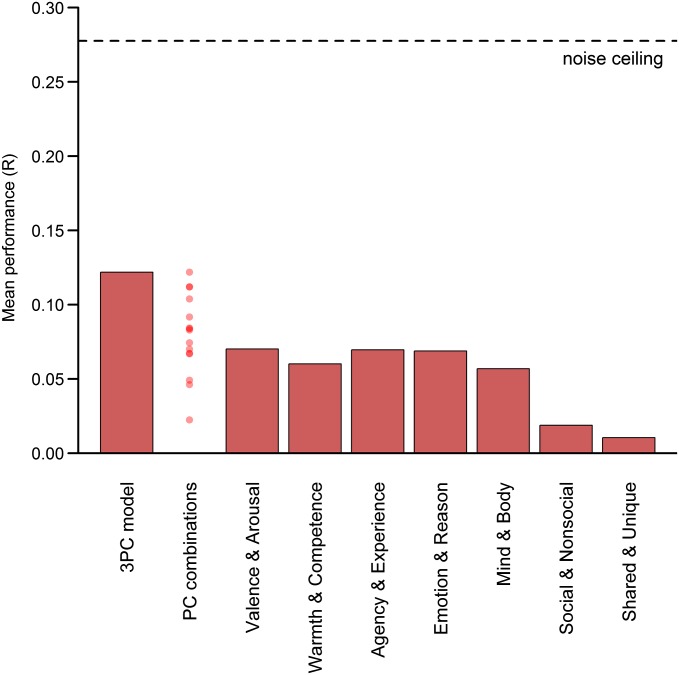
Cross-validated model performance. Bars indicate performance of a representation similarity analysis based on nonnegative least-squares regression. Weights for dimensions within each theory were trained on data from 19 participants. This regression model was then tested by predicting the neural pattern similarity of the left-out participant. Each participant was left out iteratively, and results were averaged across all 20 training-testing combinations. Points in the “PC combinations” column indicate the performance of every possible combination of 1–4 of the 4 PCs. The farthest left bar indicates the performance of the best model, consisting of the PCs rationality, social impact, and valence. The noise ceiling indicates the expected performance of an ideal model for mental state representation.
Fig. 4.
Fig. 4.
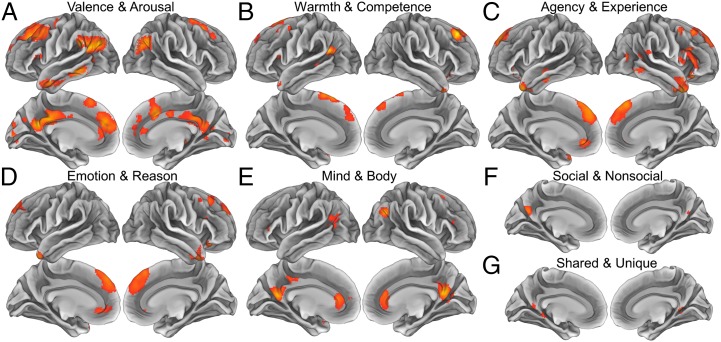
Searchlight results indicating the spatial distribution of mental state representations consistent with (A) the circumplex model of affect, (B) the stereotype content model, (C) the agency and experience model of mind perception, (D) emotion and reason, (E) mind and body, (F) social and nonsocial, and (G) shared with other animals and uniquely human. The similarity of patterns within the yellow/orange regions can be explained by their proximity to each other on the dimensions of the corresponding social cognitive models (P < 0.05 corrected). Searchlight analyses were conducted on each participant and combined through one-sample random-effects t tests.
Fig. S4.
Fig. S4.
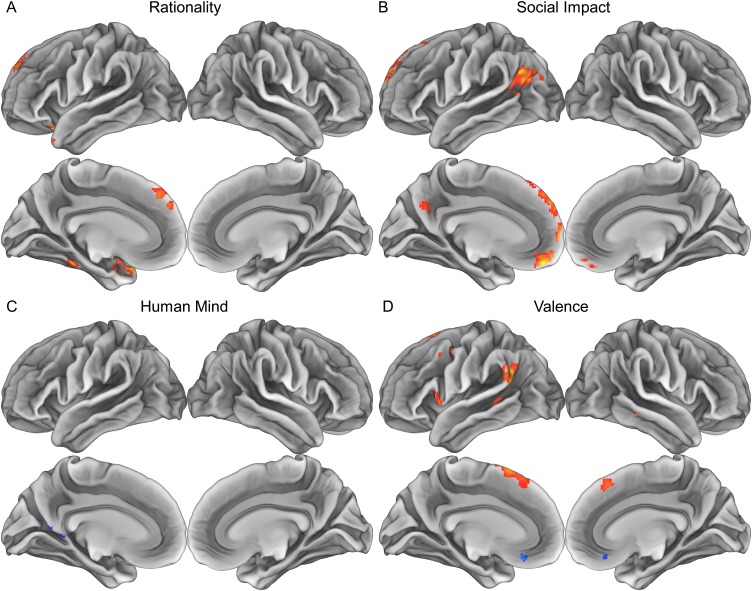
Univariate effects of PCA-derived dimensions. Significant associations between each of the four PCA-derived dimensions and voxelwise univariate brain activity. Orange voxels indicate activity associated with greater emotionality (and less rationality) of mental states (A), greater social impact (B), or greater negativity (D). Blue voxels indicate activity associated with more shared/bodily states (C), or more positive states (D). Statistical maps resulted from random effects one-sample t tests across participants and were corrected for multiple comparisons (P < 0.05) via Monte Carlo simulation (voxelwise P < .001, k > 75).
Fig. S5.
Fig. S5.
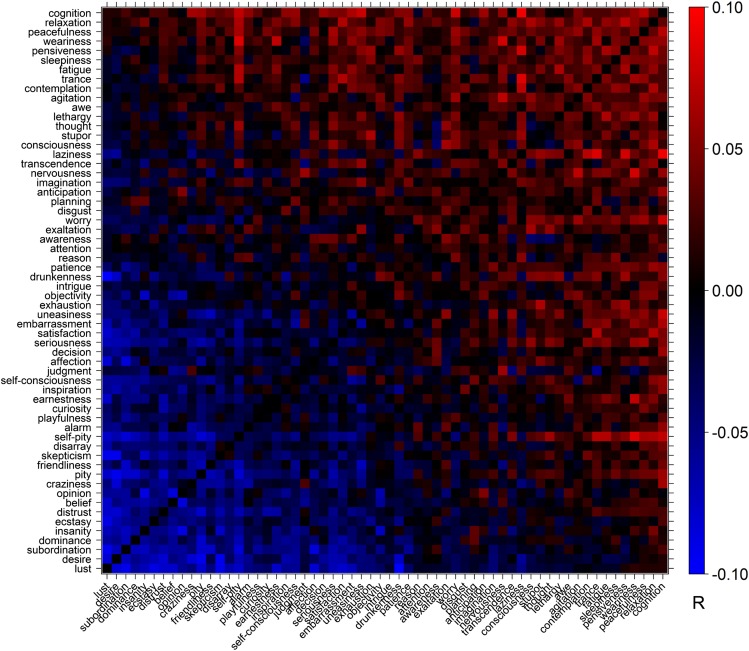
Residual representational dissimilarity matrix. High positive residuals (red) indicate that mental states were more dissimilar than three significant PCA-derived dimensions would predict. High negative residuals (blue) indicate pairs of mental states that were less different than the PCA-derived dimensions would predict.
Fig. S6.
Fig. S6.
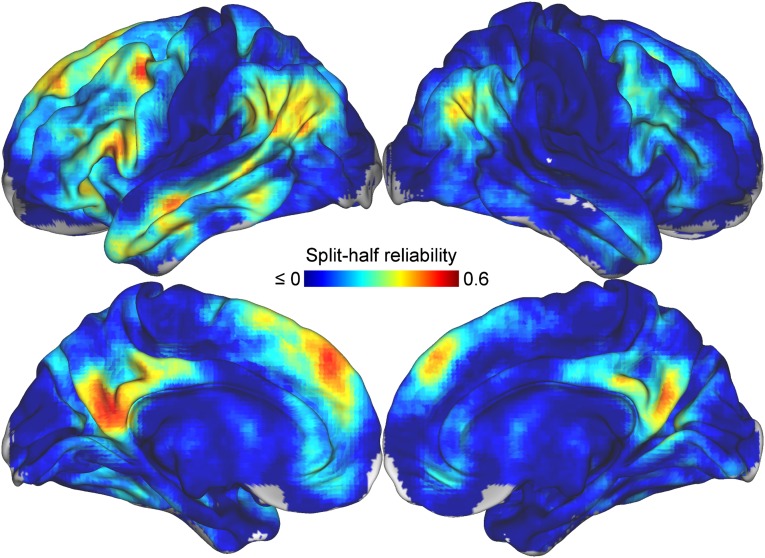
Reliability of similarity searchlights. The reliability of the neural representations of other’s mental states throughout the brain, calculated as the split-half correlation between pattern similarity estimates. Many regions typically implicated in theory of mind demonstrate relatively high reliability.

Comment in

  • How the brain represents other minds.
    Dubois J, Adolphs R. Dubois J, et al. Proc Natl Acad Sci U S A. 2016 Jan 5;113(1):19-21. doi: 10.1073/pnas.1522316113. Epub 2015 Dec 23. Proc Natl Acad Sci U S A. 2016. PMID: 26699493 Free PMC article. No abstract available.

References

    1. Konkle T, Caramazza A. Tripartite organization of the ventral stream by animacy and object size. J Neurosci. 2013;33(25):10235–10242. - PMC - PubMed
    1. Mitchell JP. Contributions of functional neuroimaging to the study of social cognition. Curr Dir Psychol Sci. 2008;17(2):142–146.
    1. Van Overwalle F, Baetens K. Understanding others’ actions and goals by mirror and mentalizing systems: A meta-analysis. Neuroimage. 2009;48(3):564–584. - PubMed
    1. Posner J, Russell JA, Peterson BS. The circumplex model of affect: An integrative approach to affective neuroscience, cognitive development, and psychopathology. Dev Psychopathol. 2005;17(3):715–734. - PMC - PubMed
    1. Russell JA. A circumplex model of affect. J Pers Soc Psychol. 1980;39(6):1161–1178.

Publication types

LinkOut - more resources