Review
. 2015 Aug;7(4):297-311.
doi: 10.5114/jcb.2015.54038. Epub 2015 Sep 14.

Brachytherapy in the treatment of lung cancer - a valuable solution

Affiliations
Review

Brachytherapy in the treatment of lung cancer - a valuable solution

Janusz Skowronek. J Contemp Brachytherapy. 2015 Aug.

Abstract

The majority of patients with lung cancer are diagnosed with clinically advanced disease. Many of these patients have a short life expectancy and are treated with palliative aim. Because of uncontrolled local or recurrent disease, patients may have significant symptoms such as: cough, dyspnea, hemoptysis, obstructive pneumonia, or atelectasis. Brachytherapy is one of the most efficient methods in overcoming difficulties in breathing that is caused by endobronchial obstruction in palliative treatment of bronchus cancer. Efforts to relieve this obstructive process are worthwhile, because patients may experience improved quality of their life (QoL). Brachytherapy plays a limited but specific role in definitive treatment with curative intent in selected cases of early endobronchial disease as well as in the postoperative treatment of small residual peribronchial disease. Depending on the location of the lesion, in some cases brachytherapy is a treatment of choice. This option is fast, inexpensive, and easy to perform on an outpatient basis. Clinical indications, different techniques, results, and complications are presented in this work.

Keywords: brachytherapy; bronchial cancer; endoluminal; interstitial; lung cancer.


Figures
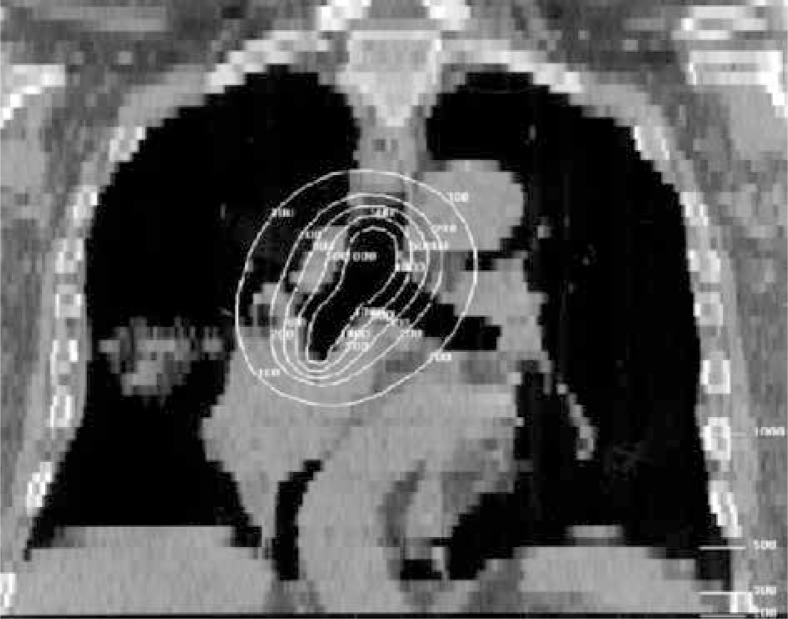
Fig. 1
Fig. 1
Coronal reconstruction plane with superimposed dose distribution achieved with dose prescription relative to the mucosa. Rapid dose-fall visible [18]
Fig. 2
Fig. 2
Endobronchial brachytherapy with a small (< 2 mm, 5- to 6-French) endobronchial applicator, entered in a tertiary bronchus for treatment [17]
Fig. 3
Fig. 3
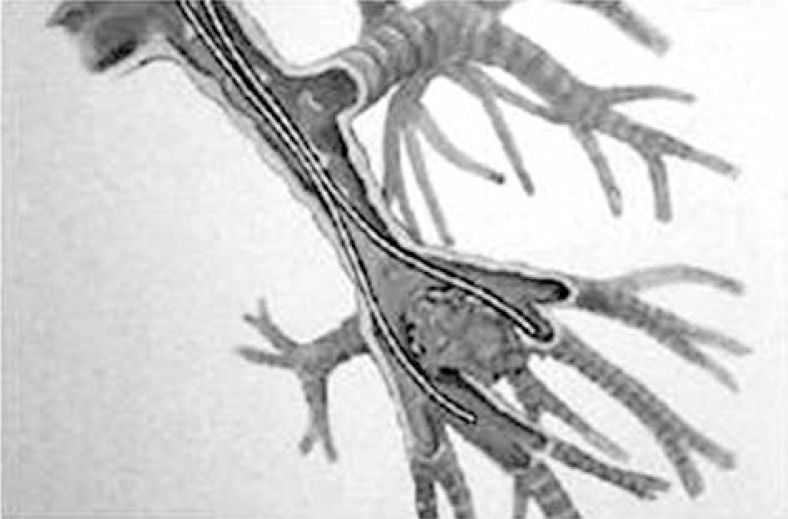
Intraluminal technique with two tubes in bronchus brachytherapy: schematic anatomical diagram showing the ideal situation with two tubes encompassing a small tumor located in the carina of two tertiary bronchi in the left lower lobe [17]
Fig. 4
Fig. 4
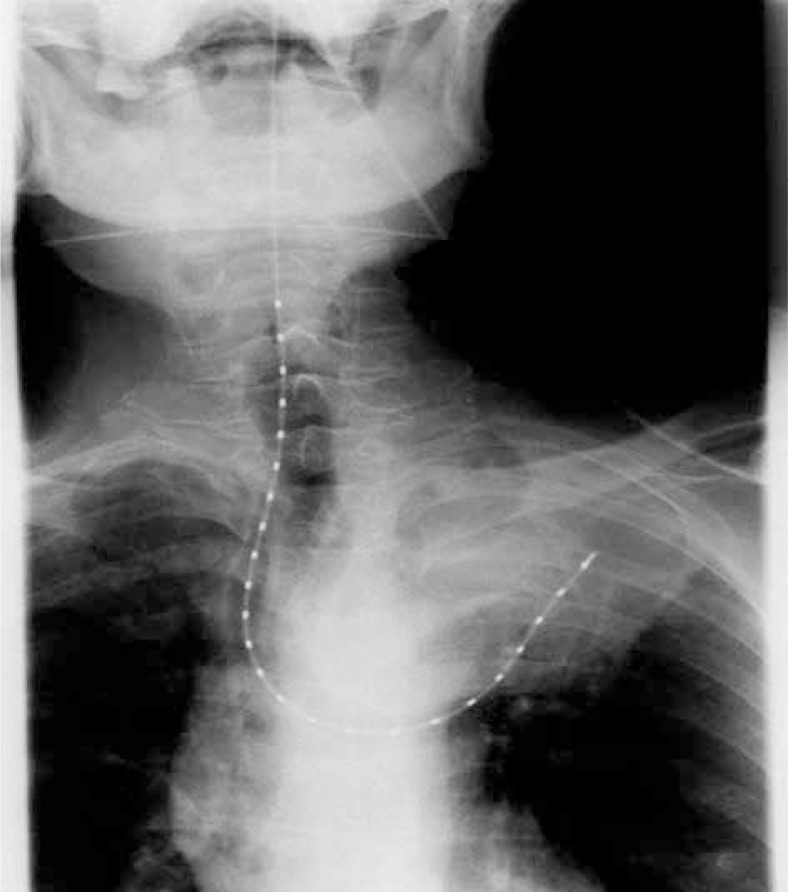
Endobronchial applicator with metal marker inside used for treatment planning, tumor localized in left upper lobe bronchus, X-ray picture [own material]
Fig. 5
Fig. 5
Bilateral lung cancer – endobronchial applicators with metal markers inside used for treatment planning, tumor localized infiltrating carina and both main bronchus, X-ray picture [own material]
Fig. 6
Fig. 6
A-E) Examples of brachytherapy – tumors localized in main bronchus, French-6 (5) catheters placed in bronchus close by, scale on catheter (n cm) useful for treatment planning visible [own material]
Fig. 7
Fig. 7
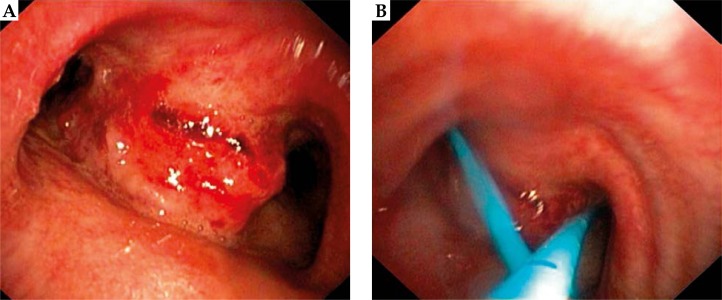
A, B) Tumor infiltrating carina and both main bronchi before application and after application of two brachytherapy catheters. In this cases, irradiated area includes carina and both main bronchi [own material]
Fig. 8
Fig. 8
Axial isodose distributions for a planar permanent 125I paraspinal implant. Intraoperative 125I seed placement has been used in conjunction with sublobar resection in patients with lung cancer who are medically unfit for lobar resection. This technique is currently being evaluated in the USA in a multi-institution randomized prospective trial by the American College of Surgeons Oncology Group (ACOSOG) Z4032 [41]
Fig. 9
Fig. 9
A) Planar implant made using 125I seeds in suture within a Vicryl mesh. B) Completed implant being placed into mediastinum using long-handled tools. The seeds will be straightened to give optimal dosimetry before lung reinflation [41]
Fig. 10
Fig. 10
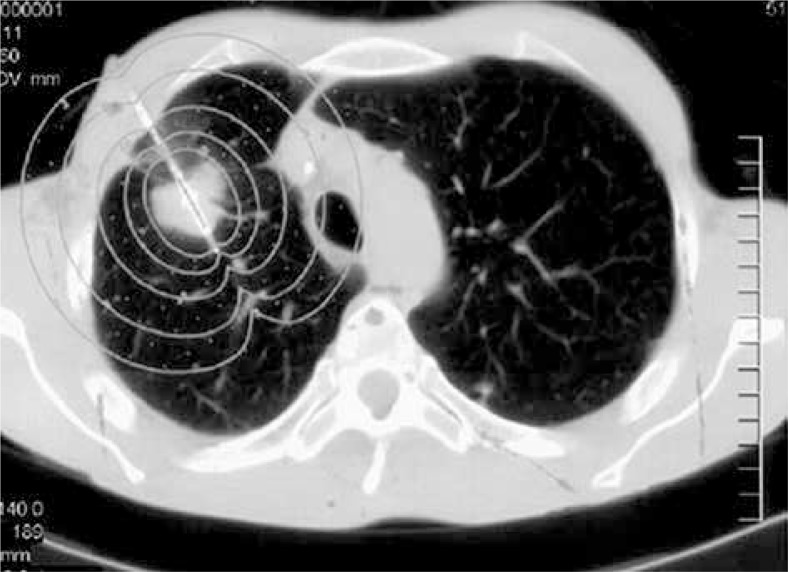
Lung metastasis of colorectal carcinoma treated with a single brachytherapy catheter. The inner isodose represents 20 Gy. Note the steep gradient with the outer isodose, illustrating a dose of 3 Gy [46]
Fig. 11
Fig. 11
A) Patient with two catheters inserted during regular 3D planning. For the 2D planning only one of them would be used (the one inserted into the bronchus with visible obturation). Comparison of GTV coverage by the 90% isodose achieved in 2D planning system. Legend: purple triangles – GTV volume, orange cylinder – 2D 90% isodose, blue – catheter. B) Patient with two catheters inserted. Comparison of GTV coverage by the 90% isodose achieved in 3D planning system. Legend: purple triangles – GTV volume, orange volume – 3D 90% isodose, blue – catheters [36]
Fig. 12
Fig. 12
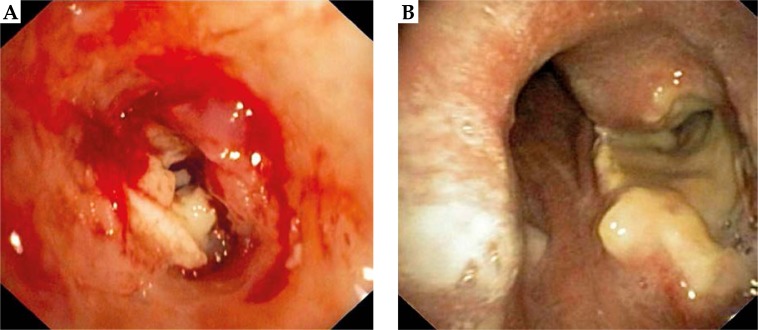
A, B) Irradiation effects after brachytherapy – partial remission, superficial necrosis with residual tumor issue [own material]

References

    1. Skowronek J. Lung cancer brachytherapy. In: West BS, Stanley DR, editors. Lung cancer treatment. New York: Nova Science; 2011.
    1. Stephens KE, Jr, Wood DE. Bronchoscopic management of central airway obstruction. J Thorac Cardiovasc Surg. 2000;119:289–296. - PubMed
    1. Sutedja G, Baris G, van Zadwijk N, et al. High-dose rate brachytherapy has a curative potential in patients with intraluminal squamous cell lung cancer. Respiration. 1993;61:167–168. - PubMed
    1. Taulelle M, Chauvet B, Vincent P, et al. High dose rate endobronchial brachytherapy: results and complications in 189 patients. Eur Respir J. 1998;11:162–168. - PubMed
    1. Skowronek J, Piotrowski T, Młynarczyk W, et al. Advanced tracheal carcinoma – a therapeutic significance of HDR brachytherapy in palliative treatment. Neoplasma. 2004;51:313–318. - PubMed

LinkOut - more resources