. 2015 Sep;10(3):1694-1700.
doi: 10.3892/ol.2015.3485. Epub 2015 Jul 13.

Chronic neutrophilic leukemia with overexpression of EVI-1, and concurrent CSF3R and SETBP1 mutations: A case report

Affiliations

Chronic neutrophilic leukemia with overexpression of EVI-1, and concurrent CSF3R and SETBP1 mutations: A case report

Otgonbat Altangerel et al. Oncol Lett. 2015 Sep.

Abstract

Chronic neutrophilic leukemia (CNL) is a rare type of myeloproliferative neoplasm, characterized by sustained neutrophilia, splenomegaly, bone marrow granulocytic hyperplasia (without evidence of dysplasia) and an absence of the Philadelphia chromosome. Thus far, ~150 cases of CNL have been described in the literature; however, none have demonstrated overexpression of the ecotropic viral integration site-1 (EVI-1, also known as MECOM) gene. The present study describes a case that fulfilled the World Health Organization diagnostic criteria for CNL, and was associated with overexpression of EVI-1, as well as novel concurrent mutations of colony stimulating factor 3 receptor (CSF3R) and SET binding protein-1 (SETBP1). In addition, the current study briefly reviewed the relevant literature regarding novel genetic findings associated with the diagnosis and treatment of CNL. To the best of our knowledge, this is the first case report of CNL with associated EVI-1 overexpression, and concurrent CSF3R and SETBP1 mutations.

Keywords: SET binding receptor mutation; chronic neutrophilic leukemia; colony stimulating factor 3 receptor mutation; ecotropic viral integration site-1.


Figures
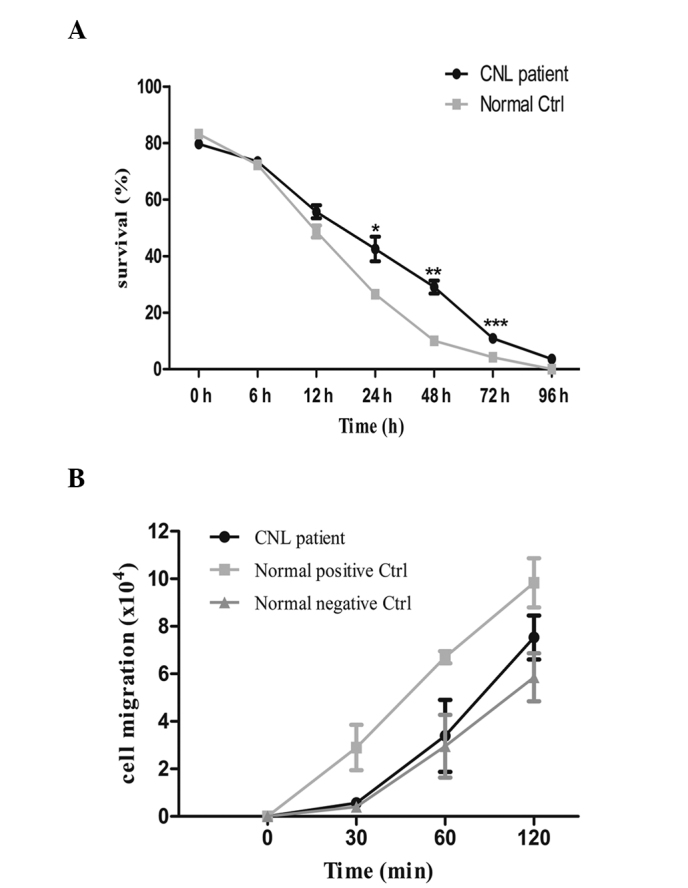
Figure 1.
Figure 1.
Cell survival curve and cell migration assay. (A) Cell survival data obtained at different time points indicating that the patient's neutrophils survive significantly longer than those of the normal control group. *P=0.210 vs. control; **P=0.0012 vs. control; and ***P=0.0010 vs. control. (B) Extent of cell migration, as determined by N-formyl-methionyl-leucyl-phenylalanine (fMLP) treatment. Migration of the patient neutrophils was low compared with the normal positive Ctrl cells (incubated with fMLP), but high compared with the normal negative Ctrl cells (incubated without fMLP). CNL, chronic neutrophilic leukemia; ctrl, control.
Figure 2.
Figure 2.
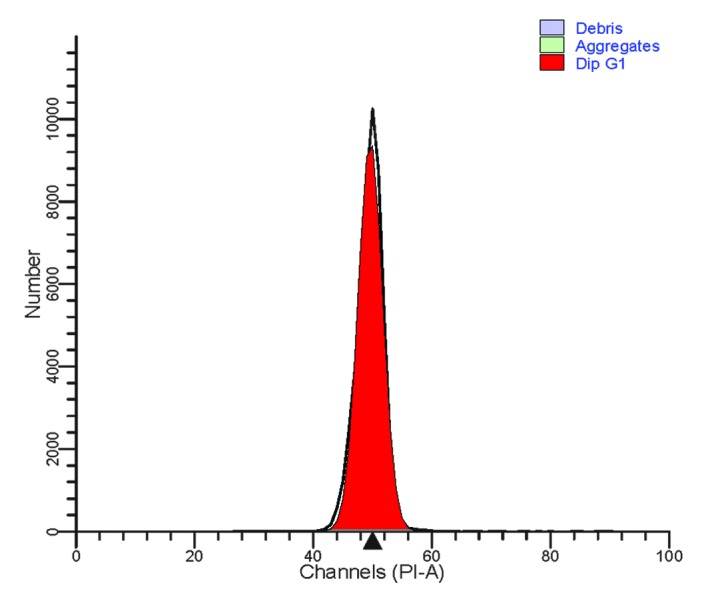
Cell cycle analysis determined by flow cytometry. All cells were terminally differentiated and there was no cell division.
Figure 3.
Figure 3.
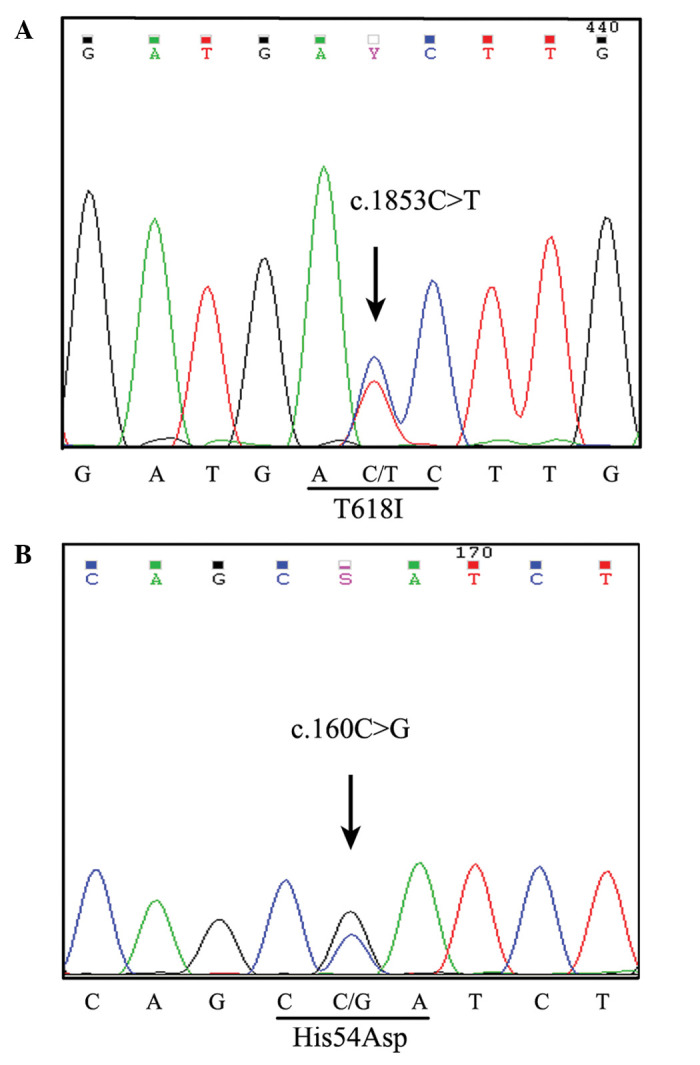
Detection of the T618I and His54Asp point mutations in colony stimulating factor 3 receptor (CSF3R). (A) Sequencing of exon 14 of CSF3R detected a base-pair mutation (C to T) at nucleotide 1853. (B) Sequencing of exon 4 of CSF3R detected a base-pair mutation (C to G) at nucleotide 160.
Figure 4.
Figure 4.
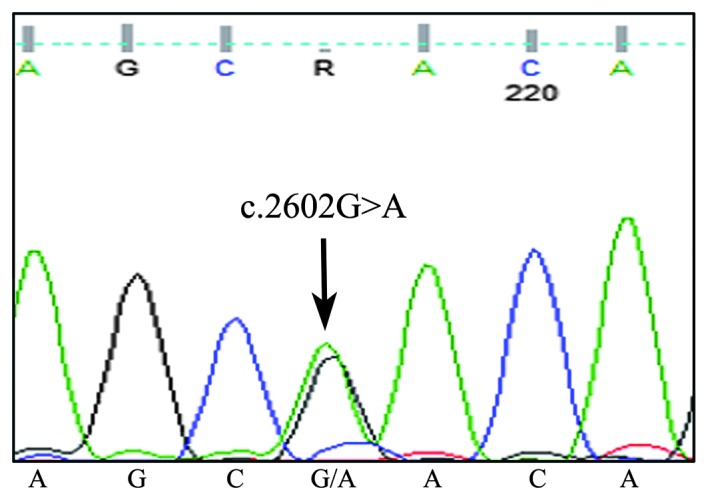
Detection of the p.Asp868Asn point mutation in the SET binding protein 1 gene.
Figure 5.
Figure 5.
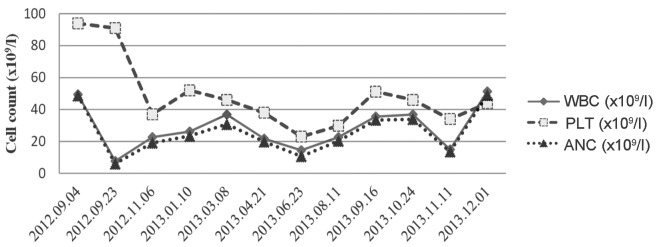
Cell count recorded throughout the disease course. WBC, white blood cells; PLT, platelets; ANC, absolute neutrophil count.

References

    1. Bain BJ, Brunning BR, Vardiman JW, Thiele J. WHO Classification of Tumors of Haematopoietic and Lymphoid Tissues. IARC Press; Lyon, France: 2008. Chronic neutrophilic leukaemia; pp. 38–39.
    1. Böhm J, Schaefer HE. Chronic neutrophilic leukaemia: 14 new cases of an uncommon myeloproliferative disease. J Clin Pathol. 2002;55:862–864. doi: 10.1136/jcp.55.11.862. - DOI - PMC - PubMed
    1. Elliott MA. Chronic neutrophilic leukemia and chronic myelomonocytic leukemia: WHO defined. Best Pract Res Clin Haematol. 2006;19:571–593. doi: 10.1016/j.beha.2005.07.012. - DOI - PubMed
    1. Beekman R, Touw IP. G-CSF and its receptor in myeloid malignancy. Blood. 2010;115:5131–5136. doi: 10.1182/blood-2010-01-234120. - DOI - PubMed
    1. Dong F, van Buitenen C, Pouwels K, et al. Distinct cytoplasmic regions of the human granulocyte colony-stimulating factor receptor involved in induction of proliferation and maturation. Mol Cell Biol. 1993;13:7774–7781. - PMC - PubMed

LinkOut - more resources