


Modelling of Thyroid Peroxidase Reveals Insights into Its Enzyme Function and Autoantigenicity
- PMID: 26623656
- PMCID: PMC4666655
- DOI: 10.1371/journal.pone.0142615
Modelling of Thyroid Peroxidase Reveals Insights into Its Enzyme Function and Autoantigenicity
Abstract
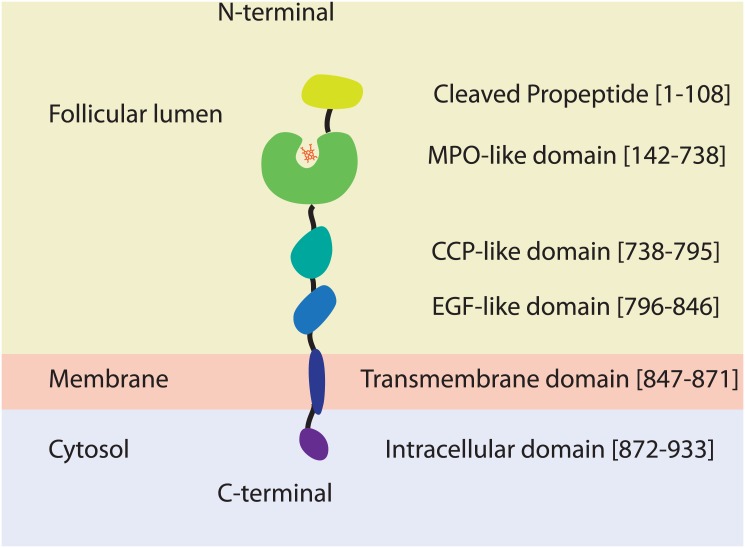
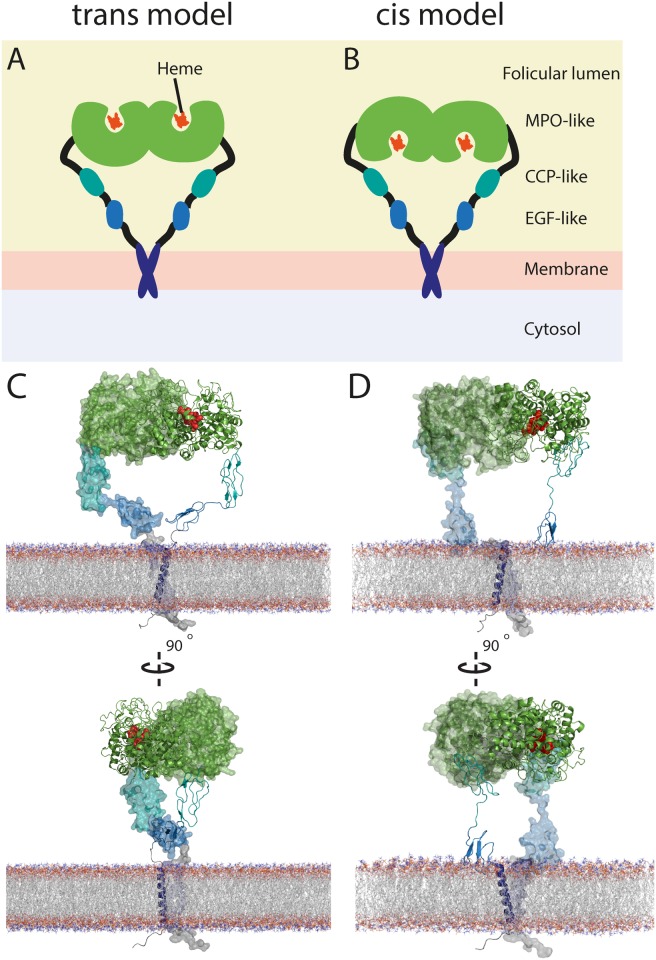
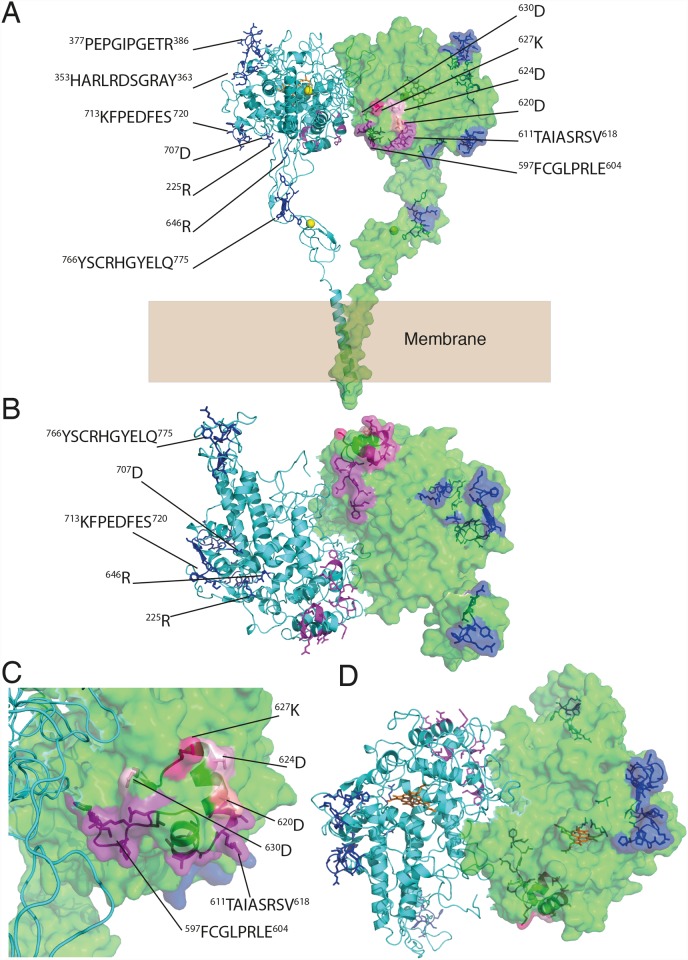
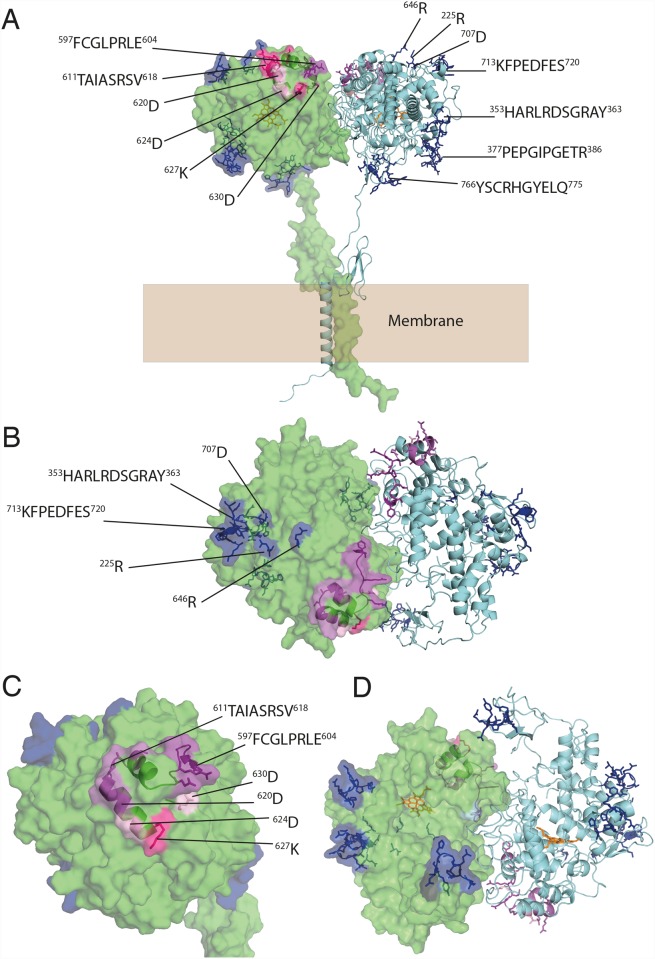
Thyroid peroxidase (TPO) catalyses the biosynthesis of thyroid hormones and is a major autoantigen in Hashimoto's disease--the most common organ-specific autoimmune disease. Epitope mapping studies have shown that the autoimmune response to TPO is directed mainly at two surface regions on the molecule: immunodominant regions A and B (IDR-A, and IDR-B). TPO has been a major target for structural studies for over 20 years; however, to date, the structure of TPO remains to be determined. We have used a molecular modelling approach to investigate plausible modes of TPO structure and dimer organisation. Sequence features of the C-terminus are consistent with a coiled-coil dimerization motif that most likely anchors the TPO dimer in the apical membrane of thyroid follicular cells. Two contrasting models of TPO were produced, differing in the orientation and exposure of their active sites relative to the membrane. Both models are equally plausible based upon the known enzymatic function of TPO. The "trans" model places IDR-B on the membrane-facing side of the myeloperoxidase (MPO)-like domain, potentially hindering access of autoantibodies, necessitating considerable conformational change, and perhaps even dissociation of the dimer into monomers. IDR-A spans MPO- and CCP-like domains and is relatively fragmented compared to IDR-B, therefore most likely requiring domain rearrangements in order to coalesce into one compact epitope. Less epitope fragmentation and higher solvent accessibility of the "cis" model favours it slightly over the "trans" model. Here, IDR-B clusters towards the surface of the MPO-like domain facing the thyroid follicular lumen preventing steric hindrance of autoantibodies. However, conformational rearrangements may still be necessary to allow full engagement with autoantibodies, with IDR-B on both models being close to the dimer interface. Taken together, the modelling highlights the need to consider the oligomeric state of TPO, its conformational properties, and its proximity to the membrane, when interpreting epitope-mapping data.
Conflict of interest statement
Figures
References
-
- Chiovato L, Bassi P, Santini F, Mammoli C, Lapi P, Carayon P, et al. Antibodies producing complement-mediated thyroid cytotoxicity in patients with atrophic or goitrous autoimmune thyroiditis. The Journal of clinical endocrinology and metabolism. 1993;77(6):1700–5. 10.1210/jcem.77.6.7903315 . - DOI - PubMed
-
- Bogner U, Kotulla P, Peters H, Schleusener H. Thyroid peroxidase/microsomal antibodies are not identical with thyroid cytotoxic antibodies in autoimmune thyroiditis. Acta endocrinologica. 1990;123(4):431–7. . - PubMed
Publication types
MeSH terms
Substances
LinkOut - more resources
Full Text Sources
Other Literature Sources
Research Materials
Miscellaneous
