. 2015 Dec 1;10(12):e0143833.
doi: 10.1371/journal.pone.0143833. eCollection 2015.

Large Neutral Amino Acid Supplementation Exerts Its Effect through Three Synergistic Mechanisms: Proof of Principle in Phenylketonuria Mice

Affiliations

Large Neutral Amino Acid Supplementation Exerts Its Effect through Three Synergistic Mechanisms: Proof of Principle in Phenylketonuria Mice

Danique van Vliet et al. PLoS One. .

Abstract

Background: Phenylketonuria (PKU) was the first disorder in which severe neurocognitive dysfunction could be prevented by dietary treatment. However, despite this effect, neuropsychological outcome in PKU still remains suboptimal and the phenylalanine-restricted diet is very demanding. To improve neuropsychological outcome and relieve the dietary restrictions for PKU patients, supplementation of large neutral amino acids (LNAA) is suggested as alternative treatment strategy that might correct all brain biochemical disturbances caused by high blood phenylalanine, and thereby improve neurocognitive functioning.

Objective: As a proof-of-principle, this study aimed to investigate all hypothesized biochemical treatment objectives of LNAA supplementation (normalizing brain phenylalanine, non-phenylalanine LNAA, and monoaminergic neurotransmitter concentrations) in PKU mice.

Methods: C57Bl/6 Pah-enu2 (PKU) mice and wild-type mice received a LNAA supplemented diet, an isonitrogenic/isocaloric high-protein control diet, or normal chow. After six weeks of dietary treatment, blood and brain amino acid and monoaminergic neurotransmitter concentrations were assessed.

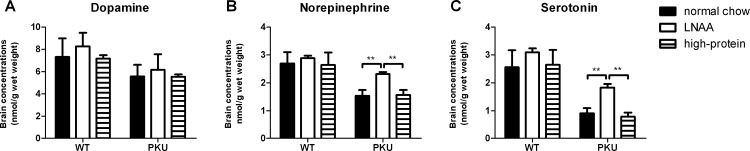
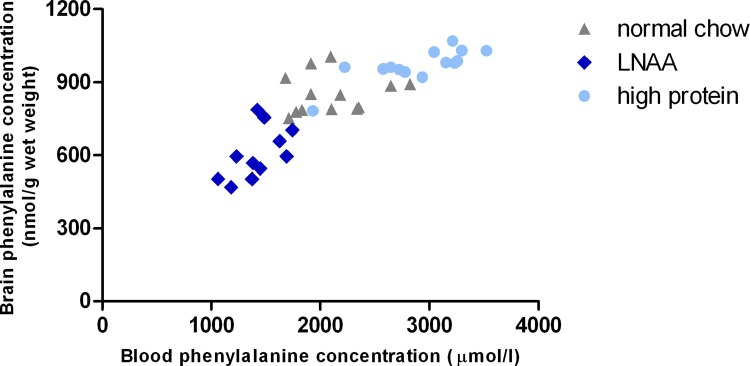
Results: In PKU mice, the investigated LNAA supplementation regimen significantly reduced blood and brain phenylalanine concentrations by 33% and 26%, respectively, compared to normal chow (p<0.01), while alleviating brain deficiencies of some but not all supplemented LNAA. Moreover, LNAA supplementation in PKU mice significantly increased brain serotonin and norepinephrine concentrations from 35% to 71% and from 57% to 86% of wild-type concentrations (p<0.01), respectively, but not brain dopamine concentrations (p = 0.307).

Conclusions: This study shows that LNAA supplementation without dietary phenylalanine restriction in PKU mice improves brain biochemistry through all three hypothesized biochemical mechanisms. Thereby, these data provide proof-of-concept for LNAA supplementation as a valuable alternative dietary treatment strategy in PKU. Based on these results, LNAA treatment should be further optimized for clinical application with regard to the composition and dose of the LNAA supplement, taking into account all three working mechanisms of LNAA treatment.


Conflict of interest statement

Competing Interests: R. D. van Anholt, in the past, received salary from Nutricia. E. A. van der Zee has received advisory board fees from Arla Foods. F. J. van Spronsen has received research grants, advisory board fees, and speaker's honoraria from Merck Serono and Nutricia Research, has received speaker's honoraria from Vitaflo, and has received advisory board fees from Arla Foods. There are no patents, products in development or marketed products to declare. This does not alter the authors' adherence to all the PLOS ONE policies on sharing data and materials.

Figures

Fig 1
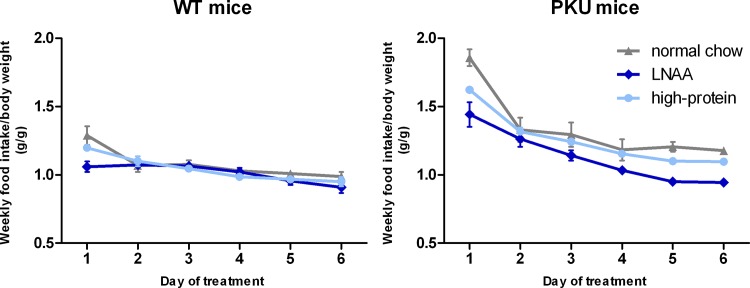
Fig 1. Weekly food intake for WT (A) and PKU (B) mice on different diets.
Numbers of mice on normal chow, LNAA supplemented diet, and high-protein diet were n = 14, n = 14, and n = 14 for WT mice respectively, while being n = 15, n = 14, and n = 15 for PKU mice. Error bars represent SEM.
Fig 2
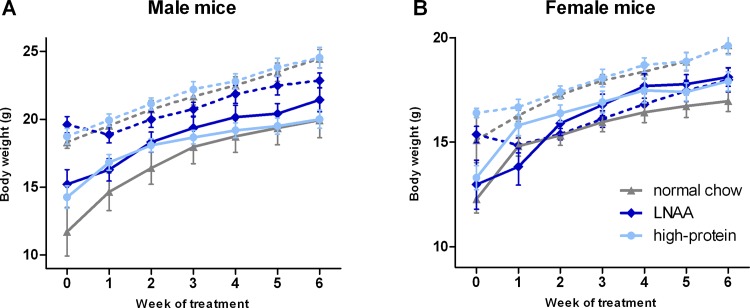
Fig 2. Body weights during the experiment.
Mean body weights for A) male and B) female WT (dashed lines) and PKU (solid lines) mice on different diets. Numbers of mice on normal chow, LNAA supplemented diet, and high-protein diet were n = 14, n = 14, and n = 14 for WT mice respectively, while being n = 15, n = 14, and n = 15 for PKU mice. Error bars represent SEM.
Fig 3
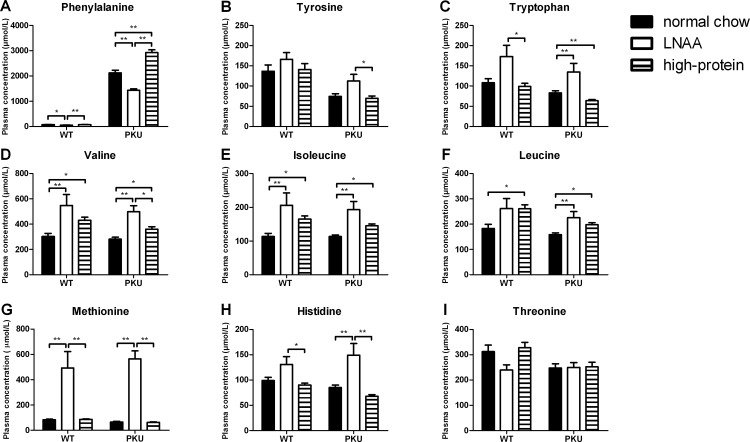
Fig 3. Plasma LNAA concentrations.
Plasma concentrations of A) phenylalanine, B) tyrosine, C) tryptophan, D) valine, E) isoleucine, F) leucine, G) methionine, H) histidine, and I) threonine in WT and PKU mice after six weeks of receiving different diets. Numbers of mice on normal chow, LNAA supplemented diet, and high-protein diet were n = 14, n = 12, and n = 14 for WT mice respectively, while being n = 14, n = 12, and n = 15 for PKU mice. Untransformed data are expressed as mean ± SEM. * p<0.05; ** p<0.01; § p<0.05 and §§ p<0.01 compared to WT mice on normal chow.
Fig 4
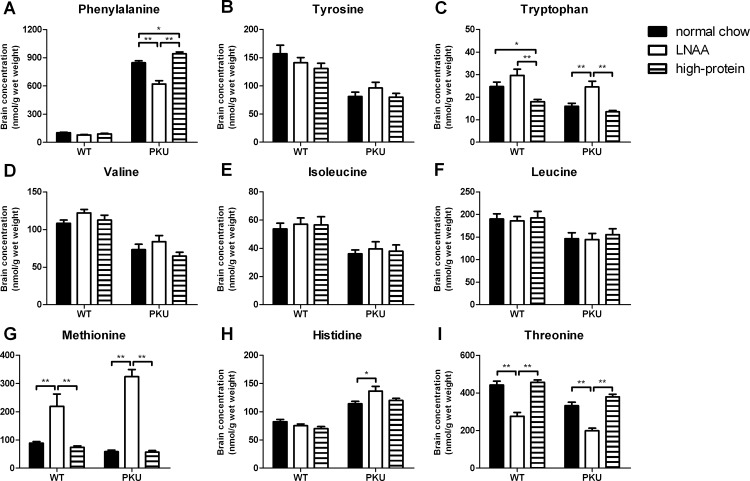
Fig 4. Brain LNAA concentrations.
Brain concentrations of A) phenylalanine, B) tyrosine, C) tryptophan, D) valine, E) isoleucine, F) leucine, G) methionine, H) histidine, and I) threonine in WT and PKU mice after six weeks of receiving different diets. Numbers of mice on normal chow, LNAA supplemented diet, and high-protein diet were n = 13, n = 12, and n = 14 for WT mice respectively, while being n = 14, n = 12, and n = 14 for PKU mice. Untransformed data are expressed as mean ± SEM. * p<0.05; ** p<0.01; § p<0.05 and §§ p<0.01 compared to WT mice on normal chow.
Fig 5
Fig 5. Brain monoaminergic neurotransmitter concentrations.
Brain concentrations of A) dopamine, B) norepinephrine, C) serotonin in WT and PKU mice after six weeks of receiving different dietary treatments. Numbers of mice on normal chow, LNAA supplemented diet, and high-protein diet were n = 13, n = 12, and n = 14 for WT mice respectively, while being n = 15, n = 13, and n = 15 for PKU mice. Untransformed data are expressed as mean ± SEM. **p<0.01; §§ p<0.01 compared to WT mice on normal chow.
Fig 6
Fig 6. Plasma versus brain Phe concentrations in PKU mice on different dietary treatments.
Relationship between plasma Phe and brain Phe concentrations in PKU mice on normal chow (n = 13), LNAA supplemented diet (n = 12), and high-protein diet (n = 14).
Fig 7
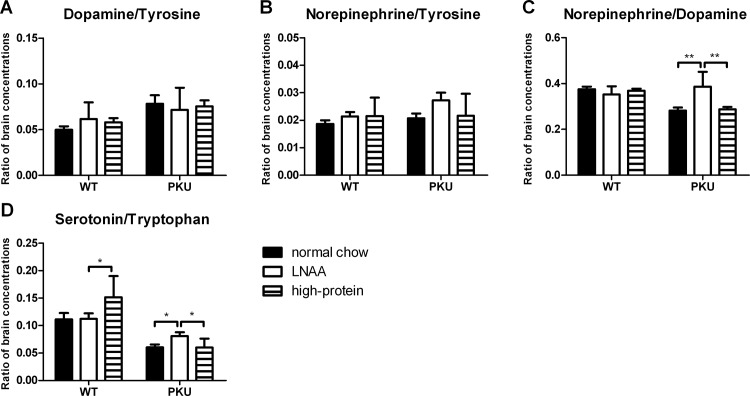
Fig 7. Ratios of brain monoaminergic neurotransmitters to precursors.
Ratios of brain A) dopamine/tyrosine, B) norepinephrine/tyrosine, C) norepinephrine/dopamine, and D) serotonin/tryptophan concentrations in WT and PKU mice after six weeks of receiving different dietary treatments. Numbers of mice on normal chow, LNAA supplemented diet, and high-protein diet were n = 13, n = 12, and n = 14 for WT mice respectively, while being n = 14, n = 12, and n = 14 for PKU mice. Untransformed data are expressed as mean ± SEM. *p<0.05; **p<0.01; and § p<0.05; §§ p<0.01 compared to WT mice on normal chow.

References

    1. Blau N, van Spronsen FJ, Levy HL. Phenylketonuria. Lancet 2010. October 23;376(9750):1417–1427. 10.1016/S0140-6736(10)60961-0 - DOI - PubMed
    1. Pardridge WM. Blood-brain barrier carrier-mediated transport and brain metabolism of amino acids. Neurochem Res 1998. May;23(5):635–644. - PubMed
    1. van Spronsen FJ, Hoeksma M, Reijngoud DJ. Brain dysfunction in phenylketonuria: is phenylalanine toxicity the only possible cause? J Inherit Metab Dis 2009. February;32(1):46–51. 10.1007/s10545-008-0946-2 - DOI - PubMed
    1. Smith QR. Transport of glutamate and other amino acids at the blood-brain barrier. J Nutr 2000. April;130(4S Suppl):1016S–22S. - PubMed
    1. Knudsen GM, Hasselbalch S, Toft PB, Christensen E, Paulson OB, Lou H. Blood-brain barrier transport of amino acids in healthy controls and in patients with phenylketonuria. J Inherit Metab Dis 1995;18(6):653–664. - PubMed