Clinical Trial
. 2016 Mar 31;127(13):1633-41.
doi: 10.1182/blood-2015-06-650226. Epub 2015 Dec 1.

A first-in-human phase 1 study of ACE910, a novel factor VIII-mimetic bispecific antibody, in healthy subjects

Affiliations
Clinical Trial

A first-in-human phase 1 study of ACE910, a novel factor VIII-mimetic bispecific antibody, in healthy subjects

Naoki Uchida et al. Blood. .

Abstract

ACE910 is a recombinant humanized bispecific antibody that binds to activated factor IX and factor X and mimics the cofactor function of factor VIII (FVIII). This first-in-human study examined the safety, tolerability, pharmacokinetics (PK), and pharmacodynamics (PD) of ACE910 in healthy male adults. A total of 40 Japanese and 24 white subjects were randomized to receive a single subcutaneous injection of ACE910 (Japanese: 0.001, 0.01, 0.1, 0.3, or 1 mg/kg; white: 0.1, 0.3, or 1 mg/kg; n = 6 per dose group) or placebo (n = 2 per dose group). ACE910 exhibited a linear PK profile and had a half-life of ∼4 to 5 weeks. In FVIII-neutralized plasma, ACE910 shortened activated partial thromboplastin time and increased peak height of thrombin generation in a dose-dependent manner. All adverse events were nonserious and did not lead to any subject's withdrawal. Neither clinical findings nor laboratory abnormalities indicating hypercoagulability were observed. Two of 48 subjects receiving ACE910 (1 Japanese and 1 white) were positive for anti-ACE910 antibodies (anti-drug antibodies [ADAs]). One subject tested positive for ADAs both before and after ACE910 administration, whereas the other became ADA positive after receiving ACE910. The PK and PD profiles of ACE910 were similar in healthy Japanese and white subjects and suggest that ACE910 will be an effective and convenient prophylactic treatment of hemophilia A. This trial was registered at www.clinicaltrials.jp as #JapicCTI-121934.


Figures

Figure 1
Figure 1
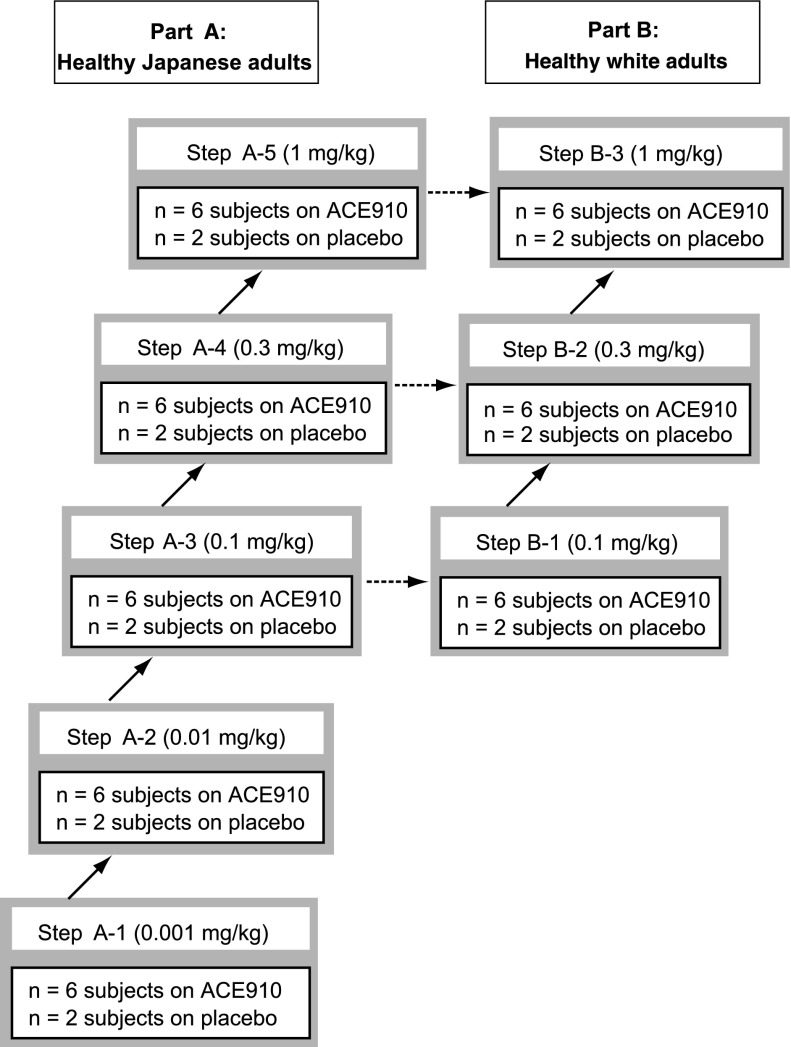
Study design and stepwise dose-escalation scheme. Stepwise dose-escalation scheme for healthy male Japanese subjects (part A) and white subjects (part B) is shown. A total of 40 Japanese subjects were recruited to part A, and a total of 24 white subjects were recruited to part B. Part A: Japanese subjects were randomized to receive a single subcutaneous dose of ACE910 (n = 6 for each dose group) or placebo (n = 2 for each dose group). The Japanese subjects were observed for 4 weeks at each dose, and data were reviewed prior to dose escalation. Part B: white subjects were randomized to receive a single subcutaneous injection of ACE910 (n = 6 for each dose group) or placebo (n = 2 for each dose group). The white subjects were observed for 4 weeks at each dose, and data were reviewed prior to dose escalation.
Figure 2
Figure 2
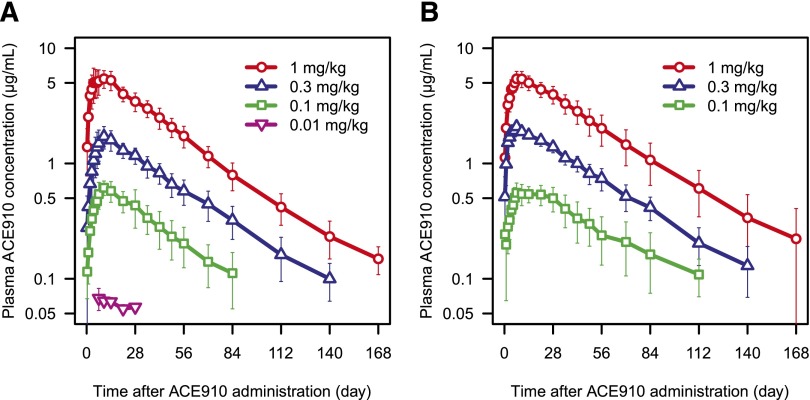
Plasma ACE910 concentration after single subcutaneous injection of ACE910. The time courses of plasma ACE910 concentration after single subcutaneous injection of 0.01 mg/kg (pink reverse triangle), 0.1 mg/kg (green square), 0.3 mg/kg (blue triangle), and 1 mg/kg (red circle) of ACE910 in Japanese (A) and white (B) healthy subjects are shown. Plasma ACE910 concentration was below the lower limit of quantification in all subjects at a dose of 0.001 mg/kg. Results are presented as mean ± standard deviation. Data out of the quantification range were handled as missing in summary statistics calculation. Summary statistics were not calculated when a plasma ACE910 concentration was below the lower limit of quantification in the majority of subjects at a certain dose group and time point.
Figure 3
Figure 3
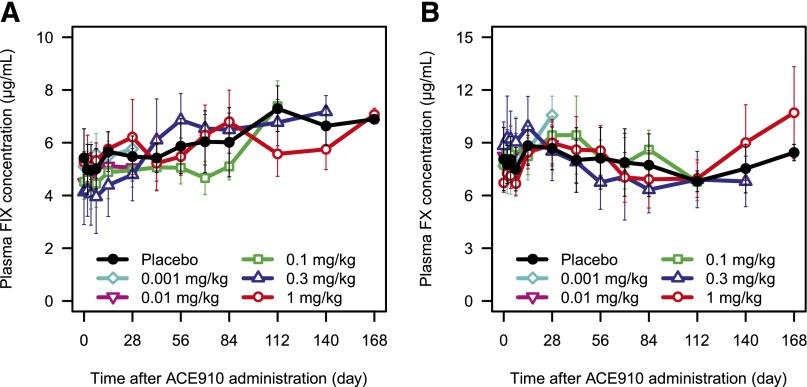
Plasma FIX and FX concentrations after single subcutaneous injection of ACE910. The time courses of plasma FIX (A) and FX (B) concentration after single subcutaneous injection of placebo (black circle), 0.001 mg/kg (light blue diamond), 0.01 mg/kg (pink reverse triangle), 0.1 mg/kg (green square), 0.3 mg/kg (blue triangle), and 1 mg/kg (red circle) of ACE910 in Japanese healthy subjects are shown. The concentrations of FIX and FX including their activated forms in plasma were determined. Results are presented as mean ± standard deviation.
Figure 4
Figure 4
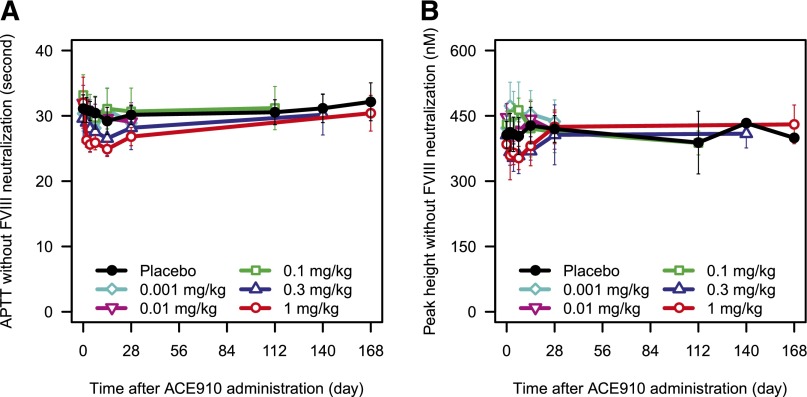
PD responses after single subcutaneous injection of ACE910 without neutralization of the endogenous FVIII. The time courses of APTT (A) and peak height of TG (B) after single subcutaneous injection of placebo (black circle), 0.001 mg/kg (light blue diamond), 0.01 mg/kg (pink reverse-triangle), 0.1 mg/kg (green square), 0.3 mg/kg (blue triangle), and 1 mg/kg (red circle) of ACE910 in Japanese healthy subjects measured without neutralization of endogenous FVIII are shown. Results are presented as mean ± standard deviation.
Figure 5
Figure 5
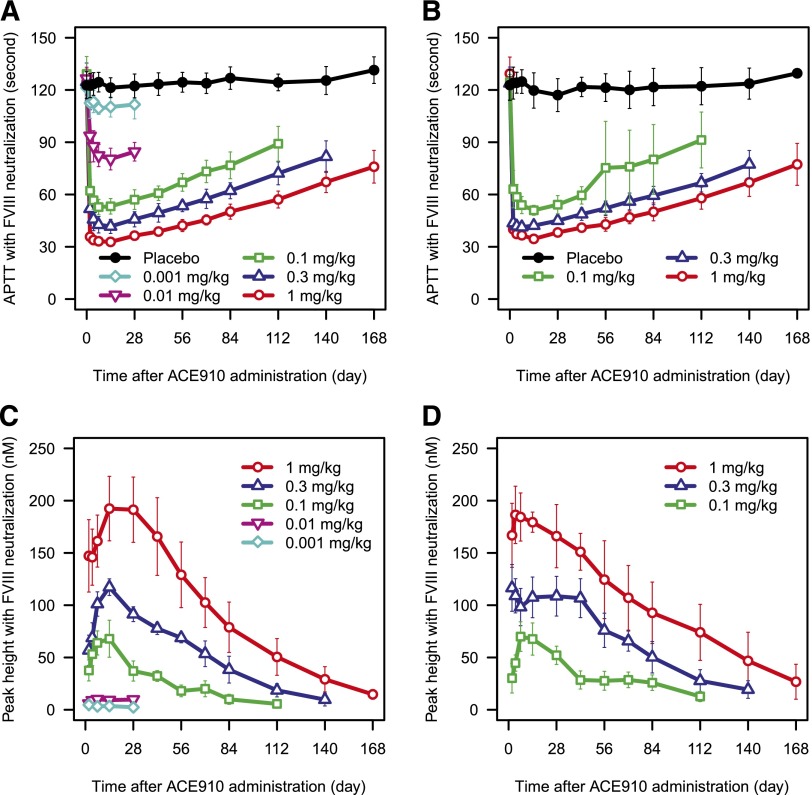
PD responses after single subcutaneous injection of ACE910 with neutralization of the endogenous FVIII. The time courses of APTT (A-B) and peak height of TG (C-D) after single subcutaneous injection of placebo (black circle), 0.001 mg/kg (light blue diamond), 0.01 mg/kg (pink reverse triangle), 0.1 mg/kg (green square), 0.3 mg/kg (blue triangle), and 1 mg/kg (red circle) of ACE910 in Japanese (A,C) and white (B,D) healthy subjects measured with neutralization of endogenous FVIII are shown. TG was undetectable at baseline in the majority of subjects in each dose group. TG remained undetectable throughout the study period in the majority of subjects receiving placebo (data not shown). Results are presented as mean ± standard deviation. Data out of the quantification range were handled as missing in summary statistics calculation. Summary statistics were not calculated when TG was undetectable in the majority of subjects at a certain dose group and time point. One observed data point of TG was excluded because of being judged as an outlier, considering its unlikely time course and drug concentration dependency.
Figure 6
Figure 6
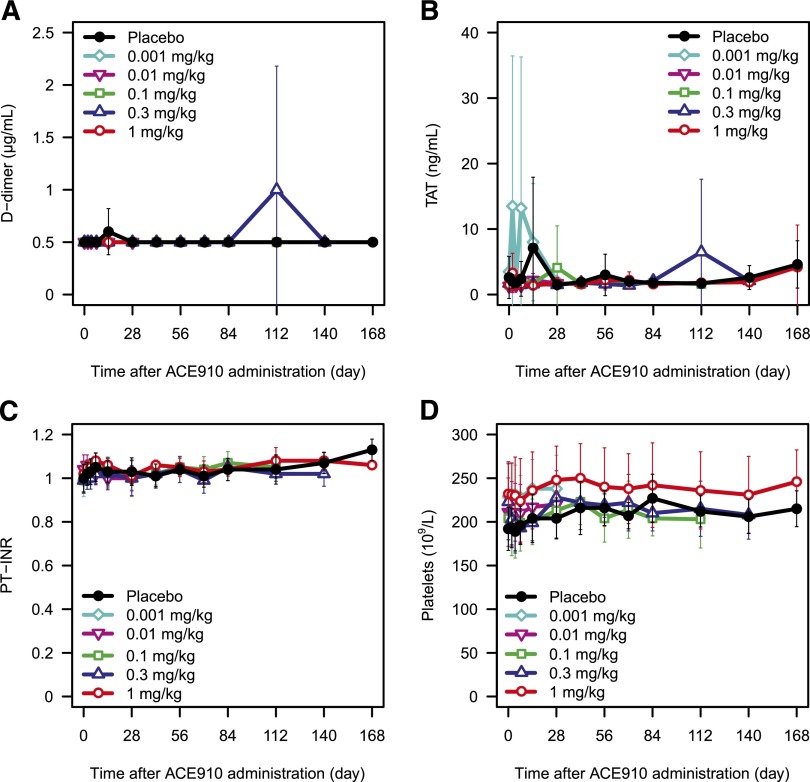
Coagulation markers and platelet count after single subcutaneous injection of ACE910. The time courses of d-dimer (A), TAT (B), PT-INR (C), and platelet count (D) after single subcutaneous injection of placebo (black circle), 0.001 mg/kg (light blue diamond), 0.01 mg/kg (pink reverse triangle), 0.1 mg/kg (green square), 0.3 mg/kg (blue triangle), and 1 mg/kg (red circle) of ACE910 in Japanese healthy subjects are shown. Results are presented as mean ± standard deviation. The data out of the quantification range were imputed by the limit of quantification values.
Figure 7
Figure 7
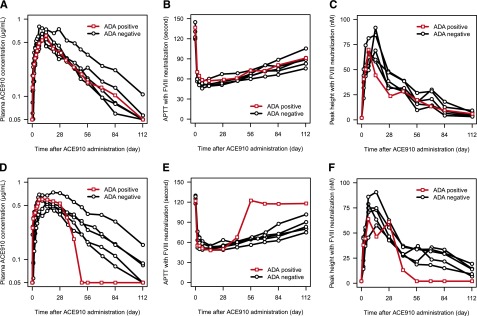
Effect of anti-ACE910 antibodies on PK and PD of ACE910. The PK and PD profiles in ADA-positive subject (red open square) and ADA-negative subjects (black open circle) are shown. (A) Plasma ACE910 concentration in the Japanese 0.1 mg/kg group. (B) APTT in the Japanese 0.1 mg/kg group. (C) Peak height of TG in the Japanese 0.1 mg/kg group. (D) Plasma ACE910 concentration in the white 0.1 mg/kg group. (E) APTT in the white 0.1 mg/kg group. (F) Peak height of TG in the white 0.1 mg/kg group. The data out of the quantification range were imputed by the limit of quantification values. One observed data point of TG was excluded because of being judged as an outlier, considering its unlikely time course and drug concentration dependency.

Comment in

References

    1. Srivastava A, Brewer AK, Mauser-Bunschoten EP, et al. Treatment Guidelines Working Group on Behalf of the World Federation of Hemophilia. Guidelines for the management of hemophilia. Haemophilia. 2013;19(1):e1–e47. - PubMed
    1. Löfqvist T, Nilsson IM, Berntorp E, Pettersson H. Haemophilia prophylaxis in young patients – a long-term follow-up. J Intern Med. 1997;241(5):395–400. - PubMed
    1. Manco-Johnson MJ, Abshire TC, Shapiro AD, et al. Prophylaxis versus episodic treatment to prevent joint disease in boys with severe hemophilia. N Engl J Med. 2007;357(6):535–544. - PubMed
    1. Geraghty S, Dunkley T, Harrington C, Lindvall K, Maahs J, Sek J. Practice patterns in haemophilia A therapy – global progress towards optimal care. Haemophilia. 2006;12(1):75–81. - PubMed
    1. Mahlangu J, Powell JS, Ragni MV, et al. A-LONG Investigators. Phase 3 study of recombinant factor VIII Fc fusion protein in severe hemophilia A. Blood. 2014;123(3):317–325. - PMC - PubMed

Publication types

MeSH terms