Review
. 2016 Apr 15;25(R1):R18-26.
doi: 10.1093/hmg/ddv476. Epub 2015 Nov 30.

Gene-targeting pharmaceuticals for single-gene disorders

Affiliations
Review

Gene-targeting pharmaceuticals for single-gene disorders

Arthur L Beaudet et al. Hum Mol Genet. .

Abstract

The concept of orphan drugs for treatment of orphan genetic diseases is perceived enthusiastically at present, and this is leading to research investment on the part of governments, disease-specific foundations and industry. This review attempts to survey the potential to use traditional pharmaceuticals as opposed to biopharmaceuticals to treat single-gene disorders. The available strategies include the use of antisense oligonucleotides (ASOs) to alter splicing or knock-down expression of a transcript, siRNAs to knock-down gene expression and drugs for nonsense mutation read-through. There is an approved drug for biallelic knock-down of the APOB gene as treatment for familial hypercholesterolemia. Both ASOs and siRNAs are being explored to knock-down the transthyretin gene to prevent the related form of amyloidosis. The use of ASOs to alter gene-splicing to treat spinal muscular atrophy is in phase 3 clinical trials. Work is progressing on the use of ASOs to activate the normally silent paternal copy of the imprinted UBE3A gene in neurons as a treatment for Angelman syndrome. A gene-activation or gene-specific ramp-up strategy would be generally helpful if such could be developed. There is exciting theoretical potential for converting biopharmaceutical strategies such gene correction and CRISPR-Cas9 editing to a synthetic pharmaceutical approach.


Figures

Figure 1.
Figure 1.
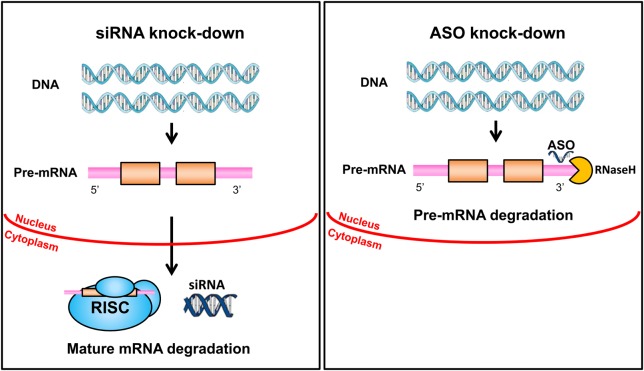
Comparison of siRNA and ASO knock-down. On the left, double-stranded silencing RNA oligonucleotides reach the cytoplasm where they engage the RNA-RISC, which is part of the RNAi pathway. This leads to the degradation of mature mRNA. On the right, single-stranded ASOs reach the nucleus where they bind to pre-mRNA and engage RNase H, which degrades the transcript.
Figure 2.
Figure 2.
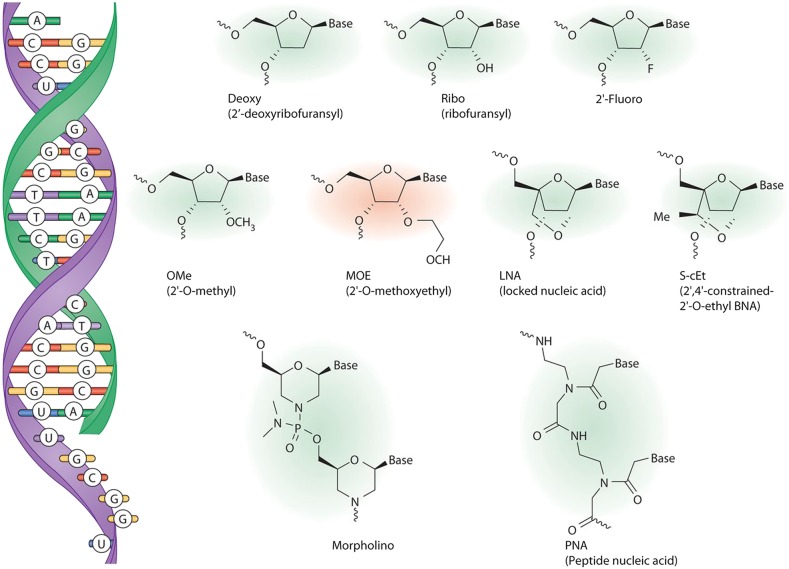
Nucleotide analogues used in ASO drugs. ASOs (green) bind to the target RNA (purple) by Watson–Crick base pairing (left). Chemical structures of various nucleotides or nucleotide analogues commonly used in antisense drugs are shown. The ASO developed by Isis Pharmaceuticals to improve SMN2 splicing has the 2′-methoxyethyl modification (red). Reproduced from Rigo et al. (2) with permission.
Figure 3.
Figure 3.
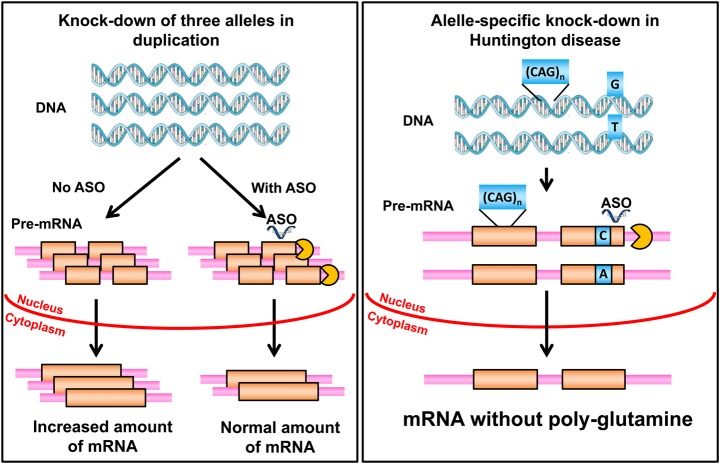
Comparison of all-allelic knock-down to allele-specific knock-down. On the left, a duplication such as occurs for PMP22 in CMT1A is depicted. An ASO is used to degrade a fraction of the pre-mRNA coming from all three alleles to decrease the amount of mature mRNA to the level that would ordinarily be produced by two copies of the gene. On the right, a triplet repeat expansion mutation encoding a polyglutamine tract in the protein is depicted. An ASO, at the site of a SNP in the transcript, is designed to hybridize with the allele that is in cis with the triplet repeat mutation. This leads to preferential degradation of the pre-mRNA from the mutant allele.
Figure 4.
Figure 4.
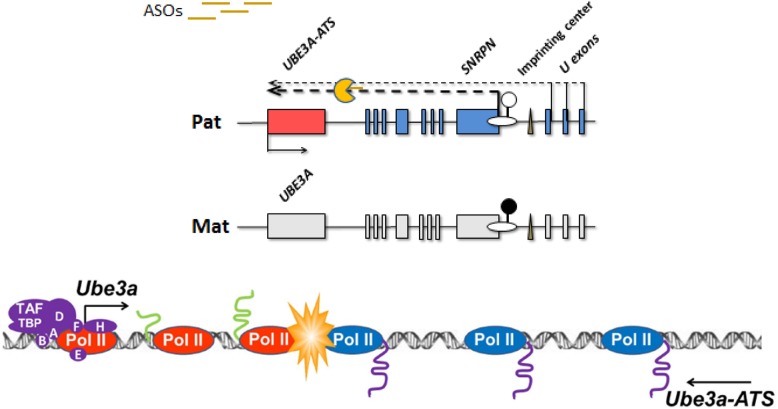
ASO knock-down of natural occurring antisense in Angelman syndrome. The upper panel depicts a deleted or otherwise inactivated maternal allele for the SNRPN to UBE3A genomic interval. A very long transcript starting in the SNRPN region has a UBE3A antisense component at its distal position. ASOs to the upstream of the antisense region lead to the degradation of the antisense. Transcription is initiated, but not fully elongated at the paternal copy of the UBE3A promoter. In the lower panel, a collision model, which agrees with available data blocks the full extension of UBE3A transcription thus silencing the paternal allele of UBE3A. The degradation of the antisense allows for the complete transcription of the UBE3A gene. Pol II in blue represents antisense transcription while Pol II in red represents sense transcription.
Figure 5.
Figure 5.
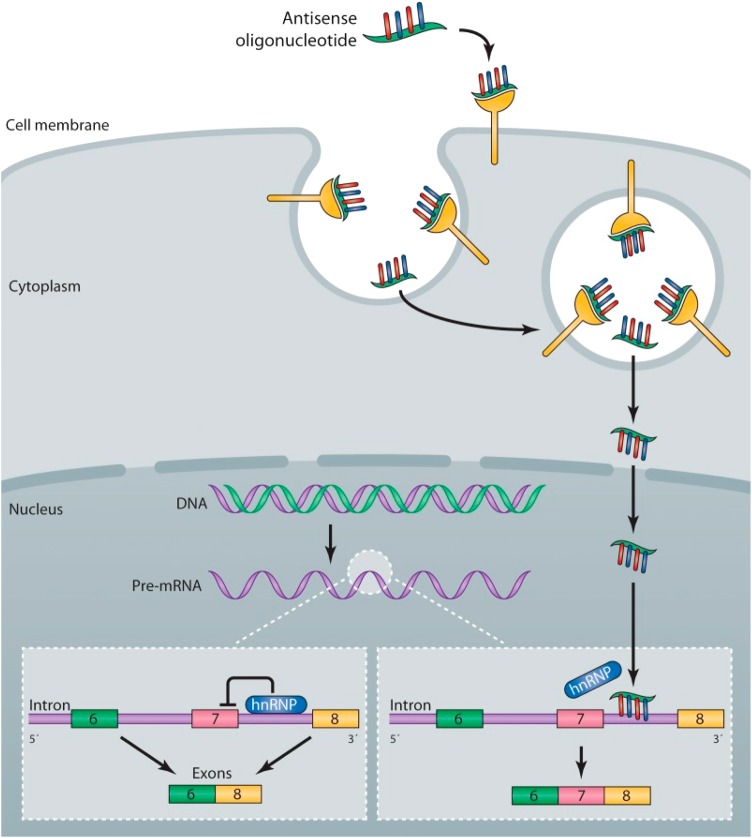
Mechanism of the action of an antisense drug that modulates SMN2 splicing. Single-stranded ASO are taken up into cells by an endocytic process via interaction with proteins expressed on the surface of cells. The ASOs escape the endosome and enter the nucleus, where they bind to the SMN2 pre-mRNA. The binding of the ASO to the RNA displaces an hnRNP protein that normally represses splicing of exon 7, resulting in the production of a mature mRNA that includes exon 7, which is translated into the full-length SMN protein. Reproduced from Rigo et al. (2) with permission.
Figure 6.
Figure 6.
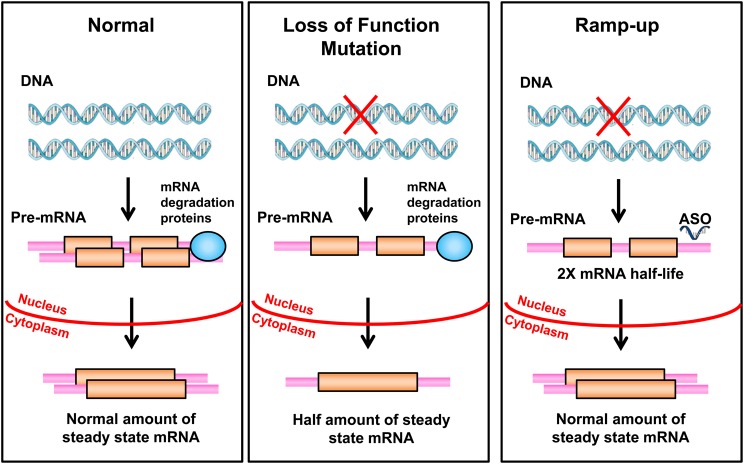
A proposed ramp-up strategy. A heterozygous deletion or other inactivating mutation is depicted in the right panel. A hypothetical process whereby an ASO would bind to the 3′-UTR of mature mRNA and by some yet to be developed technology, double its half-life is proposed. This would lead to the production of a normal level of the protein.

References

    1. Sztainberg Y., Chen H., Swann J., Hao S., Tang B., Wu Z., Tang J., Wan Y.-W., Zhandong Liy Z., Rigo F., Zoghbi H. (2015) Reversal of phenotypes in MECP2 duplication mice using genetic rescue or antisense oligonucleotides. Nature, 528, 123–126. - PMC - PubMed
    1. Rigo F., Hua Y., Krainer A.R., Bennett C.F. (2012) Antisense-based therapy for the treatment of spinal muscular atrophy. J. Cell Biol., 199, 21–25. - PMC - PubMed
    1. Bennett C.F., Swayze E.E. (2010) RNA targeting therapeutics: molecular mechanisms of antisense oligonucleotides as a therapeutic platform. Annu. Rev. Pharmacol. Toxicol., 50, 259–293. - PubMed
    1. Geary R.S., Norris D., Yu R., Bennett C.F. (2015) Pharmacokinetics, biodistribution and cell uptake of antisense oligonucleotides. Adv. Drug Deliv. Rev., 87, 46–51. - PubMed
    1. Rigo F., Seth P.P., Bennett C.F. (2014) Antisense oligonucleotide-based therapies for diseases caused by pre-mRNA processing defects. Adv. Exp. Med. Biol., 825, 303–352. - PubMed

Publication types