


In vitro drug susceptibility of 40 international reference rapidly growing mycobacteria to 20 antimicrobial agents
- PMID: 26629031
- PMCID: PMC4658920
In vitro drug susceptibility of 40 international reference rapidly growing mycobacteria to 20 antimicrobial agents
Abstract
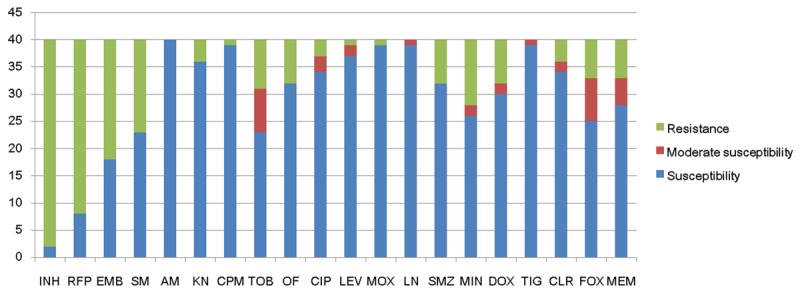
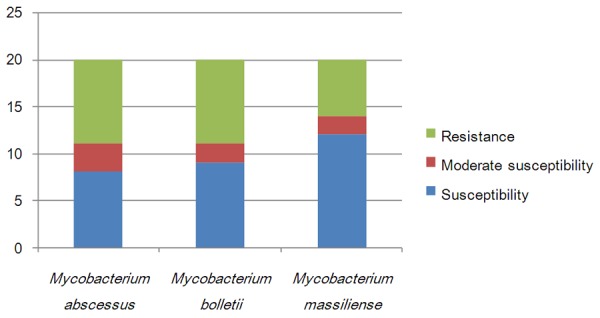
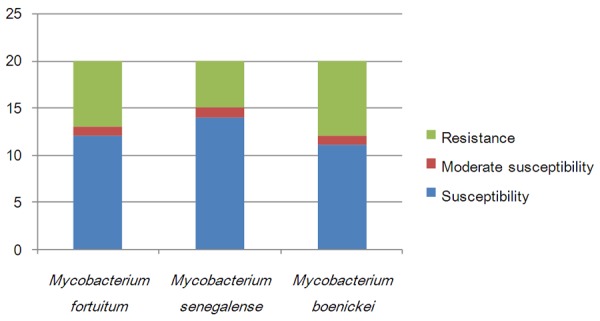
Rapidly growing mycobacteria (RGM) are human pathogens that are relatively easily identified by acid-fast staining but are proving difficult to treat in the clinic. In this study, we performed susceptibility testing of 40 international reference RGM species against 20 antimicrobial agents using the cation-adjusted Mueller-Hinton (CAMH) broth microdilution based on the minimum inhibitory concentration (MIC) assay recommended by the guidelines of the Clinical and Laboratory Standards Institute (CLSI). The results demonstrated that RGM organisms were resistant to the majority of first-line antituberculous agents but not to second-line fluoroquinolones or aminoglycosides. Three drugs (amikacin, tigecycline and linezolid) displayed potent antimycobacterial activity against all tested strains. Capreomycin, levofloxacin and moxifloxacin emerged as promising candidates for the treatment of RGM infections, and cefoxitin and meropenem were active against most strains. Mycobacterium chelonae (M. chelonae), M. abscessus, M. bolletii, M. fortuitum, M. boenickei, M. conceptionense, M. pseudoshottsii, M. septicum and M. setense were the most resistant RGM species. These results provide significant insight into the treatment of RGM species and will assist optimization of clinical criteria.
Keywords: Drug susceptibility; antimicrobial; minimum inhibitory concentration (MIC); rapidly growing mycobacteria (RGM); reference strains.
Figures
References
-
- Griffith DE, Aksamit T, Brown-Elliott BA, Catanzaro A, Daley C. An official ATS/IDSA statement: diagnosis, treatment, and prevention of nontuberculous mycobacterial diseases. Am J Respir Crit Care Med. 2007;175:367–416. - PubMed
-
- Preece CL, Perry A, Gray B, Kenna DT, Jones AL, Cummings SP, Robb A, Thomas MF, Brodlie M, O’Brien CJ, Bourke SJ, Perry JD. A novel culture medium for isolation of rapidly-growing mycobacteria from the sputum of patients with cystic fibrosis. J Cyst Fibros. 2015 [Epub ahead of print] - PubMed
LinkOut - more resources
Full Text Sources