Review
. 2015 Nov 26;6(4):281-9.
doi: 10.4331/wjbc.v6.i4.281.

Targeting amino acid metabolism in cancer growth and anti-tumor immune response

Affiliations
Review

Targeting amino acid metabolism in cancer growth and anti-tumor immune response

Elitsa Ananieva. World J Biol Chem. .

Abstract

Recent advances in amino acid metabolism have revealed that targeting amino acid metabolic enzymes in cancer therapy is a promising strategy for the development of novel therapeutic agents. There are currently several drugs in clinical trials that specifically target amino acid metabolic pathways in tumor cells. In the context of the tumor microenvironment, however, tumor cells form metabolic relationships with immune cells, and they often compete for common nutrients. Many tumors evolved to escape immune surveillance by taking advantage of their metabolic flexibility and redirecting nutrients for their own advantage. This review outlines the most recent advances in targeting amino acid metabolic pathways in cancer therapy while giving consideration to the impact these pathways may have on the anti-tumor immune response.

Keywords: Amino acid metabolism; Anti-tumor immune response; Cancer therapy; T cells; Tumor microenvironment.


Figures
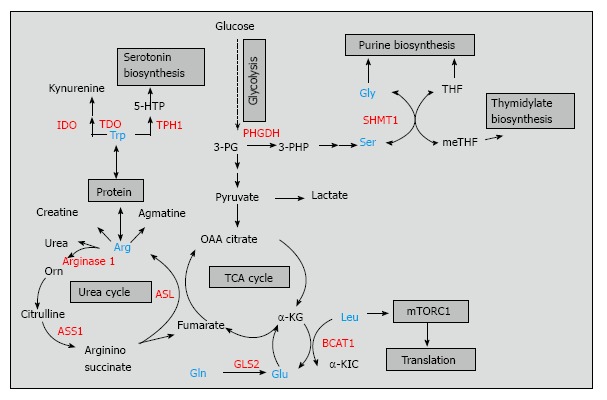
Figure 1
Figure 1
Schematic representation of amino acid metabolic pathways targeted in cancer therapy. The amino acid metabolism of Arg, Trp, Ser, Gly, Gln, Glu, and BCAAs interconnects with major catabolic and biosynthetic pathways shown in gray. Arg is an important precursor for creatine, urea, and agmatine synthesis while Trp is important for kynurenine and serotonin biosynthesis; Ser and Gly are major sources of methyl groups during purine and thymidylate biosynthesis; Leu is a known activator of complex 1 of mTOR pathway and Gln/Glu provide intermediates for the TCA cycle and restore glutathione to its reduced form. Metabolic enzymes catalyzing important steps in the metabolism of these amino acids are involved in clinical and/or preclinical cancer studies and are denoted in red. 5-HTP: 5-hydroxytrytophan; 3-PG: 3-phosphoglycerate; 3-PHP: 3-phosphohydroxy pyruvate; THF: Tetrahydrofolate; meTHF: Methyltetrahydrofolate; OAA: Oxaloacetate; α-KG: α-ketoglutarate; α-KIC: α-ketoisocaproate; Trp: Tryptophan; Arg: Arginine; Gln: Glutamine; Glu: Glutamate; BCAAs: Branched chain amino acids; Ser: Serine; Gly: Glycine; mTORC1: Complex 1 of the mammalian target of rapamycin; IDO: Indoleamine-2,3-dioxygenase; TDO: Tryptophan-2,3-dioxygenase; TPH1: Tryptophan hydroxylase-1; BCATc: Cytosolic branched chain aminotransferase; ASS1: Argininosuccinate synthetase 1; ASL: Argininosuccinate lyase; GLS2: Glutaminase 2; PHGDH: Phosphoglycerate dehydrogenase; SHMT1: Serine hydroxymethyl transferase 1.

References

    1. Macintyre AN, Rathmell JC. Activated lymphocytes as a metabolic model for carcinogenesis. Cancer Metab. 2013;1:5. - PMC - PubMed
    1. Marelli-Berg FM, Fu H, Mauro C. Molecular mechanisms of metabolic reprogramming in proliferating cells: implications for T-cell-mediated immunity. Immunology. 2012;136:363–369. - PMC - PubMed
    1. Fox CJ, Hammerman PS, Thompson CB. Fuel feeds function: energy metabolism and the T-cell response. Nat Rev Immunol. 2005;5:844–852. - PubMed
    1. Höckel M, Vaupel P. Tumor hypoxia: definitions and current clinical, biologic, and molecular aspects. J Natl Cancer Inst. 2001;93:266–276. - PubMed
    1. McNamee EN, Korns Johnson D, Homann D, Clambey ET. Hypoxia and hypoxia-inducible factors as regulators of T cell development, differentiation, and function. Immunol Res. 2013;55:58–70. - PMC - PubMed

LinkOut - more resources
