. 2015 Dec 3:5:17667.
doi: 10.1038/srep17667.

Profiling of conserved non-coding elements upstream of SHOX and functional characterisation of the SHOX cis-regulatory landscape

Affiliations

Profiling of conserved non-coding elements upstream of SHOX and functional characterisation of the SHOX cis-regulatory landscape

Hannah Verdin et al. Sci Rep. .

Abstract

Genetic defects such as copy number variations (CNVs) in non-coding regions containing conserved non-coding elements (CNEs) outside the transcription unit of their target gene, can underlie genetic disease. An example of this is the short stature homeobox (SHOX) gene, regulated by seven CNEs located downstream and upstream of SHOX, with proven enhancer capacity in chicken limbs. CNVs of the downstream CNEs have been reported in many idiopathic short stature (ISS) cases, however, only recently have a few CNVs of the upstream enhancers been identified. Here, we set out to provide insight into: (i) the cis-regulatory role of these upstream CNEs in human cells, (ii) the prevalence of upstream CNVs in ISS, and (iii) the chromatin architecture of the SHOX cis-regulatory landscape in chicken and human cells. Firstly, luciferase assays in human U2OS cells, and 4C-seq both in chicken limb buds and human U2OS cells, demonstrated cis-regulatory enhancer capacities of the upstream CNEs. Secondly, CNVs of these upstream CNEs were found in three of 501 ISS patients. Finally, our 4C-seq interaction map of the SHOX region reveals a cis-regulatory domain spanning more than 1 Mb and harbouring putative new cis-regulatory elements.


Figures
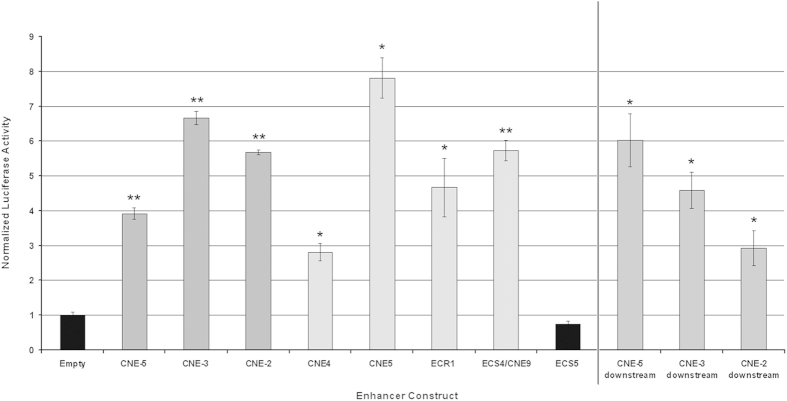
Figure 1
Figure 1. Enhancer activity of three upstream CNEs demonstrated by in vitro luciferase assays in human U2OS cells.
Luciferase reporter activity of U2OS cells transfected with the pGL3SHOXprom enhancer reporter plasmids and the Renilla luciferase control plasmid. The pGL3SHOXprom without any enhancer inserted was used as an empty vector, to normalize luciferase activity. Fold increase values were obtained by normalizing the relative luciferase units of each sample, first, with respect to the Renilla luciferase activity, and second, to that transfected with the empty reporter plasmid. All values represent the mean and standard deviation of two biological replicates with each sample assayed in triplicate. ECS5, localized outside of the deleted region and which has previously been shown not to have enhancer activity, was utilized as a negative control. The downstream SHOX enhancer regions CNE4, CNE5, ECR1 and CNE9/ECS4 were utilized as positive controls. Increased luciferase activity was observed for all three upstream SHOX enhancer constructs, CNE-5, CNE-3 and CNE-2 constructs and the positive controls.
Figure 2
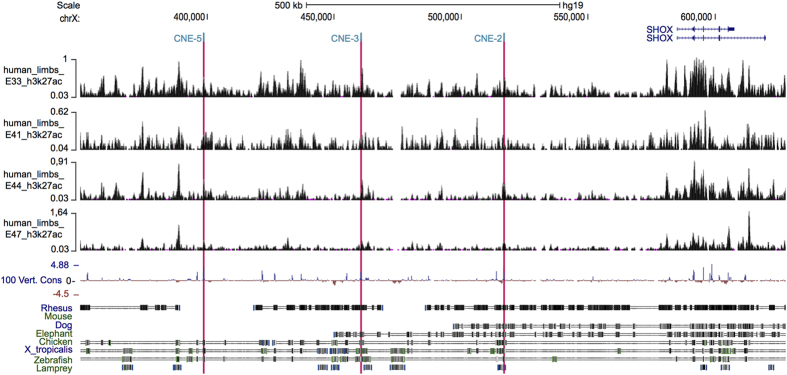
Figure 2. H3K27ac distribution of the SHOX locus in human embryonic limbs from embryonic day 33 (E33) through E47.
Overview of the human SHOX locus (chrX:350,000–628,000; UCSC, Human Genome Browser, hg19), showing the distribution of enhancer-associated H3K27ac histone marks at different human embryonic limb bud stages, produced by Cotney et al. (2013) and retrieved from GEO dataset GSE42413. Four embryonic stages are represented: E33, E41, E44 and E47. Upstream enhancers CNE-5, CNE-3 and CNE-2 are highlighted with red bars. The two SHOX isoforms are represented in blue at the top. A conservation track is represented at the bottom.
Figure 3
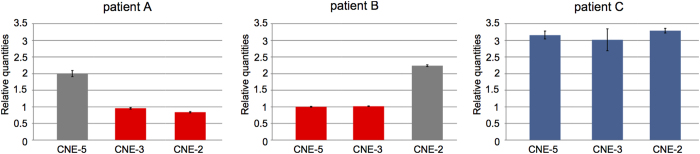
Figure 3. Copy number profiling of upstream CNEs (CNE-5, CNE-3 and CNE-2) revealing two upstream deletions and one duplication.
Each panel shows the results of the CNV analysis using qPCR. The qPCR-derived copy number results are presented as relative quantities in a bar chart. Normal copy numbers are represented in grey, deletions are shown in red and duplications in blue. Error bars are added to allow interpretation of the assay’s precision.
Figure 4
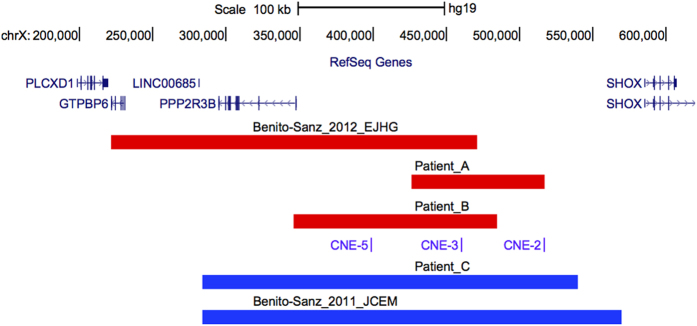
Figure 4. Overview of all reported upstream CNVs in the SHOX region.
Overview of the SHOX region (hg19: chrX:151,000-628,000; UCSC, Human Genome Browser, hg19) with custom tracks showing the deletions (red bars) and duplications (blue bars) identified in this and previous studies. A custom track representing the upstream enhancers (CNE-5, CNE-3 and CNE-2) is included, the RefSeq Genes track is shown at the top.
Figure 5
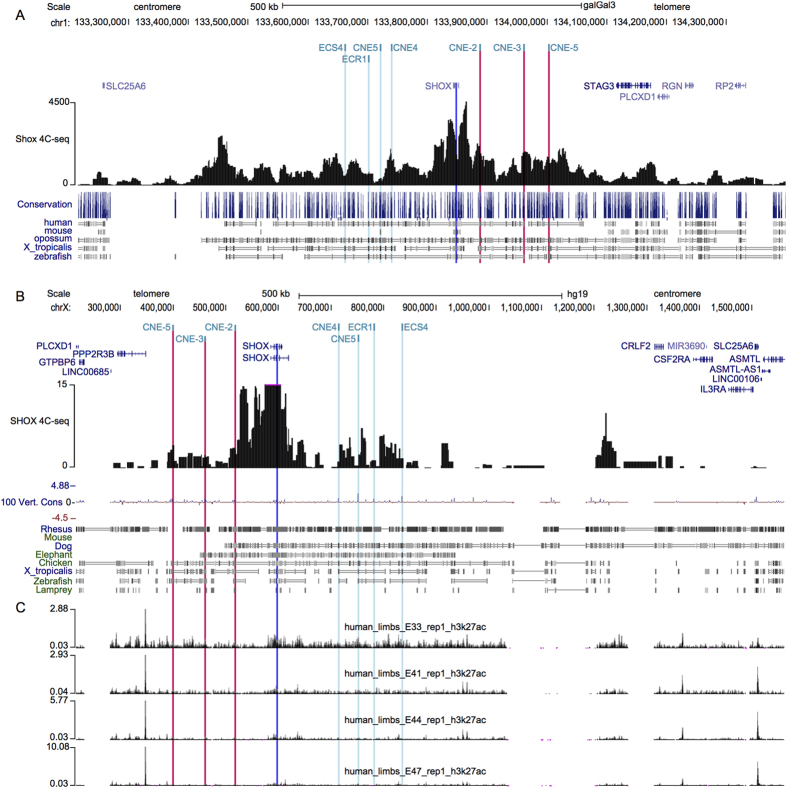
Figure 5. 4C-seq chromatin interaction map of the cis-regulatory region surrounding SHOX.
(A) 4C-seq data of the chicken Shox locus (chr1:133,215,000-134,400,000; UCSC, galGal3) showing that the Shox promoter (blue bar, viewpoint) interacts with 800 kb of adjacent genomic regions that likely contain Shox cis-regulatory regions, a region syntenic with about 1 Mb of human genomic DNA (shown in panel (B)). Red bar marks the position of the upstream CNEs. The 4C-seq data indicate that the Shox regulatory landscape extends both upstream and downstream of the currently known, functionally validated enhancers. (B) 4C-seq data of the human SHOX locus (chrX:215,733–1,561,244; UCSC, hg19) showing that the SHOX promoter (blue bar, viewpoint) interacts with the upstream enhancers (red bars). The RefSeq Genes are shown a the top and the conservation track is included at the bottom of panel (B). (C) Distribution of enhancer-associated H3K27ac histone marks at different human embryonic limb bud stages, produced by Cotney et al. (2013).

References

    1. Rao E. et al. Pseudoautosomal deletions encompassing a novel homeobox gene cause growth failure in idiopathic short stature and Turner syndrome. Nat Genet 16, 54–63 (1997). - PubMed
    1. Rao E. et al. The Leri-Weill and Turner syndrome homeobox gene SHOX encodes a cell-type specific transcriptional activator. Hum Mol Genet 10, 3083–3091 (2001). - PubMed
    1. Clement-Jones M. et al. The short stature homeobox gene SHOX is involved in skeletal abnormalities in Turner syndrome. Hum Mol Genet 9, 695–702 (2000). - PubMed
    1. Kleinjan D. A. & Van Heyningen V. Long-range control of gene expression: emerging mechanisms and disruption in disease. Am J Hum Genet 76, 8–32 (2005). - PMC - PubMed
    1. Fukami M., Kato F., Tajima T., Yokoya S. & Ogata T. Transactivation function of an approximately 800-bp evolutionarily conserved sequence at the SHOX 3′ region: implication for the downstream enhancer. Am J Hum Genet 78, 167–170 (2006). - PMC - PubMed

Publication types

Associated data