Review
. 2015 Dec 2;5(4):3416-37.
doi: 10.3390/biom5043416.

VGLUTs and Glutamate Synthesis-Focus on DRG Neurons and Pain

Affiliations
Review

VGLUTs and Glutamate Synthesis-Focus on DRG Neurons and Pain

Mariana Malet et al. Biomolecules. .

Abstract

The amino acid glutamate is the principal excitatory transmitter in the nervous system, including in sensory neurons that convey pain sensation from the periphery to the brain. It is now well established that a family of membrane proteins, termed vesicular glutamate transporters (VGLUTs), serve a critical function in these neurons: they incorporate glutamate into synaptic vesicles. VGLUTs have a central role both under normal neurotransmission and pathological conditions, such as neuropathic or inflammatory pain. In the present short review, we will address VGLUTs in the context of primary afferent neurons. We will focus on the role of VGLUTs in pain triggered by noxious stimuli, peripheral nerve injury, and tissue inflammation, as mostly explored in transgenic mice. The possible interplay between glutamate biosynthesis and VGLUT-dependent packaging in synaptic vesicles, and its potential impact in various pain states will be presented.

Keywords: DRG; axotomy; glutamate; neuropathy; neuropeptides; pain; peripheral nerves; sensory neurons; vesicular glutamate transporter; visceral organs.


Figures
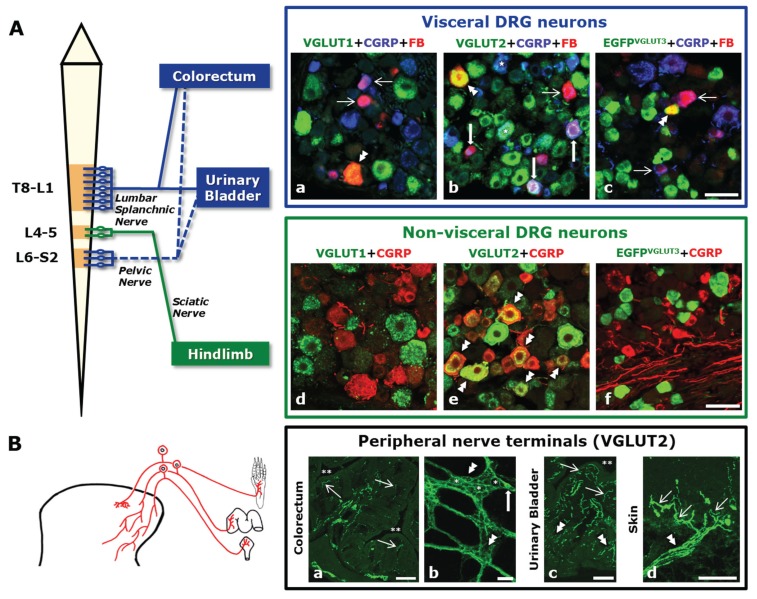
Figure 1
Figure 1
(A) (Left panel) Schematic diagram showing the spinal cord and the dorsal root ganglia (DRG) levels involved in the formation of the lumbar splanchnic, pelvic, and sciatic nerves. Colorectum and urinary bladder are examples of visceral pelvic organs receiving dual innervation by the lumbar splanchnic and pelvic nerves. Note that, for clarity, only L4–5 DRGs are depicted as supplying the sciatic nerve and innervating non-visceral tissues in the hindlimb (even though a small contribution of L6 is also common). (Top right panel) Fluorescence micrographs of DRG sections incubated with calcitonin gene-related peptide (CGRP) and vesicular glutamate transporter-1 (VGLUT1), VGLUT2, or EGFP antisera (EGFP is used as a reporter gene of VGLUT3) and where labeled urinary bladder-projecting neurons can be detected by their content of the retrograde tracer fast blue (previously injected into the subserosal space). Some urinary bladder neurons express VGLUT1 or EGFPVGLUT3 (double arrowheads in a, c); many others only express calcitonin gene-related peptide (CGRP) (thin arrows in a, c). In contrast, VGLUT2 is commonly expressed by urinary bladder neurons (double arrowhead and thick arrows in b), often along with CGRP (thick arrows in b). Bottom right panel: Fluorescence micrographs of L4-5 DRG sections incubated with CGRP and VGLUT1, VGLUT2, or EGFP antisera. Many neurons express VGLUT2, in most cases coexpressing with CGRP (double arrowheads in e). VGLUT1 and VGLUT3 appear more modestly expressed, and virtually never in association with CGRP (d, f). Many VGLUT1-, VGLUT2- and EGFPVGLUT3-only visceral and non-visceral DRG neurons can also be seen (d–f). (B) Left panel: Schematic diagram showing three representative DRG neurons projecting towards visceral organs (urinary bladder and colorectum) or the hindpaw (the central projections of these neurons and their termination (widespread distribution for visceral endings; narrow distribution for cutaneous endings) in the dorsal horn are also depicted). Right panel: (double asterisk indicates visceral organ lumen) The profuse VGLUT2 expression in nerve terminals reaching the colorectum (a, b), the urinary bladder (c) and the hindpaw glabrous skin (d) is shown. Many nerve terminals in the colorectal mucosa (thin arrows in (a) as well as myenteric plexus (double arrowheads in b) express VGLUT2. Within the myenteric plexus islets, several neurons lacking VGLUT2 can be observed (single asterisks in b), although occasional neurons expressing the transporter can be detected (thick arrow in b). In the urinary bladder, a profuse VGLUT2-expressing neuropil is detected both in muscular (double arrowheads in c) and mucosal layers (thin arrows in c). Finally, the skin is also provided with abundant nerve terminals expressing VGLUT2 (thin arrows in d) stemming from thick nerve bundles (double arrowhead in d). Scale bars: 50 µm (A: a–f; B: b); 100 µm (B: d); 200 µm (B: a, c). (Immunohistochemical techniques used in A: a–f and B: a–c are the same as in [7,8,9]; Figure B, subfigure d has been partially modified (with permission) from [9]).
Figure 2
Figure 2
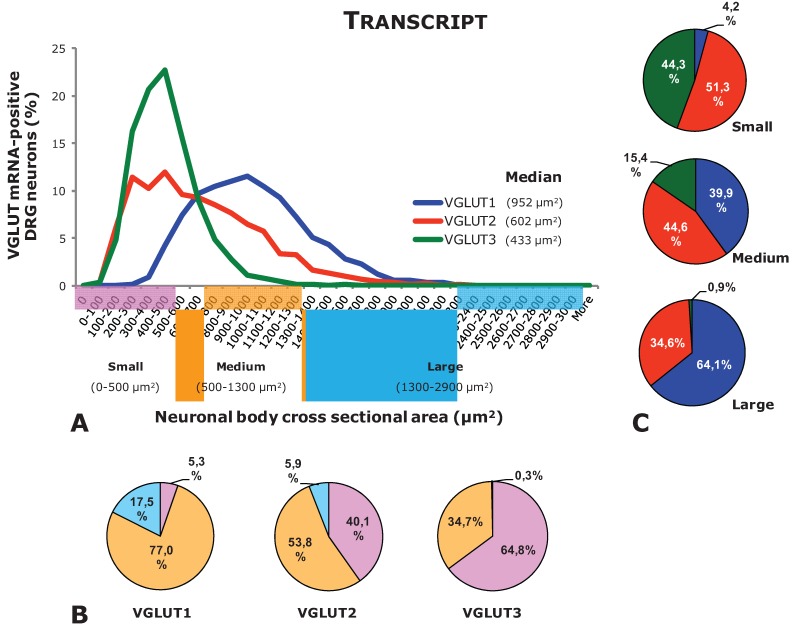
Neuronal size distribution of DRG neurons positive for VGLUT1-VGLUT3 mRNA (based on data from [13]). (A) Histogram showing the size distribution of L4-5 DRG neurons expressing the transcript of VGLUT1, VGLUT2, or VGLUT3 (Percentages were obtained comparing cell soma size at each value in “X” with the total number of neurons measured for each VGLUT). (B) Pie charts showing the percentage of small, medium-sized, and large DRG neurons relative to each VGLUT. (C) Pie charts showing the percentage of VGLUT1-, VGLUT2-, or VGLUT3-positive DRG neurons relative to each neuronal size.
Figure 3
Figure 3
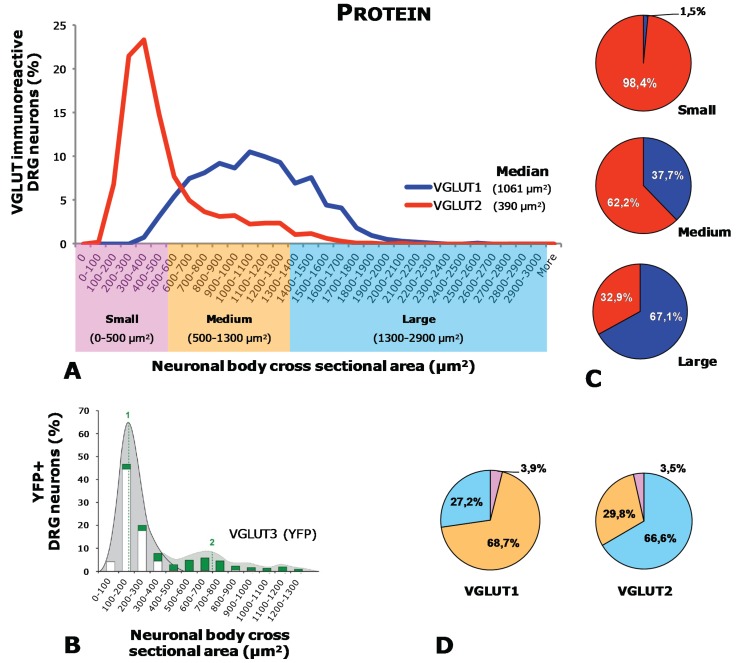
Neuronal size distribution of DRG neurons positive for VGLUT1-VGLUT3 protein (based on data from [9]). Figure in B was taken from [31] and partially modified with kind permission of Prof. Sandkühler). (A) Histogram showing the size distribution of L4–5 DRG neurons immunoreactive for VGLUT1 or VGLUT2 (Percentages were obtained comparing cell soma size at each value in “X” with the total number of neurons measured for each VGLUT). (B) Histogram showing the size distribution of Yellow Fluorescent Protein-positive (used here for identification of VGLUT3) DRG neurons. (C) Pie charts showing the percentage of small, medium-sized, and large DRG neurons relative to VGLUT1 or VGLUT2. (D) Pie charts showing the percentage of VGLUT1- or VGLUT2-positive DRG neurons relative to each neuronal size.

References

    1. Bennett G.J. Animal Models of Pain. In: Kruger L., editor. Methods in Pain Research. CRC Press; Boca Raton, FL, USA: 2001. pp. 67–92.
    1. Robinson D.R., Gebhart G.F. Inside information: the unique features of visceral sensation. Mol. Interv. 2008;8:242–253. doi: 10.1124/mi.8.5.9. - DOI - PMC - PubMed
    1. Mogil J.S., Wilson S.G., Wan Y. Assessing nociception in murine subjects. In: Kruger L., editor. Methods in Pain Research. CRC Press; Boca Ratón, FL, USA: 2001. pp. 11–40.
    1. Wang J.J., Ho S.T., Hu O.Y., Chu K.M. An innovative cold tail-flick test: The cold ethanol tail-flick test. Anesth. Analg. 1995;80:102–107. - PubMed
    1. Brenner D.S., Golden J.P., Gereau R.W.T. A novel behavioral assay for measuring cold sensation in mice. PLoS ONE. 2012;7:e39765. doi: 10.1371/journal.pone.0039765. - DOI - PMC - PubMed

Substances

LinkOut - more resources