


Frailty still matters to health and survival in centenarians: the case of China
- PMID: 26634246
- PMCID: PMC4669603
- DOI: 10.1186/s12877-015-0159-0
Frailty still matters to health and survival in centenarians: the case of China
Abstract
Background: Frailty indicates accumulated vulnerability of adverse health outcomes in later life. Its robustness in predicting dependent living, falls, comorbidity, disability, health change, mortality, and health care utilization at older ages is well-documented. However, almost no studies have ever attempted to examine its robustness in centenarians, mainly due to data unavailability. This study examines prevalence of frailty in centenarians and its predictive powers on subsequent mortality and health conditions.
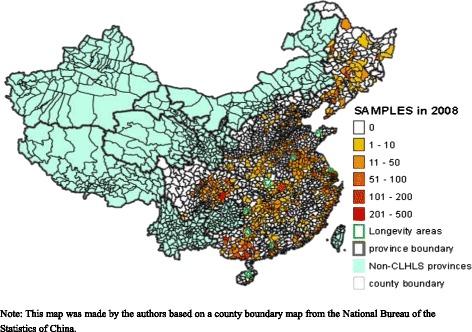
Methods: We use a sample of 4434 centenarians from the 2002, 2005, 2008, and 2011 waves of the Chinese Longitudinal Healthy Longevity Survey (CLHLS), with elders in three younger age groups 65-79, 80-89, and 90-99 as comparisons. Frailty is measured by a cumulative deficit index (DI) that is constructed from 39 variables covering physical and cognitive function, disease conditions, psychological well-being, and other health dimensions. Survival analysis is conducted to examine how frailty is associated with subsequent mortality at an average follow-up length of 3.7 years (2.6 years for deceased persons died in 2002-2011 and 7.6 years for survived persons at the 2011 wave). Logistic regressions are applied to examine how frailty is associated with subsequent physical and cognitive functions, disease conditions, and self-rated health with an average follow-up length of 3.0 years.
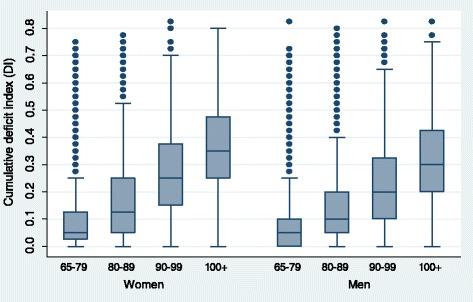
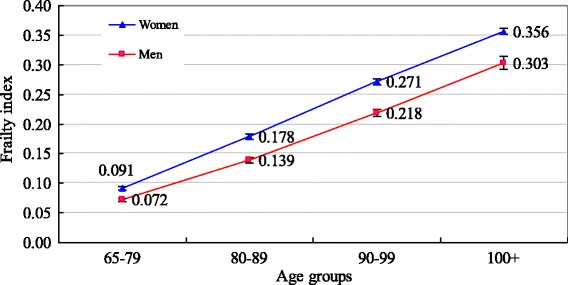
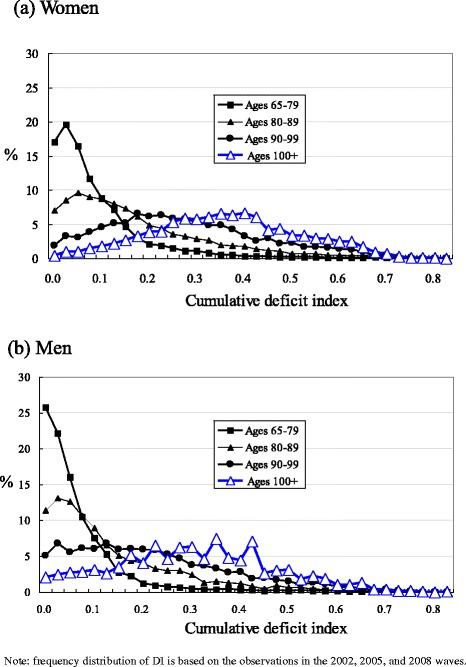
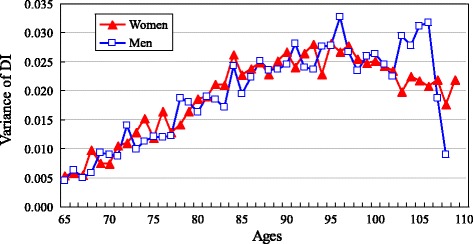
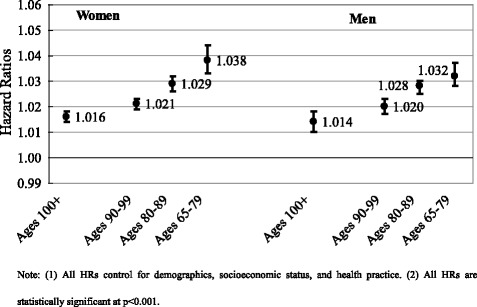
Results: The study reveals that centenarians are frailer than younger elders. The DI scores increase from less than 0.1 at ages 65-79 to over 0.30 in centenarians. Women are frailer than men at all ages. However, there is a great variation in frailty among all age groups. We also find that each additional increase of 0.01 score of the DI is associated with 1.6 % higher mortality risk (95 % CI: 1.014-1.018) in female centenarians and 1.4 % higher mortality risk (95 % CI: 1.010-1.018) in male centenarians, although these associations are weaker than those in other three younger age groups.
Conclusions: Frailty still plays an important role in determining subsequent health outcomes and mortality in centenarians.
Figures
References
-
- Kulminski A, Yashin A, Arbeev K, Akushevich I, Ukraintseva S, Land KC, et al. Accumulation of heath disorders as an indicator of aging-associated processes in the elderly: Results from analyses of the National Long-term Care Survey. Mech Ageing Dev. 2007;128:250–8. doi: 10.1016/j.mad.2006.12.004. - DOI - PMC - PubMed
Publication types
MeSH terms
Grants and funding
LinkOut - more resources
Full Text Sources
Other Literature Sources
Medical
