


The Effect of Ethnicity on Human Axillary Odorant Production
- PMID: 26634572
- PMCID: PMC4724538
- DOI: 10.1007/s10886-015-0657-8
The Effect of Ethnicity on Human Axillary Odorant Production
Abstract
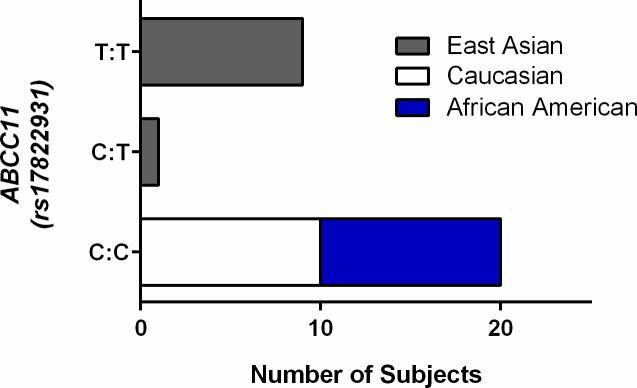
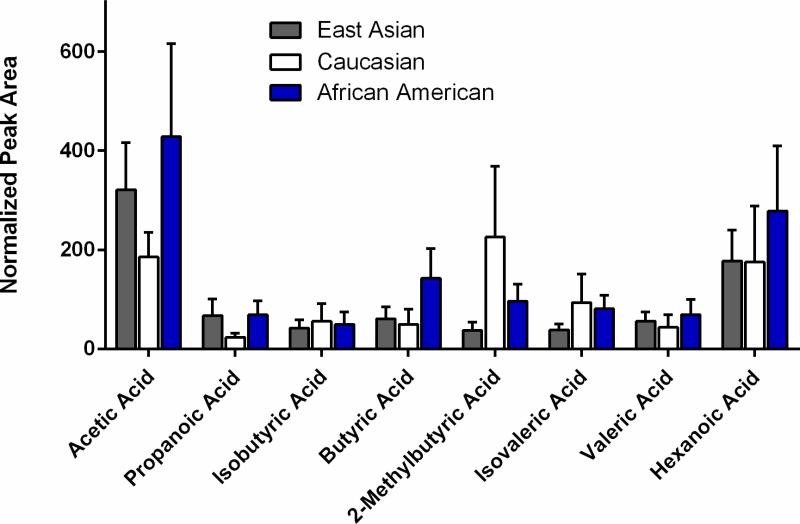
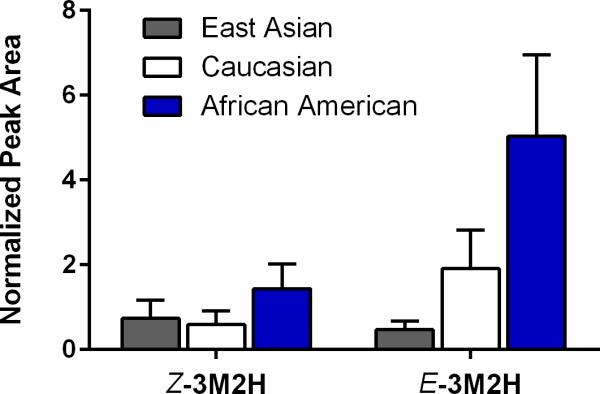
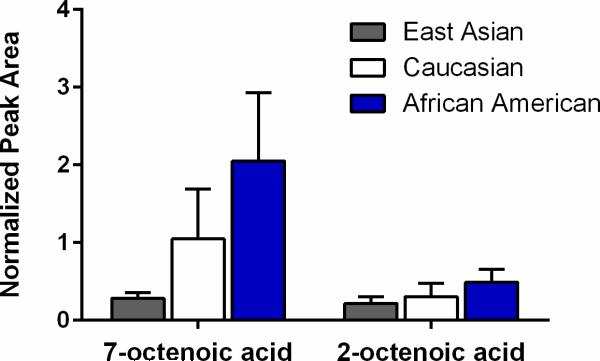
Previous findings from our laboratory highlighted marked ethnic differences in volatile organic compounds (VOCs) from cerumen among individuals of Caucasian, East Asian, and African-American descent, based, in part, on genetic differences in a gene that codes for a transport protein, which is a member of the ATP-binding cassette transporter, sub-family C, member 11 (ABCC11). In the current work, we hypothesized that axillary odorants produced by East Asians would differ markedly from those obtained from individuals of European or African descent based on the pattern of ethnic diversity that exists in ABCC11. Using gas chromatography/mass spectrometry (GC/MS) we examined differences in axillary odorant VOCs among 30 individuals of African-American, Caucasian, and East Asian descent with respect to their ABCC11 genotype. While no qualitative differences in the type of axillary odorants were observed across ethnic groups, we found that characteristic axillary odorants varied quantitatively with respect to ethnic origin. We propose that ABCC11 is not solely responsible for predicting the relative amounts of volatiles found in axillary secretions and that other biochemical pathways must be involved.
Keywords: Analytical chemistry; Axillary odor; Ethnicity/race; Genetics; Volatile organic compounds.
Figures
References
-
- Akutsu T, Sekiguchi K, Ohmori T, Sakurada K. Individual comparisons of the levels of (E)-3-methyl-2-hexenoic acid, an axillary odor-related compound. Japanese. Chem Senses. 2006;31:557–563. - PubMed
-
- Annigan J. [24 October 2014];Foods that are highest in isoleucine & leucine. 2014 http://www.livestrong.com/article/275274-foods-that-are-highest-in-isole...
-
- Barzantny H, Brune I, Tauch A. Molecular basis of human body odour formation: Insights deduced from corynebacterial genome sequences. Int J Cosmetic Sci. 2012;34:2–11. - PubMed
-
- Baumann T, Bergmann S, Schmidt-Rose T, Max H, Martin A, Enthaler B, Terstegen L, Schweiger D, Kalbacher H, Wenck H, et al. Glutathione-conjugated sulfanylalkanols are substrates for ABCC11 and gamma-glutamyl transferase 1: A potential new pathway for the formation of odorant precursors in the apocrine sweat gland. Exp Dermatol. 2014;23:247–252. - PMC - PubMed
-
- Bird S, Gower DB. The validation and use of a radioimmunoassay for 5 alpha-androst-16-en-3-one in human axillary collections. J Steroid Biochem. 1981;14:213–219. - PubMed
Publication types
MeSH terms
Substances
Grants and funding
LinkOut - more resources
Full Text Sources
Other Literature Sources
Miscellaneous
