Review
. 2015 Nov 26:6:1313.
doi: 10.3389/fmicb.2015.01313. eCollection 2015.

The Role of Ciliate Protozoa in the Rumen

Affiliations
Review

The Role of Ciliate Protozoa in the Rumen

Charles J Newbold et al. Front Microbiol. .

Abstract

First described in 1843, Rumen protozoa with their striking appearance were assumed to be important for the welfare of their host. However, despite contributing up to 50% of the bio-mass in the rumen, the role of protozoa in rumen microbial ecosystem remains unclear. Phylogenetic analysis of 18S rDNA libraries generated from the rumen of cattle, sheep, and goats has revealed an unexpected diversity of ciliated protozoa although variation in gene copy number between species makes it difficult to obtain absolute quantification. Despite repeated attempts it has proven impossible to maintain rumen protozoa in axenic culture. Thus it has been difficult to establish conclusively a role of ciliate protozoa in rumen fiber degradation. The development of techniques to clone and express ciliate genes in λ phage, together with bioinformatic indices to confirm the ciliate origin of the genes has allowed the isolation and characterization of fibrolytic genes from rumen protozoa. Elimination of the ciliate protozoa increases microbial protein supply by up to 30% and reduces methane production by up to 11%. Our recent findings suggest that holotrich protozoa play a disproportionate role in supporting methanogenesis whilst the small Entodinium are responsible for much of the bacterial protein turnover. As yet no method to control protozoa in the rumen that is safe and practically applicable has been developed, however a range of plant extract capable of controlling if not completely eliminating rumen protozoa have been described.

Keywords: defaunation; methane; microbial diversity; protozoa; rumen.


Figures
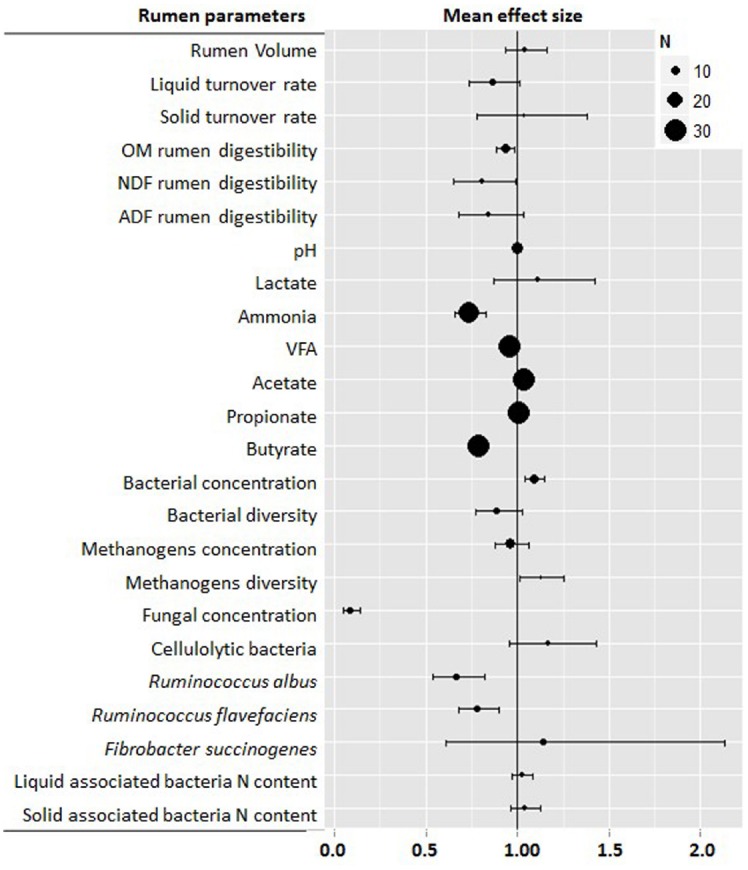
FIGURE 1
FIGURE 1
Meta-analysis describing the effects of defaunation on rumen function. For each parameter information is provided about the number of studies, observations (n), and range of values. Graph shows the mean effects and 95% confidential intervals. Values below one indicate a negative effect, while those above one indicate a positive effect of defaunation on that particular parameter.
FIGURE 2
FIGURE 2
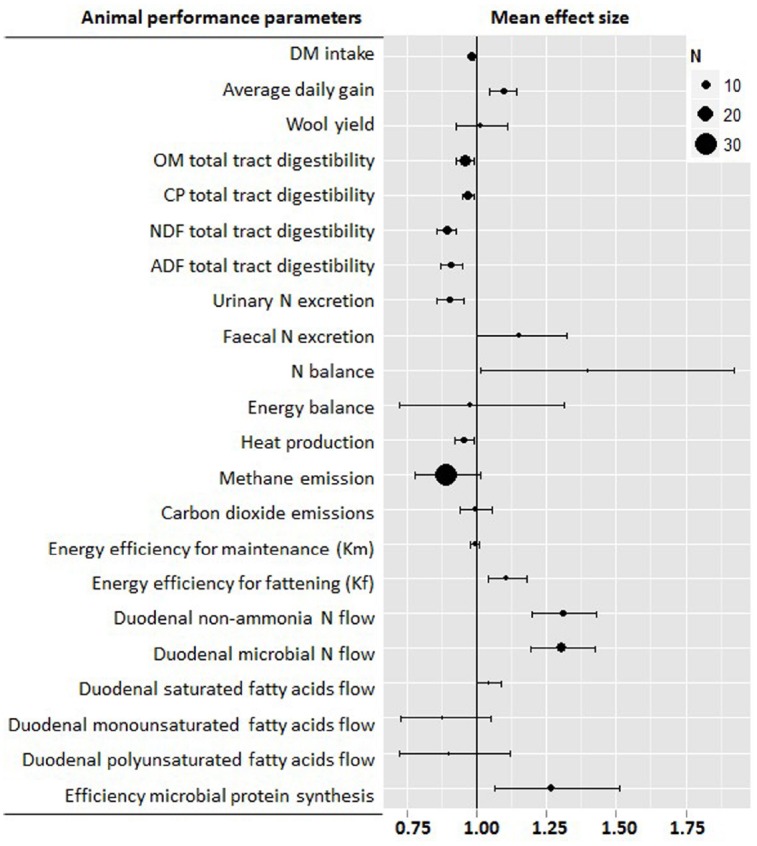
Meta-analysis describing the effects of defaunation animal performance. For each parameter information is provided about the number of studies, observations (n), and range of values. Graph shows the mean effects and 95% confidential intervals. Values below one indicate a negative effect, while those above one indicate a positive effect of defaunation on that particular parameter.

References

    1. Abe M., Iriki T., Tobe N., Shibui H. (1981). Sequestration of holotrich protozoa in the reticulo-rumen of cattle. Appl. Environ. Microbiol. 41, 758–765. - PMC - PubMed
    1. Amaral-Zettler L. A., McCliment E. A., Ducklow H. W., Huse S. M. (2009). A method for studying protistan diversity using massively parallel sequencing of v9 hypervariable regions of small-subunit ribosomal RNA genes. PLoS ONE 4:e6372. 10.1371/journal.pone.0006372 - DOI - PMC - PubMed
    1. Amaral-Zettler L. A., Zettler E. R., Theroux S. M., Palacios C., Aguilera A., Amils R. (2011). Microbial community structure across the tree of life in the extreme Rio Tinto. ISME J. 5, 42–50. 10.1038/ismej.2010.101 - DOI - PMC - PubMed
    1. Bailey R. W., Clarke R. T., Wright D. E. (1962). Carbohydrases of the rumen ciliate Epidinium ecaudatum (Crawley). Biochem. J. 83, 517–523. 10.1042/bj0830517 - DOI - PMC - PubMed
    1. Belanche A., Abecia L., Holtrop G., Guada J. A., Castrillo C., de la Fuente G., et al. (2011). Study of the effect of presence or absence of protozoa on rumen fermentation and microbial protein contribution to the chyme. J. Anim. Sci. 89, 4163–4174. 10.2527/jas.2010-3703 - DOI - PubMed