


Expanding Omics Resources for Improvement of Soybean Seed Composition Traits
- PMID: 26635846
- PMCID: PMC4657443
- DOI: 10.3389/fpls.2015.01021
Expanding Omics Resources for Improvement of Soybean Seed Composition Traits
Abstract
Food resources of the modern world are strained due to the increasing population. There is an urgent need for innovative methods and approaches to augment food production. Legume seeds are major resources of human food and animal feed with their unique nutrient compositions including oil, protein, carbohydrates, and other beneficial nutrients. Recent advances in next-generation sequencing (NGS) together with "omics" technologies have considerably strengthened soybean research. The availability of well annotated soybean genome sequence along with hundreds of identified quantitative trait loci (QTL) associated with different seed traits can be used for gene discovery and molecular marker development for breeding applications. Despite the remarkable progress in these technologies, the analysis and mining of existing seed genomics data are still challenging due to the complexity of genetic inheritance, metabolic partitioning, and developmental regulations. Integration of "omics tools" is an effective strategy to discover key regulators of various seed traits. In this review, recent advances in "omics" approaches and their use in soybean seed trait investigations are presented along with the available databases and technological platforms and their applicability in the improvement of soybean. This article also highlights the use of modern breeding approaches, such as genome-wide association studies (GWAS), genomic selection (GS), and marker-assisted recurrent selection (MARS) for developing superior cultivars. A catalog of available important resources for major seed composition traits, such as seed oil, protein, carbohydrates, and yield traits are provided to improve the knowledge base and future utilization of this information in the soybean crop improvement programs.
Keywords: genome-wide association study (GWAS); genomics; legumes; next-generation sequencing (NGS); omics; quantitative trait loci (QTL); seed traits; soybean.
Figures
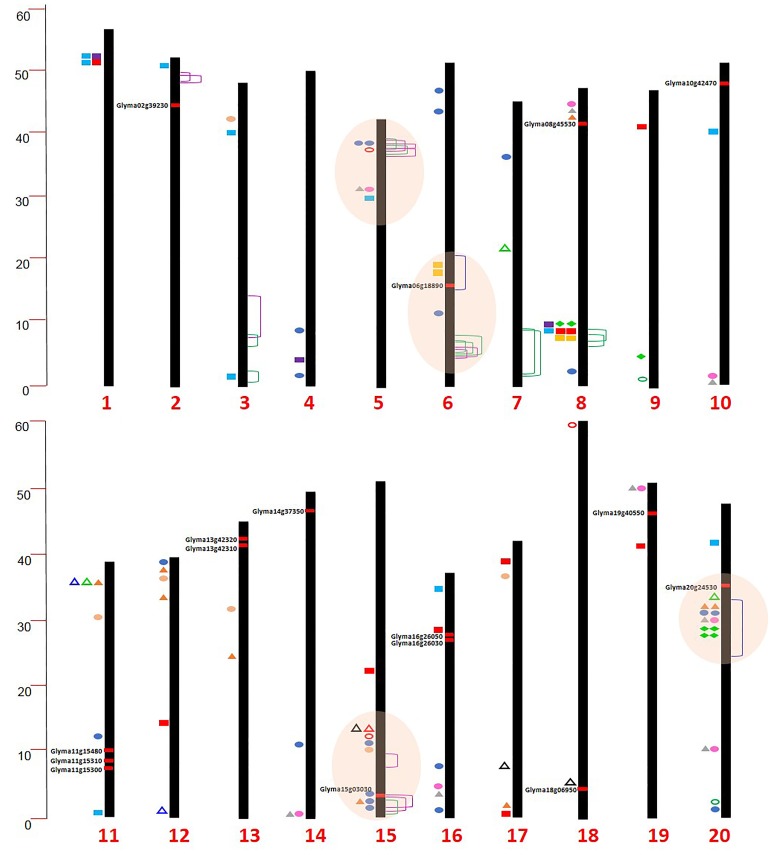
 Protein,
  Oil,
Oil,  Cysteine,
  Lysine,
  Methionine,
  Threonine,
  Sucrose,
  Stachyose (Vaughn et al., 2014);
  Protein and oil (Hwang et al., 2014);
  Protein,
  Oil (Sonah et al., 2015);
  Glucose,
  Sucrose,
  Fructose,
  Stachyose (Wang et al., 2014b);
  Protein,
  Oil (Pathan et al., 2013),
  Protein, Methionine (Warrington et al., 2015).
References
-
- Akond M., Liu S., Schoener L., Anderson J. A., Kantartzi S. K., Meksem K., et al. (2013). SNP-Based genetic linkage map of soybean using the SoySNP6K Illumina Infinium BeadChip genotyping array. J. Plant Genom. Sci. 1, 80–89. 10.5147/jpgs.2013.0090 - DOI
Publication types
LinkOut - more resources
Full Text Sources
Other Literature Sources
Miscellaneous
