


Extending Ripley's K-Function to Quantify Aggregation in 2-D Grayscale Images
- PMID: 26636680
- PMCID: PMC4670231
- DOI: 10.1371/journal.pone.0144404
Extending Ripley's K-Function to Quantify Aggregation in 2-D Grayscale Images
Abstract
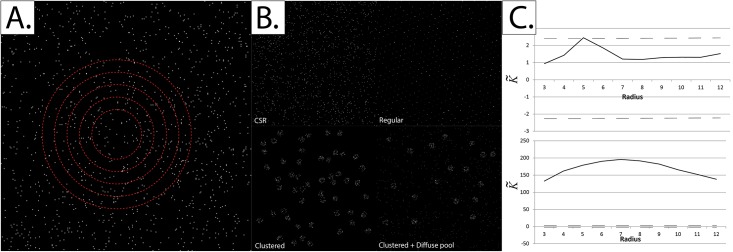
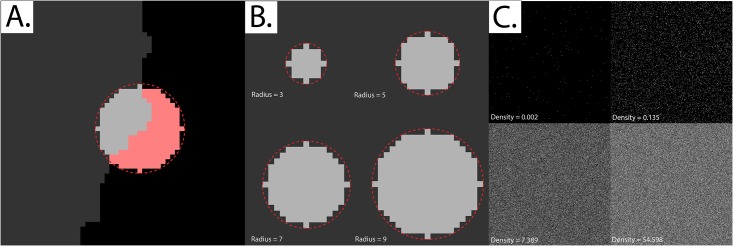
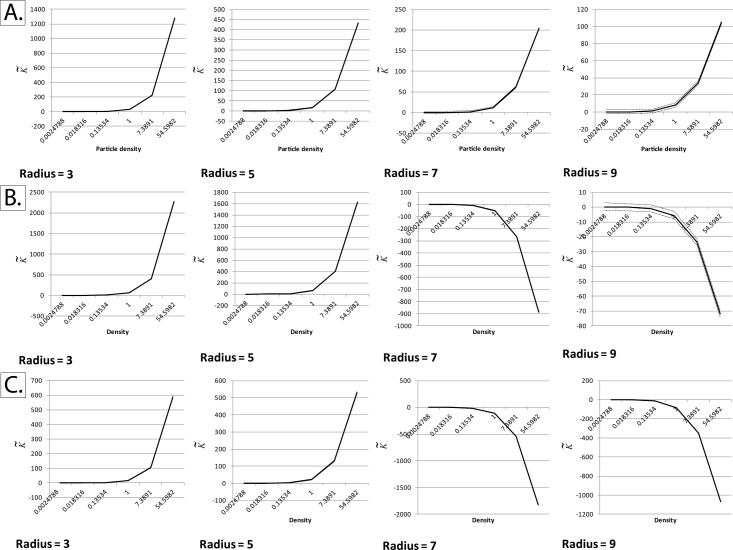
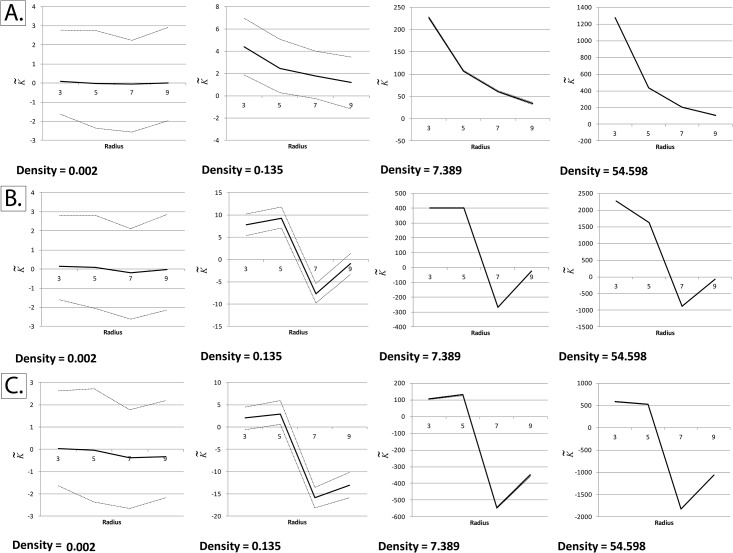
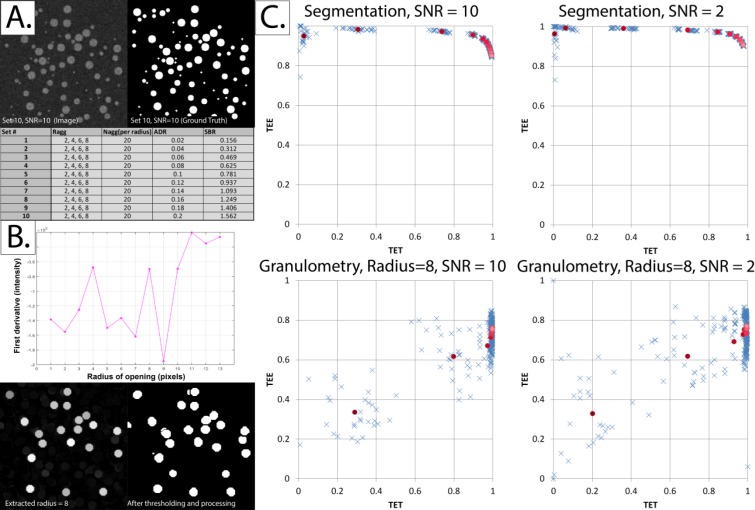
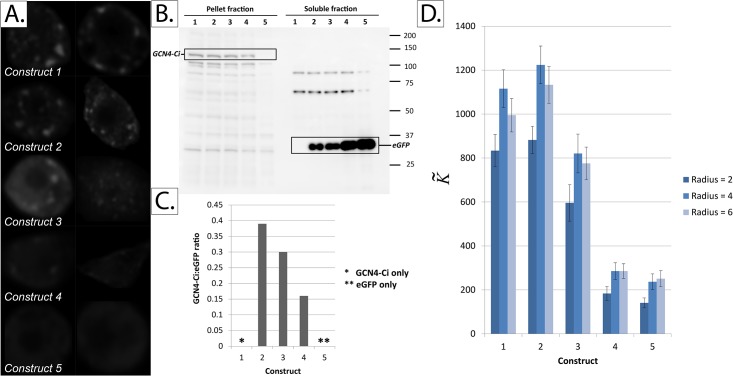
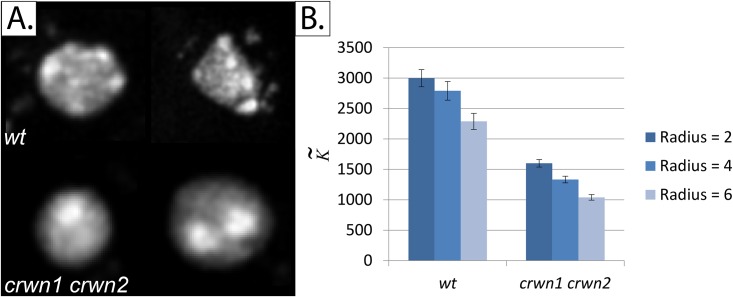
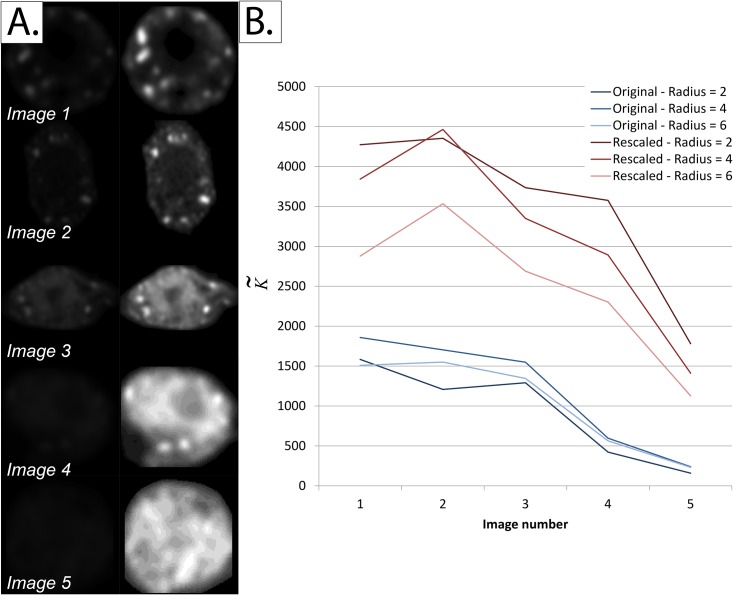
In this work, we describe the extension of Ripley's K-function to allow for overlapping events at very high event densities. We show that problematic edge effects introduce significant bias to the function at very high densities and small radii, and propose a simple correction method that successfully restores the function's centralization. Using simulations of homogeneous Poisson distributions of events, as well as simulations of event clustering under different conditions, we investigate various aspects of the function, including its shape-dependence and correspondence between true cluster radius and radius at which the K-function is maximized. Furthermore, we validate the utility of the function in quantifying clustering in 2-D grayscale images using three modalities: (i) Simulations of particle clustering; (ii) Experimental co-expression of soluble and diffuse protein at varying ratios; (iii) Quantifying chromatin clustering in the nuclei of wt and crwn1 crwn2 mutant Arabidopsis plant cells, using a previously-published image dataset. Overall, our work shows that Ripley's K-function is a valid abstract statistical measure whose utility extends beyond the quantification of clustering of non-overlapping events. Potential benefits of this work include the quantification of protein and chromatin aggregation in fluorescent microscopic images. Furthermore, this function has the potential to become one of various abstract texture descriptors that are utilized in computer-assisted diagnostics in anatomic pathology and diagnostic radiology.
Conflict of interest statement
Figures
References
-
- Gatrell AC, Bailey TC, Diggle PJ, Rowlingson BS. Spatial Point Pattern Analysis and Its Application in Geographical Epidemiology. Trans Inst Br Geogr. 1996;21: 256 10.2307/622936 - DOI
-
- Eckel SM. Statistical analysis of spatial point patterns: Applications to economical, biomedical and ecological data [Internet]. Universit¨at Ulm. 2008. Available: http://www.cabnr.unr.edu/weisberg/NRES675/Diggle2003.pdf
-
- Clark PJ, Evans FC. Distance to Nearest Neighbor as a Measure of Spatial Relationships in Populations. Ecology. 1954;35: 445 10.2307/1931034 - DOI
-
- Ripley BD. Modelling Spatial Patterns. J R Stat Soc Ser B. 1977;39: 172–212. Available: http://www.jstor.org/stable/2984796
MeSH terms
Substances
LinkOut - more resources
Full Text Sources
Other Literature Sources
Molecular Biology Databases
