


How legumes recognize rhizobia
- PMID: 26636731
- PMCID: PMC4883929
- DOI: 10.1080/15592324.2015.1120396
How legumes recognize rhizobia
Abstract
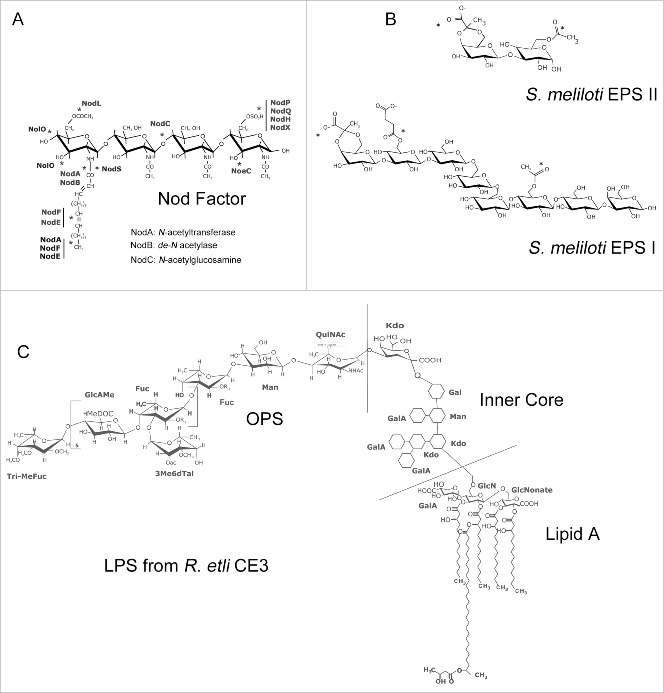
Legume plants have developed the capacity to establish symbiotic interactions with soil bacteria (known as rhizobia) that can convert N2 to molecular forms that are incorporated into the plant metabolism. The first step of this relationship is the recognition of bacteria by the plant, which allows to distinguish potentially harmful species from symbiotic partners. The main molecular determinant of this symbiotic interaction is the Nod Factor, a diffusible lipochitooligosaccharide molecule produced by rhizobia and perceived by LysM receptor kinases; however, other important molecules involved in the specific recognition have emerged over the years. Secreted exopolysaccharides and the lipopolysaccharides present in the bacterial cell wall have been proposed to act as signaling molecules, triggering the expression of specific genes related to the symbiotic process. In this review we will briefly discuss how transcriptomic analysis are helping to understand how multiple signaling pathways, triggered by the perception of different molecules produced by rhizobia, control the genetic programs of root nodule organogenesis and bacterial infection. This knowledge can help to understand how legumes have evolved to recognize and establish complex ecological relationships with particular species and strains of rhizobia, adjusting gene expression in response to identity determinants of bacteria.
Keywords: Exopolysaccharide; lipolysaccharide; nitrogen fixation; nod factor; nodulation; receptors.
Figures

References
-
- Pueppke SG, Broughton WJ. Rhizobium sp strain NGR234 and R. fredii USDA257 share exceptionally broad, nested host ranges. Mol Plant Microbe Interact 1999; 12:293-318; PMID:10188270; http://dx.doi.org/ 10.1094/MPMI.1999.12.4.293 - DOI - PubMed
-
- Aguilar OM, Riva O, Peltzer E. Analysis of Rhizobium etli and of its symbiosis with wild Phaseolus vulgaris supports coevolution in centers of host diversification. Proc Natl Acad Sci USA 2004; 101:13548-53; PMID:15340138; http://dx.doi.org/ 10.1073/pnas.0405321101 - DOI - PMC - PubMed
-
- Yang S, Tang F, Gao M, Krishnan HB, Zhu H. R gene-controlled host specificity in the legume-rhizobia symbiosis. Proc Natl Acad Sci USA 2010; 107:18735-40; PMID:20937853; http://dx.doi.org/ 10.1073/pnas.1011957107 - DOI - PMC - PubMed
-
- Limpens E, Zeijl AV, Geurts R. Lipochitooligosaccharides modulate plant host immunity to enable endosymbioses. Annu Rev Phytopathol 2015; 53:311-34; PMID:26047562; http://dx.doi.org/ 10.1146/annurev-phyto-080614-120149 - DOI - PubMed
-
- Radutoiu S, Madsen LH, Madsen EB, Jurkiewicz A, Fukai E, Quistgaard EM, Albrektsen AS, James EK, Thirup S, Stougaard J. LysM domains mediate lipochitin-oligosaccharide recognition and Nfr genes extend the symbiotic host range. EMBO J 2007; 26:3923-35; PMID:17690687; http://dx.doi.org/ 10.1038/sj.emboj.7601826 - DOI - PMC - PubMed
Publication types
MeSH terms
Substances
LinkOut - more resources
Full Text Sources
Other Literature Sources
