Review
. 2015:2015:82-91.
doi: 10.1182/asheducation-2015.1.82.

B-cell receptor pathway modulators in NHL

Affiliations
Review

B-cell receptor pathway modulators in NHL

Kristie A Blum. Hematology Am Soc Hematol Educ Program. 2015.

Abstract

With the recent success of the Bruton's tyrosine kinase (BTK) inhibitor, ibrutinib, and the phosphoinositide-3-kinase (PI3K) inhibitor, idelalisib, in the treatment of patients with relapsed or refractory non-Hodgkin's lymphoma (NHL), a number of new agents targeting the B-cell receptor (BCR) pathway are in clinical development. In addition, multiple trials combining these agents with conventional cytotoxic chemotherapy, immunomodulatory agents, monoclonal antibodies, or other kinase inhibitors are underway. This review will summarize the current data with the use of single agent and combination therapy with BCR inhibitors in NHL. In addition, commonly encountered as well as serious toxicities and hypothesized resistance mechanisms will be discussed. Lastly, this review will examine the future of these agents and opportunities to maneuver them into the front-line setting in selected NHL subtypes.


Figures

Figure 1
Figure 1
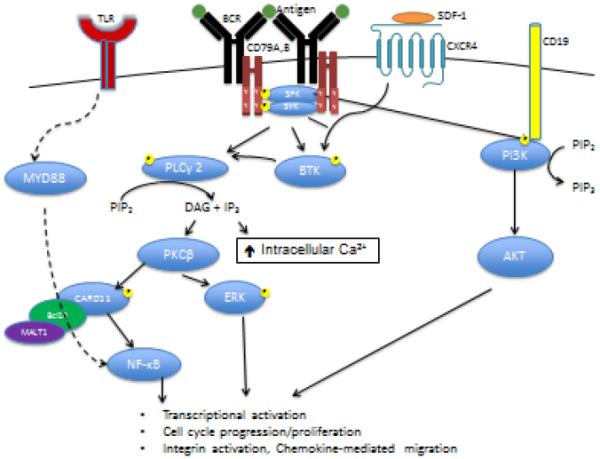
(Adapted from Alinari, Quinion, and Blum. Clin Pharmacol Ther 2015). B-Cell Receptor (BCR) signaling is a critical component of B cell activation, proliferation, survival, and migration in normal as well as malignant B cells. BCR activation, for example after antigen binding, induces CD79A and B immunoreceptor tyrosine-based activation motif (ITAM) phosphorylation and subsequent recruitment of multiple kinases including Spleen tyrosine kinase (SYK) and the SRC family kinases (SFK), LYN, SRC and BLK. Activation of these kinases initiates the signaling cascade leads to phosphorylation, recruitment, and activation of other important kinases and signaling molecules including Bruton's tyrosine kinase (BTK), Phospholipase C–gamma 2 (PLCγ2), Protein kinase C (PKC), and phosphoinositide 3-kinase (PI3K). The BCR signaling cascade ultimately leads to activation of multiple pro-survival pathways including ERK, NF-κB, and AKT signaling leading to increased transcriptional activation, proliferation, and migration. Additional abbreviations: SDF-1: stromal cell-derived factor 1; CXCR4: chemokine receptor 4; PIP2: phosphatidylinositol bisphosphate; PIP3: Phosphatidylinositol triphosphate; DAG: diacyl-glycerol; IP3: Inositol triphosphate; and Ca2+: calcium.

References

    1. Young RM, Staudt LM. Targeting pathological B cell receptor signalling in lymphoid malignancies. Nat Rev Drug Discov. 2013;12:229–43. - PMC - PubMed
    1. Advani RH, Buggy JJ, Sharman JP, et al. Bruton Tyrosine Kinase Inhibitor Ibrutinib (PCI-32765) Has Significant Activity in Patients With Relapsed/Refractory B-Cell Malignancies. Journal of Clinical Oncology. 2013;31:88–94. - PMC - PubMed
    1. Wang ML, Rule S, Martin P, et al. Targeting BTK with Ibrutinib in Relapsed or Refractory Mantle-Cell Lymphoma. N Engl J Med. 2013;369:507–516. - PMC - PubMed
    1. Wang M, Rule S, Martin P, et al. Single-Agent Ibrutinib Demonstrates Safety and Durability of Response at 2 Years Follow-up in Patients with Relapsed or Refractory Mantle Cell Lymphoma: Updated Results of an International, Multicenter, Open-Label Phase 2 Study. ASH Annual Meeting Abstracts. 2014;124:4453. abstr.
    1. Woyach JA, Furman RR, Liu TM, et al. Resistance mechanisms for the Bruton's tyrosine kinase inhibitor ibrutinib. N Engl J Med. 2014;370:2286–94. - PMC - PubMed

Publication types

MeSH terms