


Do antioxidant supplements interfere with skeletal muscle adaptation to exercise training?
- PMID: 26638792
- PMCID: PMC5023714
- DOI: 10.1113/JP270654
Do antioxidant supplements interfere with skeletal muscle adaptation to exercise training?
Abstract
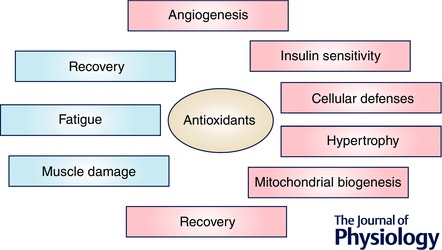
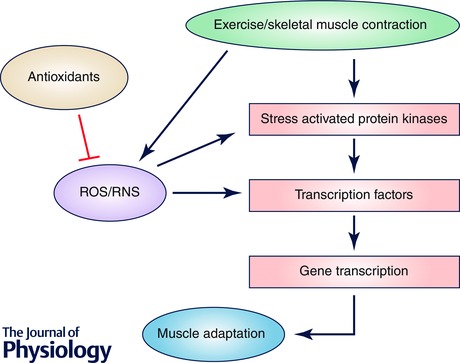
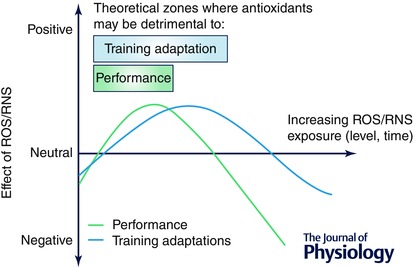
A popular belief is that reactive oxygen species (ROS) and reactive nitrogen species (RNS) produced during exercise by the mitochondria and other subcellular compartments ubiquitously cause skeletal muscle damage, fatigue and impair recovery. However, the importance of ROS and RNS as signals in the cellular adaptation process to stress is now evident. In an effort to combat the perceived deleterious effects of ROS and RNS it has become common practice for active individuals to ingest supplements with antioxidant properties, but interfering with ROS/RNS signalling in skeletal muscle during acute exercise may blunt favourable adaptation. There is building evidence that antioxidant supplementation can attenuate endurance training-induced and ROS/RNS-mediated enhancements in antioxidant capacity, mitochondrial biogenesis, cellular defence mechanisms and insulin sensitivity. However, this is not a universal finding, potentially indicating that there is redundancy in the mechanisms controlling skeletal muscle adaptation to exercise, meaning that in some circumstances the negative impact of antioxidants on acute exercise response can be overcome by training. Antioxidant supplementation has been more consistently reported to have deleterious effects on the response to overload stress and high-intensity training, suggesting that remodelling of skeletal muscle following resistance and high-intensity exercise is more dependent on ROS/RNS signalling. Importantly there is no convincing evidence to suggest that antioxidant supplementation enhances exercise-training adaptions. Overall, ROS/RNS are likely to exhibit a non-linear (hormetic) pattern on exercise adaptations, where physiological doses are beneficial and high exposure (which would seldom be achieved during normal exercise training) may be detrimental.
© 2015 The Authors. The Journal of Physiology © 2015 The Physiological Society.
Figures
References
-
- Aguilo A, Tauler P, Sureda A, Cases N, Tur J & Pons A (2007). Antioxidant diet supplementation enhances aerobic performance in amateur sportsmen. J Sports Sci 25, 1203–1210. - PubMed
-
- Asha Devi S, Prathima S & Subramanyam MV (2003). Dietary vitamin E and physical exercise: I. Altered endurance capacity and plasma lipid profile in ageing rats. Exp Gerontol 38, 285–290. - PubMed
-
- Avery NG, Kaiser JL, Sharman MJ, Scheett TP, Barnes DM, Gomez AL, Kraemer WJ & Volek JS (2003). Effects of vitamin E supplementation on recovery from repeated bouts of resistance exercise. J Strength Cond Res 17, 801–809. - PubMed
Publication types
MeSH terms
Substances
LinkOut - more resources
Full Text Sources
Other Literature Sources
Medical
