


Reducing mortality in HIV-infected infants and achieving the 90-90-90 target through innovative diagnosis approaches
- PMID: 26639120
- PMCID: PMC4670838
- DOI: 10.7448/IAS.18.7.20299
Reducing mortality in HIV-infected infants and achieving the 90-90-90 target through innovative diagnosis approaches
Abstract
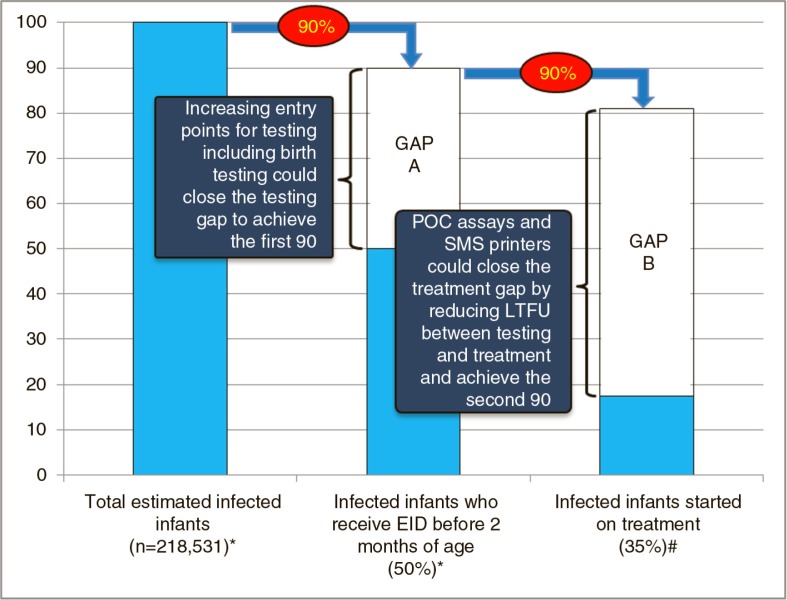
Introduction: Despite significant gains in access to early infant diagnosis (EID) over the past decade, most HIV-exposed infants still do not get tested for HIV in the first two months of life. For those who are tested, the long turnaround time between when the sample is drawn and when the results are returned leads to a high rate of loss to follow-up, which in turn means that few infected infants start antiretroviral treatment. Consequently, there continues to be high mortality from perinatally acquired HIV, and the ambitious goals of 90% of infected children identified, 90% of identified children treated and 90% of treated children with sustained virologic suppression by 2020 seem far beyond our reach. The objective of this commentary is to review recent advances in the field of HIV diagnosis in infants and describe how these advances may overcome long-standing barriers to access to testing and treatment.
Discussion: Several innovative approaches to EID have recently been described. These include point-of-care testing, use of SMS printers to connect the central laboratory and the health facility through a mobile phone network, expanding paediatric testing to other entry points where children access the health system and testing HIV-exposed infants at birth as a rapid way to identify in utero infection. Each of these interventions is discussed here, together with the opportunities and challenges associated with scale-up. Point-of-care testing has the potential to provide immediate results but is less cost-effective in settings where test volumes are low. Virological testing at birth has been piloted in some countries to identify those infants who need urgent treatment, but a negative test at birth does not obviate the need for additional testing at six weeks. Routine testing of infants in child health settings is a useful strategy to identify exposed and infected children whose mothers were not enrolled in programmes for the prevention of mother-to-child transmission. Facility-based SMS printers speed up the return of laboratory results and may be of value for other testing services apart from HIV infant diagnosis.
Conclusions: New tools and strategies for HIV infant diagnosis could have a significant positive impact on the identification and retention of HIV-infected infants. In order to be most effective, national programmes should carefully consider which ideas to implement and how best to integrate novel strategies into existing systems. There is no single solution that will work everywhere. Rather, a number of approaches need to be considered and should be linked in order to achieve the greatest impact on the continuum of care from testing to treatment.
Keywords: HIV; SMS; diagnosis; infant; point of care; treatment.
Figures
References
-
- 90–90–90: an ambitious treatment target to help end the AIDS epidemic. Geneva: UNAIDS; [Internet]. 2014 [cited 2015 Sep 4]. Available from: http://www.unaids.org/en/resources/documents/2014/90-90-90.
-
- How AIDS changed everything – MDG6: 15 years, 15 lessons of hope from the AIDS response. Geneva: UNAIDS; [Internet]. 2015 [cited 2015 Sep 4]. Available from: http://www.unaids.org/en/resources/documents/2015/MDG6_15years-15lessons....
-
- Bourne DE, Thompson M, Brody LL, Cotton M, Draper B, Laubscher R, et al. Emergence of a peak in early infant mortality due to HIV/AIDS in South Africa. AIDS. 2009;23(1):101–6. - PubMed
-
- Innes S, Lazarus E, Otwombe K, Liberty A, Germanus R, Van Rensburg AJ, et al. Early severe HIV disease precedes early antiretroviral therapy in infants: are we too late? J Int AIDS Soc. 2014;17 18914. doi: http://dx.doi.org/10.7448/IAS.17.1.18914. - DOI - PMC - PubMed
-
- Newell ML, Coovadia H, Cortina-Borja M, Rollins N, Gaillard P, Dabis F. Mortality of infected and uninfected infants born to HIV-infected mothers in Africa: a pooled analysis. Lancet. 2004;364(9441):1236–43. - PubMed
Publication types
MeSH terms
Grants and funding
LinkOut - more resources
Full Text Sources
Medical
Miscellaneous
