


Comparison of Dry Needling versus Orthopedic Manual Therapy in Patients with Myofascial Chronic Neck Pain: A Single-Blind, Randomized Pilot Study
- PMID: 26640708
- PMCID: PMC4657116
- DOI: 10.1155/2015/327307
Comparison of Dry Needling versus Orthopedic Manual Therapy in Patients with Myofascial Chronic Neck Pain: A Single-Blind, Randomized Pilot Study
Abstract
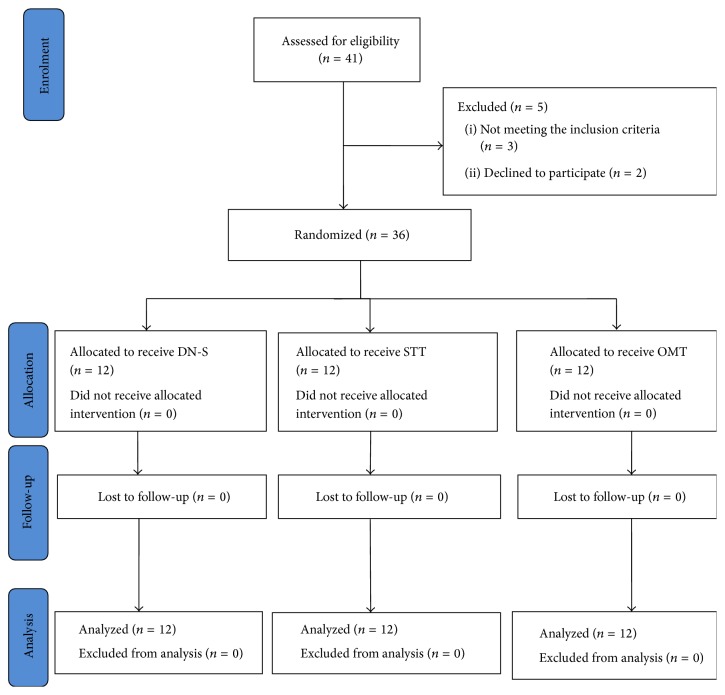
Objective. The aim of this study was to compare the efficacy of three interventions for the treatment of myofascial chronic neck pain. Methods. Thirty-six patients were randomly assigned to one of three intervention groups: orthopedic manual therapy (OMT), dry needling and stretching (DN-S), and soft tissue techniques (STT). All groups received two treatment sessions with a 48 h time interval. Outcome measures included neck pain intensity measured using a visual analogue scale, cervical range of motion (ROM), pressure pain threshold for measuring mechanical hyperalgesia, and two self-reported questionnaires (neck disability index and pain catastrophizing scale). Results. The ANOVA revealed significant differences for the group × time interaction for neck disability, neck pain intensity, and pain catastrophizing. The DN-S and OMT groups reduced neck disability. Only the OMT group showed decreases in mechanical hyperalgesia and pain catastrophizing. The cervical ROM increased in OMT (i.e., flexion, side-bending, and rotation) and DN-S (i.e., side-bending and rotation) groups. Conclusions. The three interventions are all effective in reducing pain intensity. Reduction in mechanical hyperalgesia and pain catastrophizing was only observed in the OMT group. Cervical ROM improved in the DN-S and OMT groups and also neck disability being only clinically relevant for OMT group.
References
-
- Simons D. G., Travell J. S. L. Myofascial Pain and Dysfunction: The Trigger Point Manual. Vol. 1. Baltimore, Md, USA: Lippincott Williams & Wilkins; 1999.
-
- Muñoz-Muñoz S., Muñoz-García M. T., Alburquerque-Sendín F., Arroyo-Morales M., Fernández-De-Las-Peñas C. Myofascial trigger points, pain, disability, and sleep quality in individuals with mechanical neck pain. Journal of Manipulative and Physiological Therapeutics. 2012;35(8):608–613. doi: 10.1016/j.jmpt.2012.09.003. - DOI - PubMed
LinkOut - more resources
Full Text Sources
Other Literature Sources
Medical