


The role of rice fields, fish ponds and water canals for transmission of fish-borne zoonotic trematodes in aquaculture ponds in Nam Dinh Province, Vietnam
- PMID: 26642755
- PMCID: PMC4672484
- DOI: 10.1186/s13071-015-1237-z
The role of rice fields, fish ponds and water canals for transmission of fish-borne zoonotic trematodes in aquaculture ponds in Nam Dinh Province, Vietnam
Abstract
Background: Fish-borne zoonotic trematodes (FZT), such as Clonorchis sinensis, Opistorchis viverini (Opisthorchiidae) and intestinal trematodes of the family Heterophyidae, constitute a public health hazard in Vietnam and infections with these trematodes has been linked to consumption of raw or undercooked fish from aquaculture. The FZT transmission pathways, however, are more complicated than just the presence of intermediate snail hosts in aquaculture ponds as ponds may exchange water with surrounding habitats such as rice fields and irrigation canals and thereby these surrounding habitats may be a source of snails and cercariae and contribute to FZT infection in cultured fish.
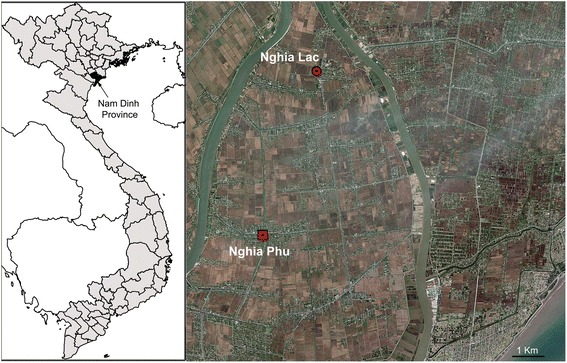
Methods: This is a longitudinal descriptive study on selected farms (n = 30) in Nam Dinh Province which is endemic for FZT. At each farm, we sampled one pond, a small irrigation canal used to supply the pond with water, and a nearby rice field. At each of these three sites, we estimated the density of the FZT intermediate snail hosts and determined their trematode infection status. Comparative analysis was performed for the prevalence and density of FZT infections in fish and snails.
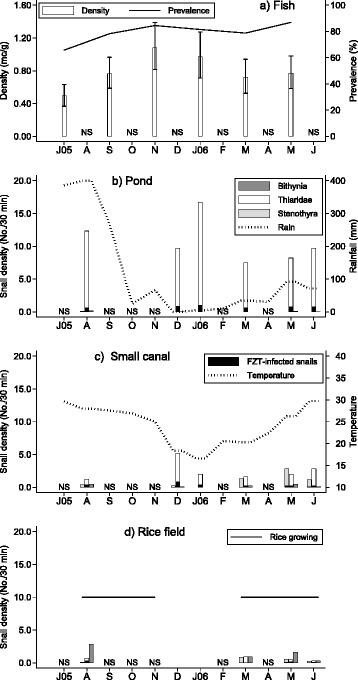
Results: Species of the Thiaridae, and most notably Melanoides tuberculata, the most important host species for FZT belonging to the Heterophyidae, were particularly abundant in ponds and small canals, i.e. M. tuberculata was found in 27 ponds and 13 small canals. Bithynia fuchsiana, a potential host for both Heterophyidae and Opisthorchiidae, was rarely found in fish ponds but common in rice fields. A total of 12 types of cercariae were found in the snails and pleurolophocercous cercariae, primarily FZT, constituted about 40 % of all cercarial infections. The fish species cultured were mainly carp species and Haplorchis pumilio was the dominating trematode species infecting fish. Clonorchis spp. were not recorded in any of the ponds. FZT transmission to fish was intense during the summer period (May-June to November) but less intense during the winter months (December-January) partly because cercarial emergence ceases due to the low temperature.
Conclusion: Our findings highlight the complexity of FZT transmission within aquaculture farm settings and suggest that efforts to control these infections must take a holistic approach using interventions against all stages of the transmission cycle.
Figures
References
-
- World Health Organization. Report of Joint WHO/FAO Workshop on Foodborne Trematode Infections in Asia. Ha Noi, Vietnam, 26–28 November, WHO Rept. Ser. no. RS/2002/GE/40(VTN) 2004.
-
- De NV, Murrell KD, Cong LD, Cam PD, Chau LV, Dalsgaard A. The foodborne trematode zoonoses of Vietnam. Southeast Asian J Trop Med Public Health. 2003;34(Suppl 1):12–34. - PubMed
Publication types
MeSH terms
Substances
LinkOut - more resources
Full Text Sources
Other Literature Sources
Research Materials
Miscellaneous
