Review
. 2015:17:113-141.
doi: 10.1146/annurev-bioeng-071114-040829.

The Mechanobiology of Aging

Affiliations
Review

The Mechanobiology of Aging

Jude M Phillip et al. Annu Rev Biomed Eng. 2015.

Abstract

Aging is a complex, multifaceted process that induces a myriad of physiological changes over an extended period of time. Aging is accompanied by major biochemical and biomechanical changes at macroscopic and microscopic length scales that affect not only tissues and organs but also cells and subcellular organelles. These changes include transcriptional and epigenetic modifications; changes in energy production within mitochondria; and alterations in the overall mechanics of cells, their nuclei, and their surrounding extracellular matrix. In addition, aging influences the ability of cells to sense changes in extracellular-matrix compliance (mechanosensation) and to transduce these changes into biochemical signals (mechanotransduction). Moreover, following a complex positive-feedback loop, aging is accompanied by changes in the composition and structure of the extracellular matrix, resulting in changes in the mechanics of connective tissues in older individuals. Consequently, these progressive dysfunctions facilitate many human pathologies and deficits that are associated with aging, including cardiovascular, musculoskeletal, and neurodegenerative disorders and diseases. Here, we critically review recent work highlighting some of the primary biophysical changes occurring in cells and tissues that accompany the aging process.

Keywords: cellular mechanics; extracellular matrix; mitochondrial dysfunction; nuclear mechanics.


Figures
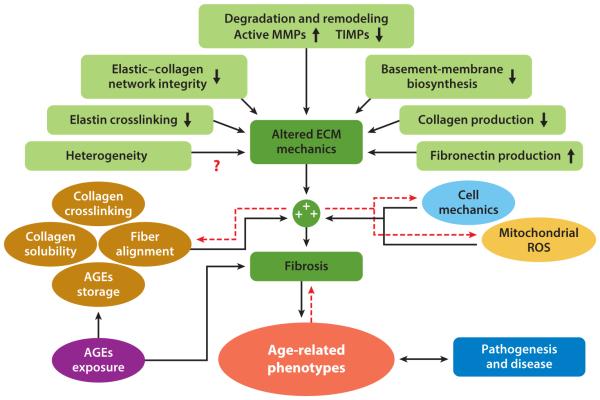
Figure 1
Figure 1
Age-related dysfunction of the extracellular matrix (ECM). Interactome of the effects of ECM deregulation and mechanical deficiency, cellular and nuclear mechanics, mitochondrial dysfunctions, and cellular damage—e.g., exposure to, and buildup of, advanced glycation end-products (AGEs) in long-lived proteins, such as collagen and elastin (1, 11)—on the aging phenotype. Concomitantly, these effects combine to foster a multidirectional feedback cascade that leads to pathogenesis and disease. Red dashed arrows represent potential bidirectional interactions. Red question marks illustrate potential functional interactions that warrant further study to identify the magnitude of their contribution to age-dependent functional decline. Abbreviations: MMPs, matrix metalloproteinases; ROS, reactive oxygen species; TIMPs, tissue inhibitors of metalloproteinases.
Figure 2
Figure 2
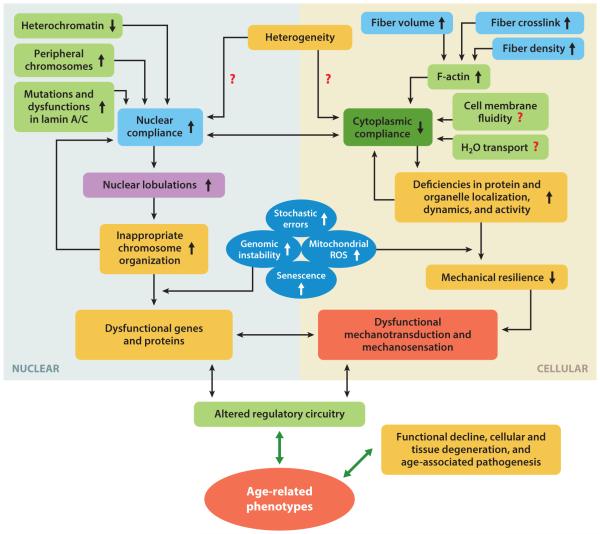
Interactome illustrating the functional coupling of cellular and nuclear mechanics, and their influences on biochemical mediators and responses. Age-related phenotypes, which foster functional decline and cellular degeneration, are associated with the disruption of multidirectional interactions between biomechanical and biochemical pathways. Red question marks illustrate potential functional interactions that warrant further study to identify the magnitude of their contribution to age-dependent functional decline. Abbreviation: ROS, reactive oxygen species.
Figure 3
Figure 3
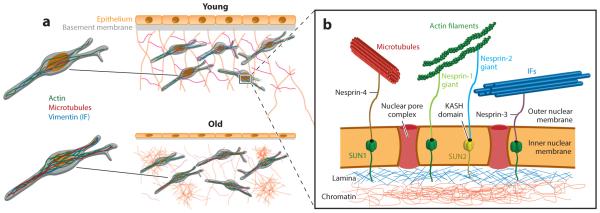
Overview of age-dependent cellular, nuclear, and extracellular changes associated with age. (a) Young and old epithelial microenvironments where age-dependent changes involve cellular atrophy, thinning of the basement membrane, degradation of the extracellular matrix, local regions of fibrosis, an increased number of and thicker actin filaments, and enhanced nuclear lobulations. (b) Overview of LINC (linker of nucleoskeleton and cytoskeleton) complex proteins that physically connect the cytoskeleton to the nuclear lamina. The nuclear envelope comprises nuclear pore complexes that enable the transport of cargo in and out of the nucleus. The envelope also contains SUN1 and SUN2 proteins, which span the inner nuclear membrane and interact with the nuclear lamina, namely with lamin proteins. SUN proteins also contain a KASH-binding domain, which enables their interactions with KASH-domain proteins. KASH proteins span the outer nuclear membrane and provide a direct link to various cytoskeletal filaments, including microtubules, F-actin, and intermediate filaments. KASH-domain proteins include Nesprin-1, -2, -3, and -4. Directly underneath the nuclear lamina is nuclear DNA in the form of chromatin. The structural connection of KASH and SUN proteins between the cytoskeleton and chromatin facilitate mechanotransduction between the cell exterior and the nuclear interior. Abbreviation: IF, intermediate filament.
Figure 4
Figure 4
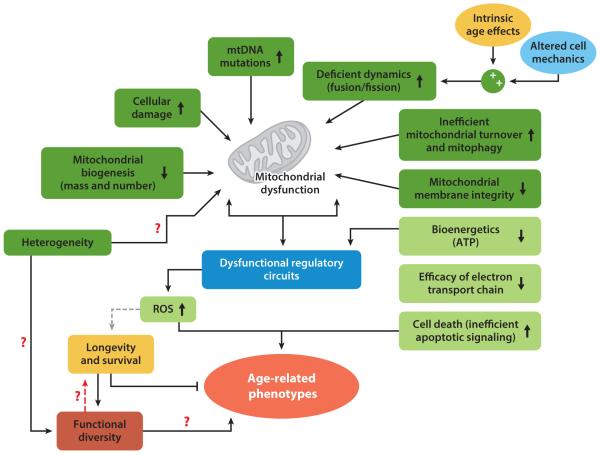
Age-related mitochondrial dysfunction. Mitochondrial function becomes deficient with age-associated changes, including cellular damage, decreased mitochondrial biogenesis, and compromised membrane integrity. This leads to dysfunctional regulation of cellular processes, and a complex feedback cascade that perpetuates the dysfunction. In healthy, young individuals, levels of reactive oxygen species (ROS) are maintained within the optimal range that promotes longevity and survival. However, during aging, when ROS regulation becomes progressively more inefficient in dictating cellular responses to stress, it leads to impaired bioenergetics and cell death (43). A key question that remains to be answered is how heterogeneity and functional diversity relate to the perpetuation or remediation of these dysfunctions, and whether this occurs through mitochondrial dysfunction, functional diversity, or both. The red dashed arrow represents a potential bidirectional interaction; the gray dashed arrow represents the interaction that has been proposed in the literature but warrants further study. Red question marks illustrate potential functional interactions that warrant further study to identify the magnitude of their contribution to age-dependent functional decline. Abbreviations: ATP, adenosine triphosphate; mtDNA, mitochondrial DNA.

References

    1. Frantz C, Stewart KM, Weaver VM. The extracellular matrix at a glance. J. Cell Sci. 2010;123:4195–200. - PMC - PubMed
    1. Gilkes DM, Semenza GL, Wirtz D. Hypoxia and the extracellular matrix: drivers of tumour metastasis. Nat. Rev. Cancer. 2014;14:430–39. - PMC - PubMed
    1. Naba A, Clauser KR, Hoersch S, Liu H, Carr SA, Hynes RO. The matrisome: in silico definition and in vivo characterization by proteomics of normal and tumor extracellular matrices. Mol. Cell. Proteomics. 2012;11:M111.014647. - PMC - PubMed
    1. Jarvelainen H, Sainio A, Koulu M, Wight TN, Penttinen R. Extracellular matrix molecules: potential targets in pharmacotherapy. Pharmacol. Rev. 2009;61:198–223. - PMC - PubMed
    1. Minimas DA. Ageing and its influence on wound healing. Wounds UK. 2007;3:42–50.

Publication types