. 2015 Dec 7;60(2):1013-21.
doi: 10.1128/AAC.01968-15. Print 2016 Feb.

Towards Rational Dosing Algorithms for Vancomycin in Neonates and Infants Based on Population Pharmacokinetic Modeling

Affiliations

Towards Rational Dosing Algorithms for Vancomycin in Neonates and Infants Based on Population Pharmacokinetic Modeling

Esther J H Janssen et al. Antimicrob Agents Chemother. .

Abstract

Because of the recent awareness that vancomycin doses should aim to meet a target area under the concentration-time curve (AUC) instead of trough concentrations, more aggressive dosing regimens are warranted also in the pediatric population. In this study, both neonatal and pediatric pharmacokinetic models for vancomycin were externally evaluated and subsequently used to derive model-based dosing algorithms for neonates, infants, and children. For the external validation, predictions from previously published pharmacokinetic models were compared to new data. Simulations were performed in order to evaluate current dosing regimens and to propose a model-based dosing algorithm. The AUC/MIC over 24 h (AUC24/MIC) was evaluated for all investigated dosing schedules (target of >400), without any concentration exceeding 40 mg/liter. Both the neonatal and pediatric models of vancomycin performed well in the external data sets, resulting in concentrations that were predicted correctly and without bias. For neonates, a dosing algorithm based on body weight at birth and postnatal age is proposed, with daily doses divided over three to four doses. For infants aged <1 year, doses between 32 and 60 mg/kg/day over four doses are proposed, while above 1 year of age, 60 mg/kg/day seems appropriate. As the time to reach steady-state concentrations varies from 155 h in preterm infants to 36 h in children aged >1 year, an initial loading dose is proposed. Based on the externally validated neonatal and pediatric vancomycin models, novel dosing algorithms are proposed for neonates and children aged <1 year. For children aged 1 year and older, the currently advised maintenance dose of 60 mg/kg/day seems appropriate.


Figures

FIG 1
FIG 1
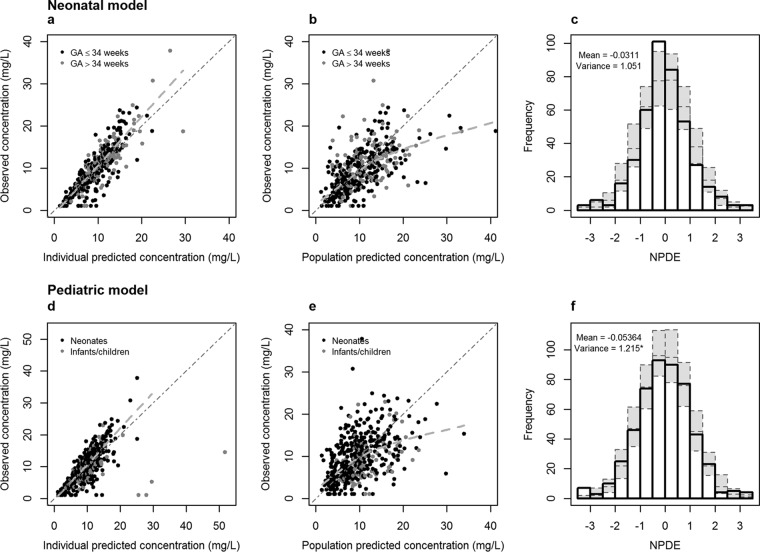
Results of the external validation of the models: observed versus individual predicted concentrations (a and d) and observed versus population predicted concentrations (b and e) for the neonatal model (black dots, preterm neonates; gray dots, term neonates) and the pediatric model (black dots, postnatal age of <31 days; gray dots, postnatal age of >30 days). The dotted lines represent the regression lines. The histograms (c and f) show the distributions of the normalized prediction distribution errors (NPDE) for, respectively, the neonatal model and the pediatric model, with mean and variance of NPDE analysis. The gray dotted boxes reflect the variance of the NPDE. *, variance is significantly different from 1 (P < 0.01).
FIG 2
FIG 2
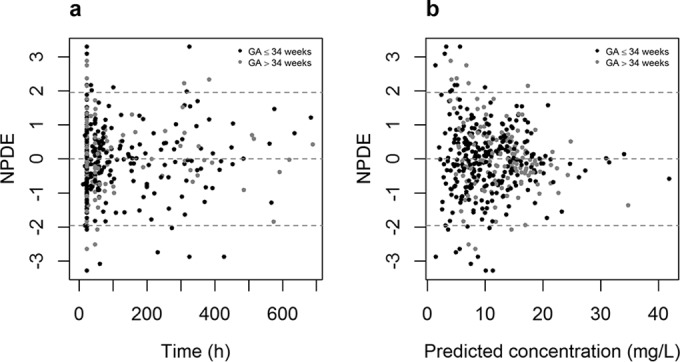
Results of the normalized prediction distribution error (NPDE) analysis of the neonatal model for individuals with GA of ≤34 and of >34 weeks versus time and versus predicted concentration.
FIG 3
FIG 3
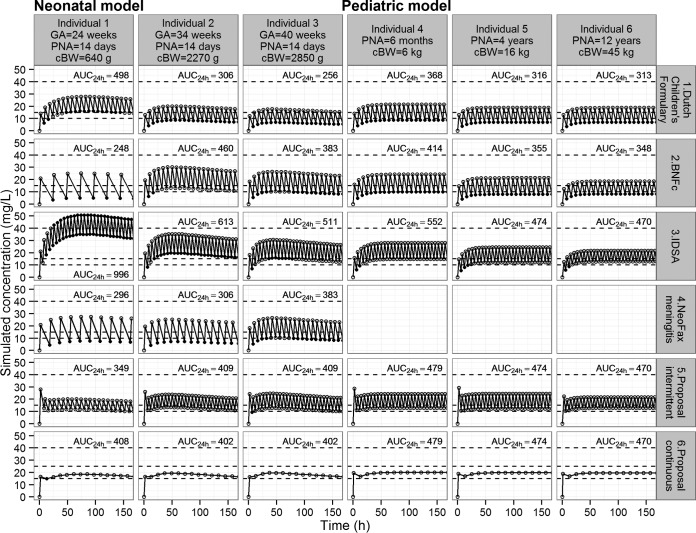
Model-based predicted concentration-time profiles for six individuals. The Dutch Children's Formulary (37), British National Formulary for Children (BNFc) (38), Infectious Diseases Society of America (IDSA) (39), and NeoFax (meningitis regimen) (; see also Table S1 in the supplemental material) dosing guidelines and model-based dosing algorithms (Table 2) were used. GA, gestational age; PNA, postnatal age; cBW, current body weight. The dotted lines indicate the target concentrations (10 to 15 mg/liter for trough concentrations upon intermittent dosing and 15 to 25 mg/liter for steady-state concentrations upon continuous dosing) and concentrations above which toxicity might occur (40 mg/liter). Concentrations outside the target and peak concentrations above 40 mg/liter are indicated by black dots. AUC24h, calculated area under the concentration-time curve (mg · h/liter) on the seventh day of treatment.

References

    1. Cuzzolin L, Atzei A, Fanos V. 2006. Off-label and unlicensed prescribing for newborns and children in different settings: a review of the literature and a consideration about drug safety. Expert Opin Drug Saf 5:703–718. doi:10.1517/14740338.5.5.703. - DOI - PubMed
    1. Knibbe CAJ, Danhof M. 2011. Individualized dosing regimens in children based on population PKPD modelling: are we ready for it? Int J Pharm 415:9–14. doi:10.1016/j.ijpharm.2011.02.056. - DOI - PubMed
    1. De Cock RFW, Piana C, Krekels EHJ, Danhof M, Allegaert K, Knibbe CAJ. 2011. The role of population PK-PD modelling in paediatric clinical research. Eur J Clin Pharmacol 67(Suppl 1):5–16. doi:10.1007/s00228-009-0782-9. - DOI - PMC - PubMed
    1. Ince I, de Wildt SN, Tibboel D, Danhof M, Knibbe CAJ. 2009. Tailor-made drug treatment for children: creation of an infrastructure for data-sharing and population PK-PD modeling. Drug Discov Today 14:316–320. doi:10.1016/j.drudis.2008.11.004. - DOI - PubMed
    1. Admiraal R, van Kesteren C, Boelens JJ, Bredius RGM, Tibboel D, Knibbe CAJ. 2014. Towards evidence-based dosing regimens in children on the basis of population pharmacokinetic pharmacodynamic modelling. Arch Dis Child 99:267–272. doi:10.1136/archdischild-2013-303721. - DOI - PubMed

Publication types