. 2016 Jan 21;127(3):310-3.
doi: 10.1182/blood-2015-03-635599. Epub 2015 Dec 7.

Brca1 deficiency causes bone marrow failure and spontaneous hematologic malignancies in mice

Affiliations

Brca1 deficiency causes bone marrow failure and spontaneous hematologic malignancies in mice

Aparna Vasanthakumar et al. Blood. .

Abstract

BRCA1 is critical for maintenance of genomic stability and interacts directly with several proteins that regulate hematopoietic stem cell function and are part of the Fanconi anemia (FA) double-strand break DNA repair pathway. The effects of complete BRCA1 deficiency on bone marrow (BM) function are unknown. To test the hypothesis that Brca1 is essential in hematopoiesis, we developed a conditional mouse model with Mx1-Cre-mediated Brca1 deletion. Mice lacking Brca1 in the BM have baseline cytopenias and develop spontaneous bone marrow failure or diverse hematologic malignancies by 6 months of age. Brca1(-/-) BM cells have a reduced capacity to form hematopoietic colonies in vitro and to reconstitute hematopoiesis in irradiated recipients, consistent with a hematopoietic progenitor functional defect. Brca1(-/-) BM cells also show FA-like hypersensitivity to the DNA crosslinking agent mitomycin C, and karyotypes feature genomic instability. Taken together, our results show that loss of Brca1 in murine BM causes hematopoietic defects similar to those seen in people with FA, which provides strong evidence that Brca1 is critical for normal hematopoiesis and that Brca1 is a bona fide FA-like gene.


Figures

Figure 1
Figure 1
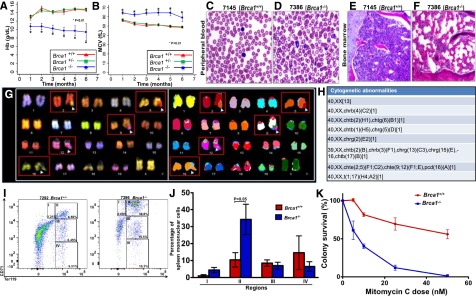
Brca1 deficiency causes PB cytopenias, BM failure featuring genomic instability, and DNA crosslinking agent hypersensitivity. Complete blood counts from Brca1+/+ (red), Brca1+/− (green), and Brca1−/− (blue) mice were measured once per month up to 6 months of age. (A) Hb concentration (g/dL); (B) mean corpuscular volume (MCV) (fL). The number of mice in each cohort at each time point analyzed is listed in supplemental Figure 2. Analysis of variance was used to analyze for differences in counts at each time point (*P < .01). PB smears from (C) a Brca1+/+ (7145) and (D) a Brca1−/− (7386) mouse are shown (magnification ×10). BM sections from (E) a Brca1+/+ (7145) and (F) a Brca1−/− (7386) mouse are shown (magnification ×10). (G-H) Spectral karyotyping analysis revealed multiple structural abnormalities, including chromatid exchanges and premature centromere divisions. Representative cell karyotype in G: 40,XX,chte(2;5)(F1;C2),chte(9;12)(F1;E),pcd(16)(A)[1]. (I) Representative fluorescence-activated cell sorter plots from spleen cells from a Brca1+/+ (B7292) and a Brca1−/− (B7386) mouse stained with antibodies against CD71 and Ter119. (J) Average proportion of spleen cells accumulating in regions I, II, III, and IV of red blood cell differentiation after staining with antibodies against CD71 and Ter119. Student t test was used to analyze the differences in the proportion of cells within each region. (K) Sensitivity of Brca1−/− cells (blue) relative to Brca1+/+ cells (red) in methylcellulose colony-forming assays to mitomycin C at doses of 0, 5, 10, 25, and 50 nM. Averages are shown with standard error of the mean. chrb, chromosome break; chrg, chromosome gap; chtb, chromatid break; chte, chromatid exchange; chtg, chromatid gap; pcd, premature centromere division.
Figure 2
Figure 2
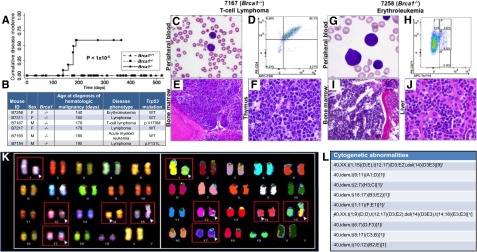
Brca1 deficiency increases susceptibility of mice to HMs characterized by leukemic infiltration of multiple organs consistent with the Bethesda criteria.14,15 (A) Cumulative disease incidence curves for Brca1+/+ (dash-dot-dot line), Brca1+/− (dashed line), and Brca1−/− (solid line) mice. Statistical significance was calculated by using the log-rank test. The number of mice in each cohort at each time point analyzed is listed in supplemental Figure 9H. (B) Characteristics of diseased mice and specific HM diagnosis. Presence or absence of a Trp53 mutation in each tumor is indicated. (C-F) Organs isolated from 7167, a Brca1−/−mouse that developed a T-cell lymphoma. (C) PB smear with Wright-Giemsa stain showing the presence of lymphoma cells (magnification ×10). (D) PB flow cytometry analysis using antibodies against T-lymphoid markers CD4 and CD8, showing the malignant cells to be CD4+/CD8+. (E) BM stained with hematoxylin and eosin (H&E), showing extensive involvement with lymphoma (magnification ×10). (F) Thymus stained with H&E, showing effacement of the normal thymic architecture by infiltrating lymphoma cells (magnification ×50). (G-J) Organs isolated from B7258, a Brca1−/− mouse that developed an erythroleukemia. (G) PB smear with Wright-Giemsa stain showing many erythroid blasts (magnification ×50). (H) PB flow cytometry analysis using antibodies against CD71 and Ter119. (I) BM stained with H&E, showing extensive leukemic involvement (magnification ×10). (J) Liver stained with H&E, showing extensive infiltration by leukemic cells (magnification ×50). (K) Spectral karyotyping analysis of erythroleukemia cells from a secondary transplant recipient mouse revealed an abnormal clone characterized by structural rearrangements: karyotype: 40,XX,t(1;15)(D;E), t(12;17)(D3;E2), and del(14)(D3E3). (L) Cytogenetic abnormalities identified within the erythroleukemia. del, deletion; idem, the same as the stemline clone listed first.

References

    1. Walden H, Deans AJ. The Fanconi anemia DNA repair pathway: structural and functional insights into a complex disorder. Annu Rev Biophys. 2014;43:257–278. - PubMed
    1. Wang B. BRCA1 tumor suppressor network: focusing on its tail. Cell Biosci. 2012;2(1):6. - PMC - PubMed
    1. D’Andrea AD. BRCA1: a missing link in the Fanconi anemia/BRCA pathway. Cancer Discov. 2013;3(4):376–378. - PMC - PubMed
    1. Sawyer SL, Tian L, Kähkönen M, Schwartzentruber J, Kircher M. Biallelic mutations in BRCA1 cause a new Fanconi anemia subtype. Cancer Discov. 2015 5(2):135-142. - PMC - PubMed
    1. Miki Y, Swensen J, Shattuck-Eidens D, et al. A strong candidate for the breast and ovarian cancer susceptibility gene BRCA1. Science. 1994;266(5182):66–71. - PubMed

Publication types

MeSH terms