Review
. 2015 Dec;201(4):1279-94.
doi: 10.1534/genetics.115.182717.

Rendering the Intractable More Tractable: Tools from Caenorhabditis elegans Ripe for Import into Parasitic Nematodes

Affiliations
Review

Rendering the Intractable More Tractable: Tools from Caenorhabditis elegans Ripe for Import into Parasitic Nematodes

Jordan D Ward. Genetics. 2015 Dec.

Abstract

Recent and rapid advances in genetic and molecular tools have brought spectacular tractability to Caenorhabditis elegans, a model that was initially prized because of its simple design and ease of imaging. C. elegans has long been a powerful model in biomedical research, and tools such as RNAi and the CRISPR/Cas9 system allow facile knockdown of genes and genome editing, respectively. These developments have created an additional opportunity to tackle one of the most debilitating burdens on global health and food security: parasitic nematodes. I review how development of nonparasitic nematodes as genetic models informs efforts to import tools into parasitic nematodes. Current tools in three commonly studied parasites (Strongyloides spp., Brugia malayi, and Ascaris suum) are described, as are tools from C. elegans that are ripe for adaptation and the benefits and barriers to doing so. These tools will enable dissection of a huge array of questions that have been all but completely impenetrable to date, allowing investigation into host-parasite and parasite-vector interactions, and the genetic basis of parasitism.

Keywords: C. elegans; CRISPR; parasitic nematode; tool development.


Figures

Figure 1
Figure 1
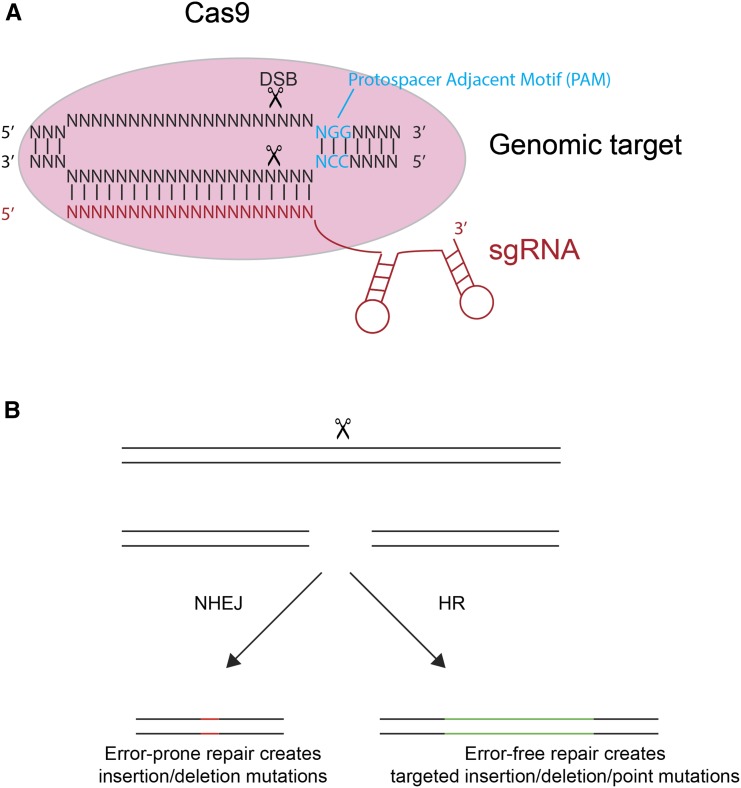
CRISPR/Cas9 editing. (A) The Cas9:sgRNA complex scans the genome searching for “NGG” PAM sequences (blue text). The 20 bp at the 5′ end of the sgRNA are homologous to the 20 bp 5′ to the PAM in the genomic target site, and the sgRNA pairs with the complementary strand in the genomic target sequence. The PAM sequence instructs Cas9 to make a DNA double-stranded break (DSB) three to four nucleotides 5′ to the PAM. (B) A Cas9-induced DSB can be repaired through error-prone nonhomologous end joining (NHEJ) or error-free homologous recombination (HR) pathways. NHEJ can be used for gene inactivation, as it produces small, random insertion and deletion mutations at the DSB site. By supplying repair templates with homology arms flanking the break site, one can use HR to precisely delete sequences, insert epitopes, or introduce point mutations. To recover HR-mediated knock-ins, one must often either screen large numbers of cells/animals or use positive selection/co-CRISPR approaches; HR is typically less efficient at producing edits compared to NHEJ.
Figure 2
Figure 2
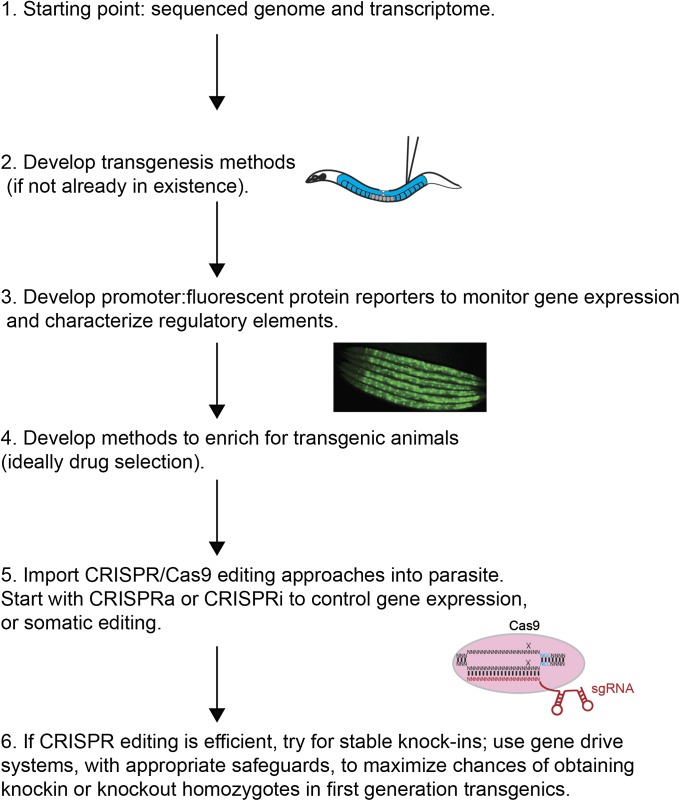
Recommended pipeline for technology import into parasitic nematodes. One should start with a parasitic nematode species that has an annotated genome or transcriptome or generate these datasets. For the described genetic tools, a method of transgenesis is a prerequisite. Promoter:FP reporters should be used to characterize regulatory elements, and monitor gene expression, temporally and spatially. The regulatory elements characterized through the FP reporters are useful for development of selection systems and CRISPR editing approaches. Positive selection systems, such as drug resistance or FP reporter expression, help identify transgenic animals. Drug selection cassettes are preferable, as they could allow for in vivo selection of transgenic parasites in host animals. For CRISPR approaches, it is best to start with activation or repression of gene expression using CRISPRa or CRISPRi, respectively, or generation of indel mutations using somatic CRISPR editing. These approaches should work in first generation transgenic animals, circumventing issues with requisite host passage. If these methods are robust, the lifecycle can be maintained, and once a positive selection system is in place, one can attempt to generate stable knockouts or knockins. A gene drive system is recommended, with appropriate safeguards, to create homozygotes in first generation transgenics, and subsequently in any genetic background to which the transgene is introduced.

References

    1. Abad P., Gouzy J., Aury J.-M., Castagnone-Sereno P., Danchin E. G. J., et al. , 2008. Genome sequence of the metazoan plant-parasitic nematode Meloidogyne incognita. Nat. Biotechnol. 26: 909–915. - PubMed
    1. Aboobaker A. A., Blaxter M. L., 2003. Use of RNA interference to investigate gene function in the human filarial nematode parasite Brugia malayi. Mol. Biochem. Parasitol. 129: 41–51. - PubMed
    1. Ahmed R., Chang Z., Younis A. E., Langnick C., Li N., et al. , 2013. Conserved miRNAs are candidate post-transcriptional regulators of developmental arrest in free-living and parasitic nematodes. Genome Biol. Evol. 5: 1246–1260. - PMC - PubMed
    1. Akbari O. S., Bellen H. J., Bier E., Bullock S. L., Burt A., et al. , 2015. Safeguarding gene drive experiments in the laboratory. Science 349: 927–929. - PMC - PubMed
    1. Arribere J. A., Bell R. T., Fu B. X. H., Artiles K. L., Hartman P. S., et al. , 2014. Efficient Marker-Free Recovery of Custom Genetic Modifications with CRISPR/Cas9 in Caenorhabditis elegans. Genetics 198: 837–846. - PMC - PubMed

Publication types