Review
. 2016 Jan 19;371(1686):20150081.
doi: 10.1098/rstb.2015.0081.

Towards a second-person neuropsychiatry

Affiliations
Review

Towards a second-person neuropsychiatry

Leonhard Schilbach. Philos Trans R Soc Lond B Biol Sci. .

Abstract

Psychiatric disorders can affect our ability to successfully and enjoyably interact with others. Conversely, having difficulties in social relations is known to increase the risk of developing a psychiatric disorder. In this article, the assumption that psychiatric disorders can be construed as disorders of social interaction is reviewed from a clinical point of view. Furthermore, it is argued that a psychiatrically motivated focus on the dynamics of social interaction may help to provide new perspectives for the field of social neuroscience. Such progress may be crucial to realize social neuroscience's translational potential and to advance the transdiagnostic investigation of the neurobiology of psychiatric disorders.

Keywords: neural mechanisms; psychiatric disorders; social interaction.


Figures

Figure 1.
Figure 1.
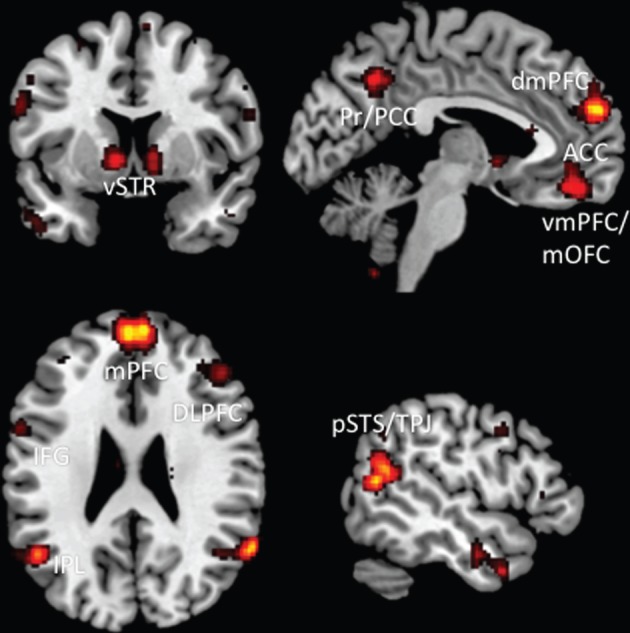
Brain regions involved during social interaction. This figure was created by using the automated meta-analysis functionality provided by NeuroSynth.org and depicts brain regions that are associated with ‘mentalizing’, ‘mirror’, ‘social reward’, ‘intentions' and ‘executive’ (cf. different domains of social cognition as described by Frith & Frith [128]).

References

    1. Fowler JC, Allen JG, Oldham JM, Frueh BC. 2013. Exposure to interpersonal trauma, attachment insecurity, and depression severity. J. Affect. Disord. 149, 313–318. ( 10.1016/j.jad.2013.01.045) - DOI - PubMed
    1. Fredman L, Weissman MM, Leaf PJ, Bruce ML. 1988. Social functioning in community residents with depression and other psychiatric disorders: results of the New Haven Epidemiologic Catchment Area Study. J. Affect. Disord. 15, 103–112. ( 10.1016/0165-0327(88)90077-8) - DOI - PubMed
    1. Schilbach L, Timmermans B, Reddy V, Costall A, Bente G, Schlicht T, Vogeley K. 2013. Toward a second-person neuroscience. Behav. Brain Sci. 36, 393–414. ( 10.1017/S0140525X12000660) - DOI - PubMed
    1. Schneider D, Slaughter VP, Bayliss AP, Dux PE. 2013. A temporally sustained implicit theory of mind deficit in autism spectrum disorders. Cognition 129, 410–417. ( 10.1016/j.cognition.2013.08.004) - DOI - PubMed
    1. Coan JA, Sbarra DA. 2015. Social baseline theory: the social regulation of risk and effort. Curr. Opin. Psychol. 1, 87–91. ( 10.1016/j.copsyc.2014.12.021) - DOI - PMC - PubMed

Publication types