


Safety, Feasibility, and Efficacy of Vagus Nerve Stimulation Paired With Upper-Limb Rehabilitation After Ischemic Stroke
- PMID: 26645257
- PMCID: PMC4689175
- DOI: 10.1161/STROKEAHA.115.010477
Safety, Feasibility, and Efficacy of Vagus Nerve Stimulation Paired With Upper-Limb Rehabilitation After Ischemic Stroke
Abstract
Background and purpose: Recent animal studies demonstrate that vagus nerve stimulation (VNS) paired with movement induces movement-specific plasticity in motor cortex and improves forelimb function after stroke. We conducted a randomized controlled clinical pilot study of VNS paired with rehabilitation on upper-limb function after ischemic stroke.
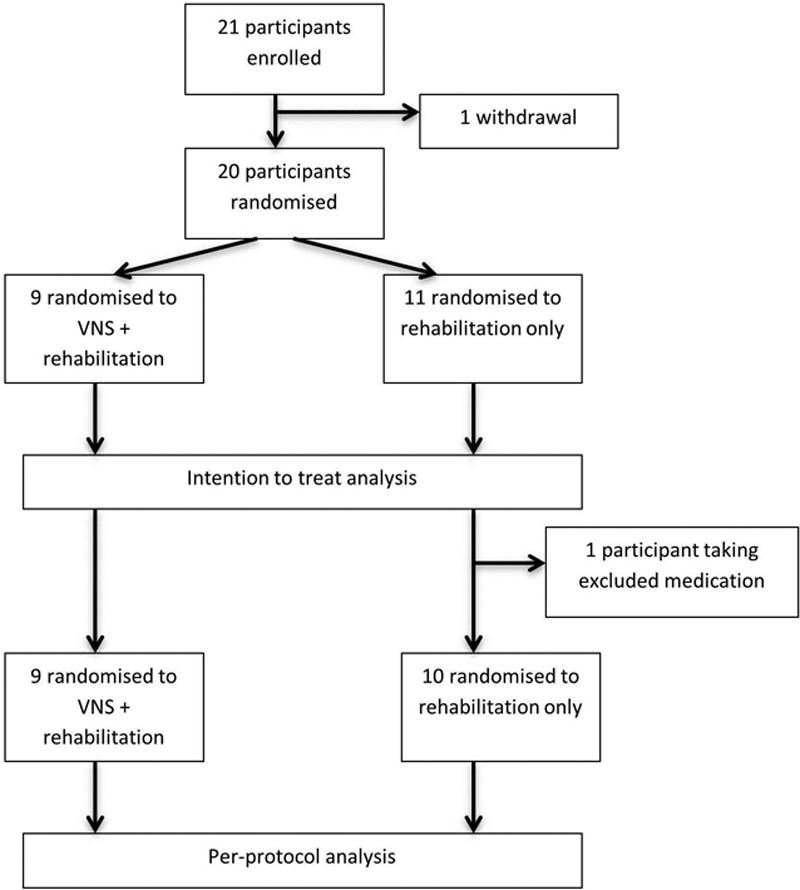
Methods: Twenty-one participants with ischemic stroke >6 months before and moderate to severe upper-limb impairment were randomized to VNS plus rehabilitation or rehabilitation alone. Rehabilitation consisted of three 2-hour sessions per week for 6 weeks, each involving >400 movement trials. In the VNS group, movements were paired with 0.5-second VNS. The primary objective was to assess safety and feasibility. Secondary end points included change in upper-limb measures (including the Fugl-Meyer Assessment-Upper Extremity).
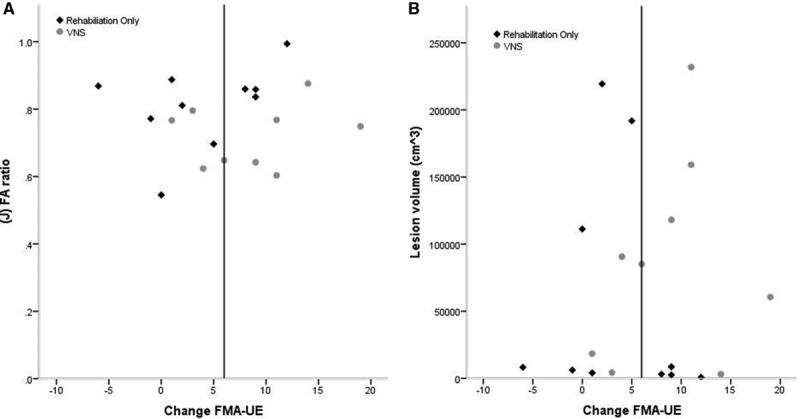
Results: Nine participants were randomized to VNS plus rehabilitation and 11 to rehabilitation alone. There were no serious adverse device effects. One patient had transient vocal cord palsy and dysphagia after implantation. Five had minor adverse device effects including nausea and taste disturbance on the evening of therapy. In the intention-to-treat analysis, the change in Fugl-Meyer Assessment-Upper Extremity scores was not significantly different (between-group difference, 5.7 points; 95% confidence interval, -0.4 to 11.8). In the per-protocol analysis, there was a significant difference in change in Fugl-Meyer Assessment-Upper Extremity score (between-group difference, 6.5 points; 95% confidence interval, 0.4 to 12.6).
Conclusions: This study suggests that VNS paired with rehabilitation is feasible and has not raised safety concerns. Additional studies of VNS in adults with chronic stroke will now be performed.
Clinical trial registration: URL: https://www.clinicaltrials.gov. Unique identifier: NCT01669161.
Keywords: deglutition disorders; intention to treat analysis; rehabilitation; stroke; vagus nerve.
© 2015 The Authors.
Figures
References
-
- Pollock A, St George B, Fenton M, Firkins L. Top ten research priorities relating to life after stroke. Lancet Neurol. 2012;11:209. doi: 10.1016/S1474-4422(12)70029-7. - PubMed
-
- Nakayama H, Jørgensen HS, Raaschou HO, Olsen TS. Recovery of upper extremity function in stroke patients: the Copenhagen Stroke Study. Arch Phys Med Rehabil. 1994;75:394–398. - PubMed
-
- National Institute for Health Care and Clinical Excellence, Stroke Rehabilitation. Long term rehabilitation after stroke. CG162, London: National Institute for Health Care and Clinical Excellence; 2013.
-
- Langhorne P, Coupar F, Pollock A. Motor recovery after stroke: a systematic review. Lancet Neurol. 2009;8:741–754. doi: 10.1016/S1474-4422(09)70150-4. - PubMed
Publication types
MeSH terms
Associated data
Grants and funding
LinkOut - more resources
Full Text Sources
Other Literature Sources
Medical
